

Commander Decks
Filters
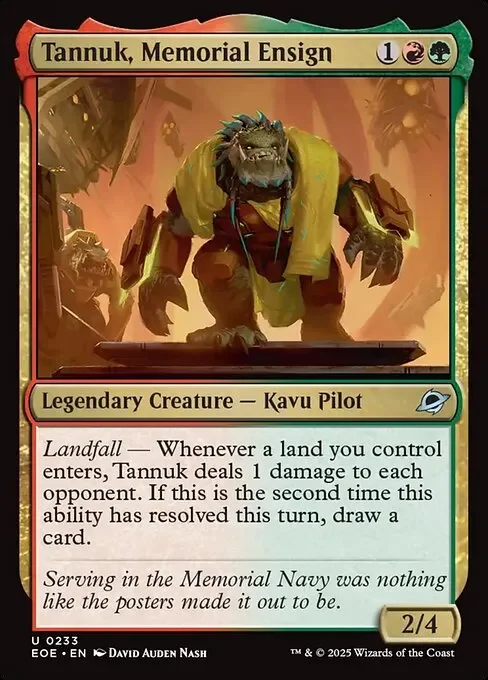
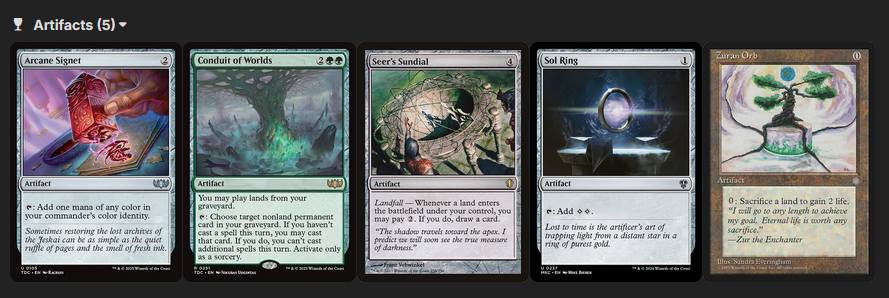
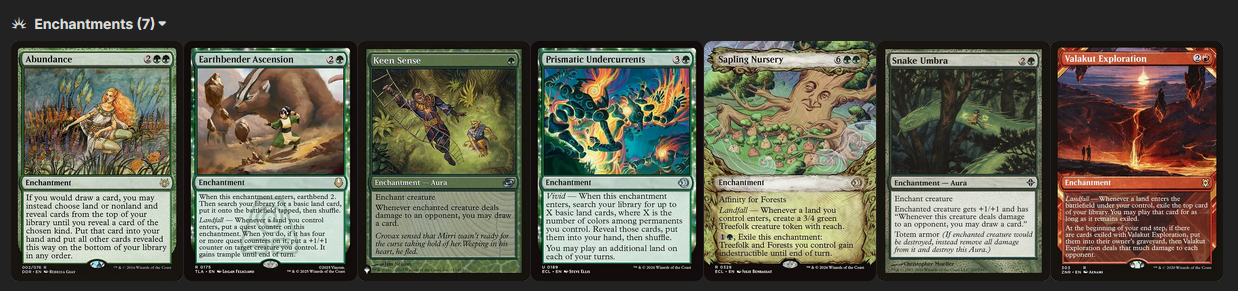
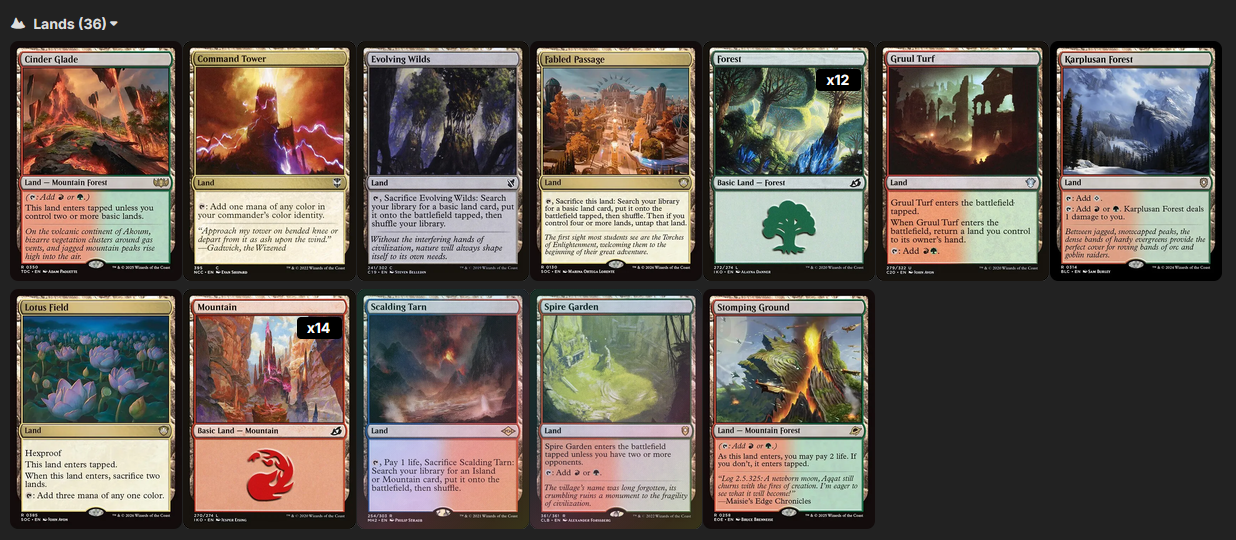
Tannuk, Memorial Ensign leads a focused Gruul landfall strategy built to turn routine land development into repeatable table-wide damage and card advantage. Tannuk deals 1 damage to each opponent whenever a land enters under your control, then draws a card when that ability resolves for the second time in a turn, making additional land drops, fetch lands, and land recursion central to the deck's engine.
Rather than relying only on conventional ramp, the list treats lands as an active resource. Lands are played, sacrificed, recovered, and replayed to repeatedly trigger Tannuk alongside a dense collection of landfall payoffs. The resulting play pattern combines steady resource growth with token production, direct damage, and substantial late-game inevitability.
Deck Overview
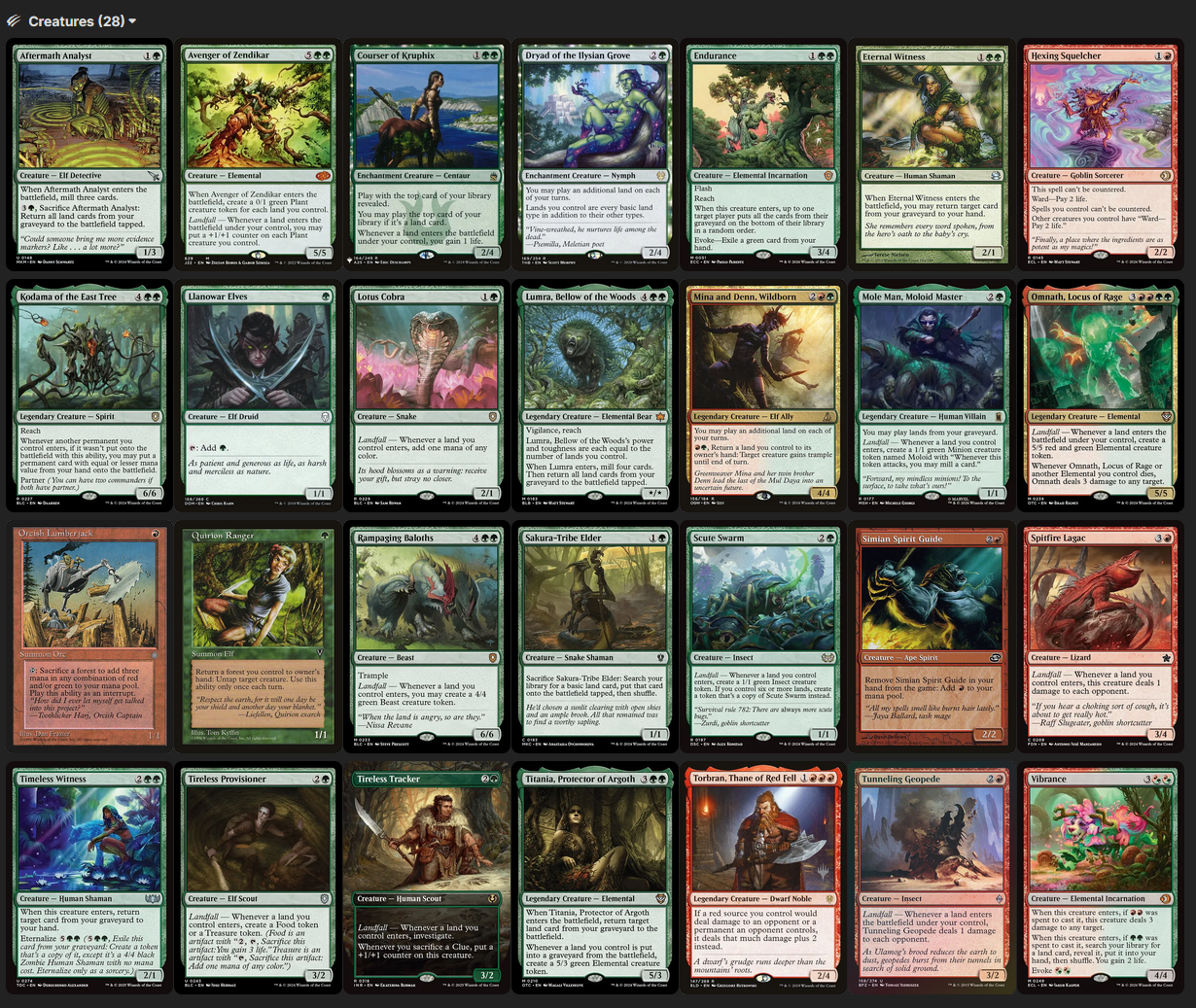
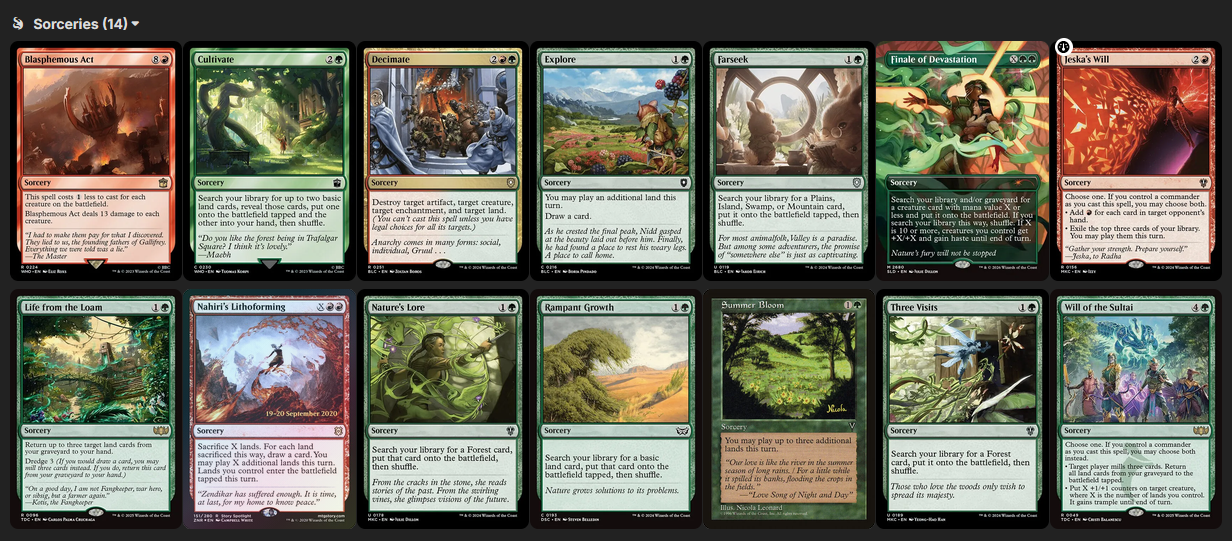
This build operates as a Gruul Landfall and Lands-Recursion engine, with Tannuk functioning as both a damage source and a reliable source of incremental card advantage. Dryad of the Ilysian Grove, Mina and Denn, Wildborn, Explore, Summer Bloom, Courser of Kruphix, and Prismatic Undercurrents increase the number of lands the deck can deploy, allowing Tannuk's second landfall trigger to become a routine part of each turn.
The deck then converts those land entries into multiple forms of value. Lotus Cobra, Tireless Provisioner, Tireless Tracker, Valakut Exploration, Seer's Sundial, Scute Swarm, Rampaging Baloths, Avenger of Zendikar, Omnath, Locus of Rage, and Sapling Nursery ensure that additional lands translate into mana, cards, creatures, or damage rather than simply advancing the mana base.
A secondary lands-from-the-graveyard package gives the strategy additional depth. Life from the Loam, Conduit of Worlds, Aftermath Analyst, Lumra, Bellow of the Woods, Mole Man, Moloid Master, Eternal Witness, Timeless Witness, and Will of the Sultai allow sacrificed and milled lands to remain productive resources throughout longer games.
Key Strategic Elements
Additional Land Drops and Landfall
Tannuk is at his most efficient when the deck can consistently produce at least two land entries each turn. Dryad of the Ilysian Grove, Mina and Denn, Wildborn, Explore, Summer Bloom, and Prismatic Undercurrents provide additional land plays, while Fabled Passage, Evolving Wilds, Scalding Tarn, Harrow, Crop Rotation, and Lotus Field create multiple land movements from individual cards.
This structure allows the deck to repeatedly access Tannuk's built-in draw trigger while simultaneously advancing every other landfall permanent on the battlefield.
Land Sacrifice and Recursion
The graveyard functions as an extension of the hand rather than a final destination. Life from the Loam repeatedly recovers lands, while Conduit of Worlds and Mole Man, Moloid Master allow them to be played directly from the graveyard. Aftermath Analyst, Lumra, Bellow of the Woods, and Will of the Sultai provide larger-scale recovery effects capable of returning multiple lands at once.
Cards such as Zuran Orb, Harrow, Crop Rotation, Lotus Field, Nahiri's Lithoforming, Fabled Passage, and Evolving Wilds deliberately move lands to the graveyard, where the recursion package can convert them into additional landfall triggers later.
Landfall Payoffs and Token Production
The list contains multiple threats that scale rapidly with repeated land entries. Scute Swarm can develop an extensive creature presence, while Rampaging Baloths and Sapling Nursery convert landfall into substantial bodies. Avenger of Zendikar provides both a large token base and additional scaling from subsequent land drops.
Omnath, Locus of Rage adds another major payoff by producing Elementals and turning their eventual deaths into additional damage. These cards ensure the deck can transition naturally from resource development into a dominant battlefield without abandoning its primary game plan.
Card Advantage and Damage Conversion
Tannuk already provides card selection through repeated landfall, but the deck compounds that advantage with Tireless Tracker, Valakut Exploration, Courser of Kruphix, Seer's Sundial, and Abundance.
Keen Sense and Snake Umbra are particularly effective when placed on Tannuk. Because Tannuk deals damage directly to opponents through landfall, those effects can convert his repeated damage triggers into additional cards.
The damage package also extends beyond the commander. Spitfire Lagac and Tunneling Geopede provide additional landfall-based pressure, while Torbran, Thane of Red Fell substantially increases the damage produced by red sources such as Tannuk.
Interaction and Resilience
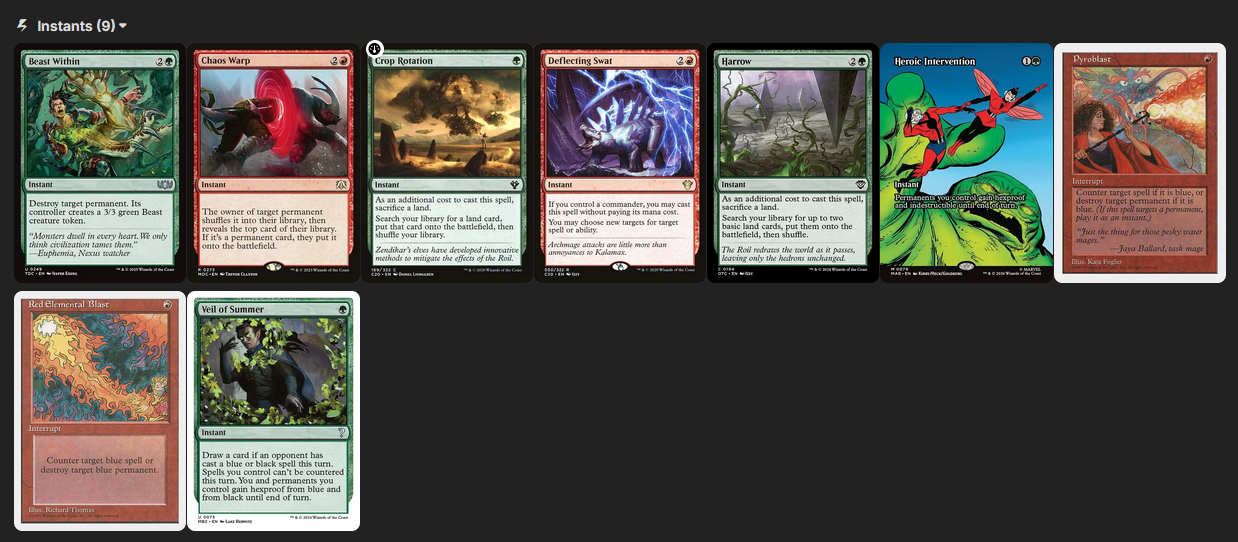
The deck includes a broad interaction suite without compromising its primary engine. Beast Within, Chaos Warp, Decimate, and Blasphemous Act answer problematic permanents and crowded boards, while Pyroblast, Red Elemental Blast, Deflecting Swat, and Veil of Summer provide efficient stack interaction.
Heroic Intervention protects established boards, and Hexing Squelcher helps insulate the deck's spells and creatures from opposing countermagic and targeted interaction. Endurance supplies additional graveyard control while remaining a useful creature within the deck's green framework.
Closing the Game
Tannuk allows the deck to apply pressure without entering combat, and repeated landfall triggers gradually reduce opposing life totals throughout normal development. Torbran, Thane of Red Fell can accelerate this clock considerably when paired with Tannuk or the deck's other red damage sources.
When direct damage is not enough, Avenger of Zendikar, Rampaging Baloths, Scute Swarm, Sapling Nursery, Titania, Protector of Argoth, and Omnath, Locus of Rage create enough battlefield presence to close through combat. Finale of Devastation functions as both a creature tutor and a late-game finishing mechanism once sufficient mana is available.
Build Philosophy
This Tannuk build is constructed around making nearly every stage of land development strategically relevant. Ramp spells do more than accelerate mana, fetch lands generate additional triggers, sacrificed lands become recursion targets, and late-game land recovery can rebuild both resources and battlefield pressure simultaneously.
The deck maintains a deliberate balance between extra land effects, recursion, payoff permanents, interaction, and protection. Its Gruul mana base combines a substantial basic-land foundation with carefully selected utility and fixing lands, while conventional ramp and mana acceleration support consistent early sequencing.
Every major package contributes directly to the same underlying engine: put lands onto the battlefield repeatedly, extract value from each entry, and recycle those lands when possible.
Technical Details
100-card singleton Commander deck, legal for EDH
All cards in Near Mint to Lightly Played condition
Professionally sleeved and ready to play
Built for consistent performance and strategic depth
Ideal For Players Who:
Enjoy landfall strategies built around repeated land drops, sacrifice, and graveyard recursion
Prefer Gruul decks that generate value through both direct damage and scalable creature production
Appreciate cohesive Commander builds with layered engines and multiple paths to closing a game
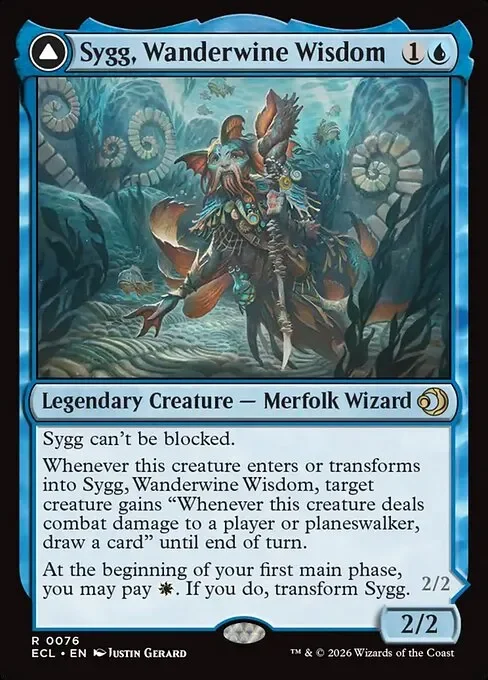
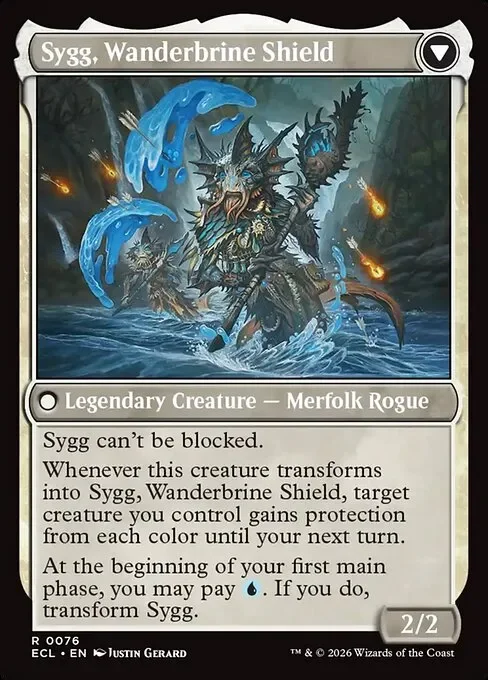
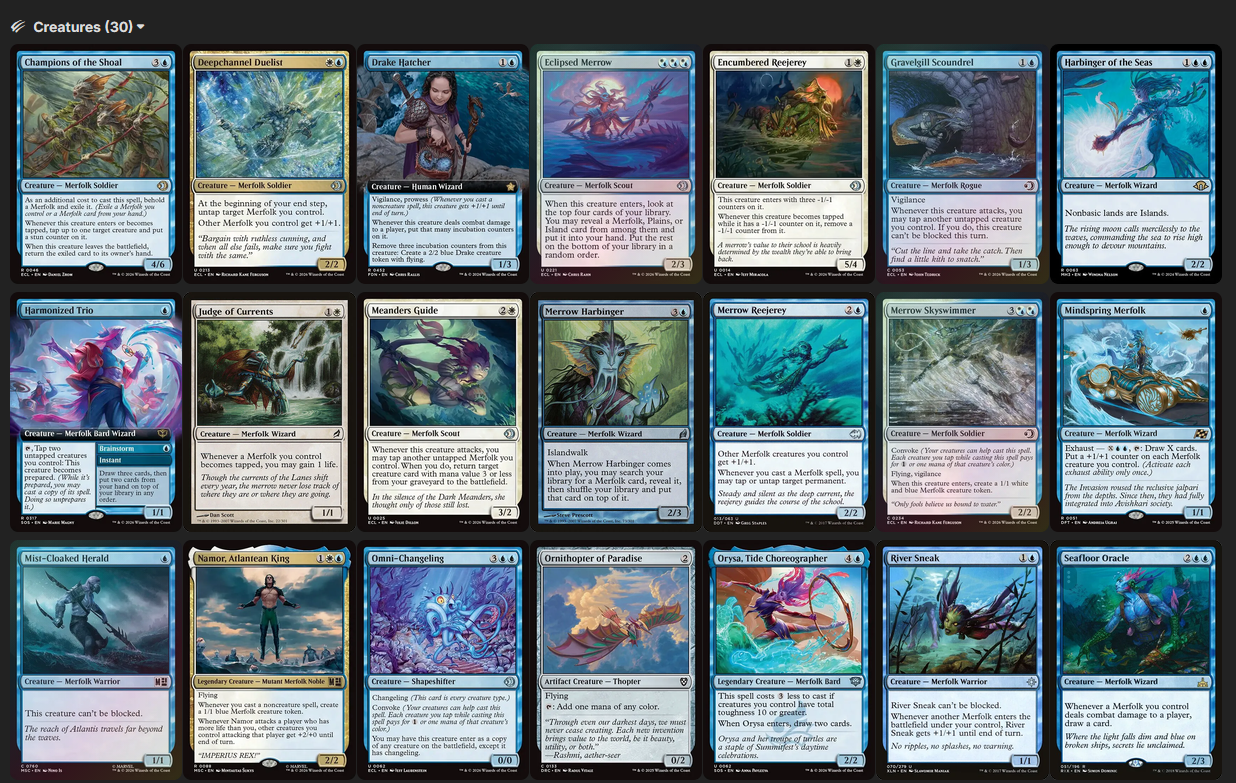
Sygg, Wanderwine Wisdom leads a focused Azorius Merfolk deck built around creature development, deliberate tapping synergies, evasive combat, and sustained card advantage. Sygg provides an unblockable threat while repeatedly shifting between a card-draw role and Sygg, Wanderbrine Shield, which can grant a key creature protection from every color until your next turn.
The deck combines traditional Merfolk typal support with newer Lorwyn Eclipsed designs that reward tapping creatures for value. Rather than relying exclusively on anthem effects, the build develops a broad board, converts Merfolk into resources through convoke and tap abilities, and uses a substantial protection and interaction package to preserve that position.
Deck Overview
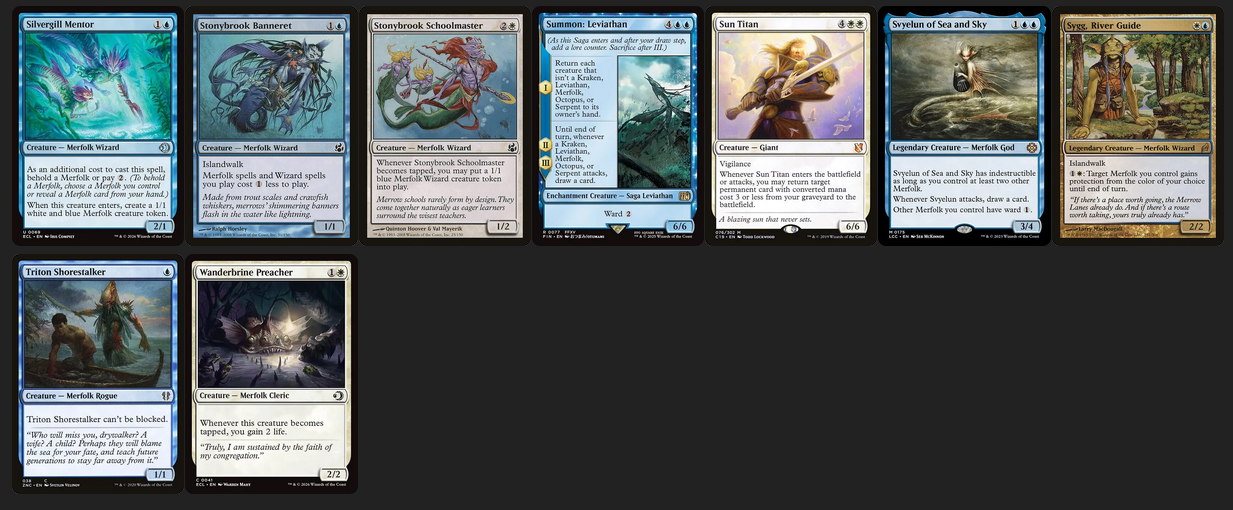
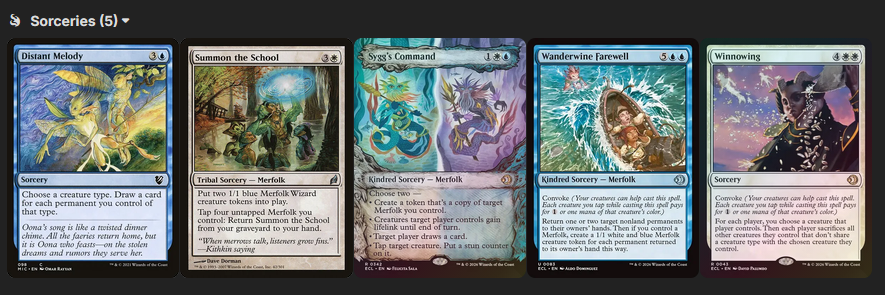
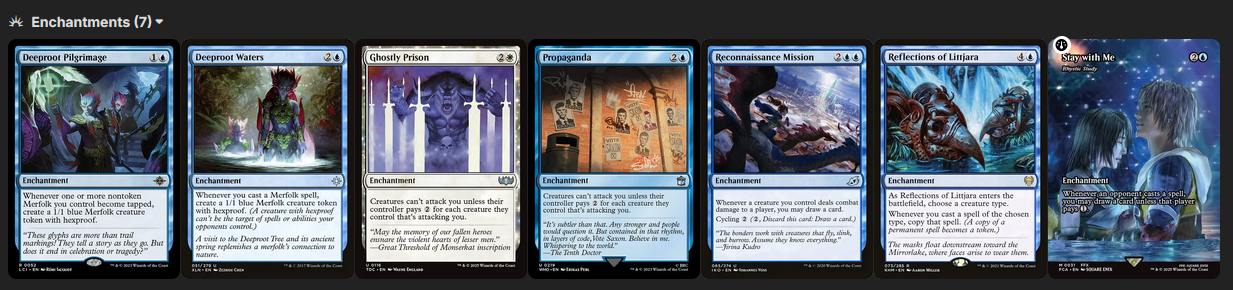
This is an Azorius Merfolk Tokens and Tempo strategy with a strong combat-draw component. Cards such as Deeproot Pilgrimage, Deeproot Waters, Stonybrook Schoolmaster, Silvergill Mentor, and Summon the School continually increase the number of Merfolk available, creating material for both combat and the deck's numerous tap-based effects.
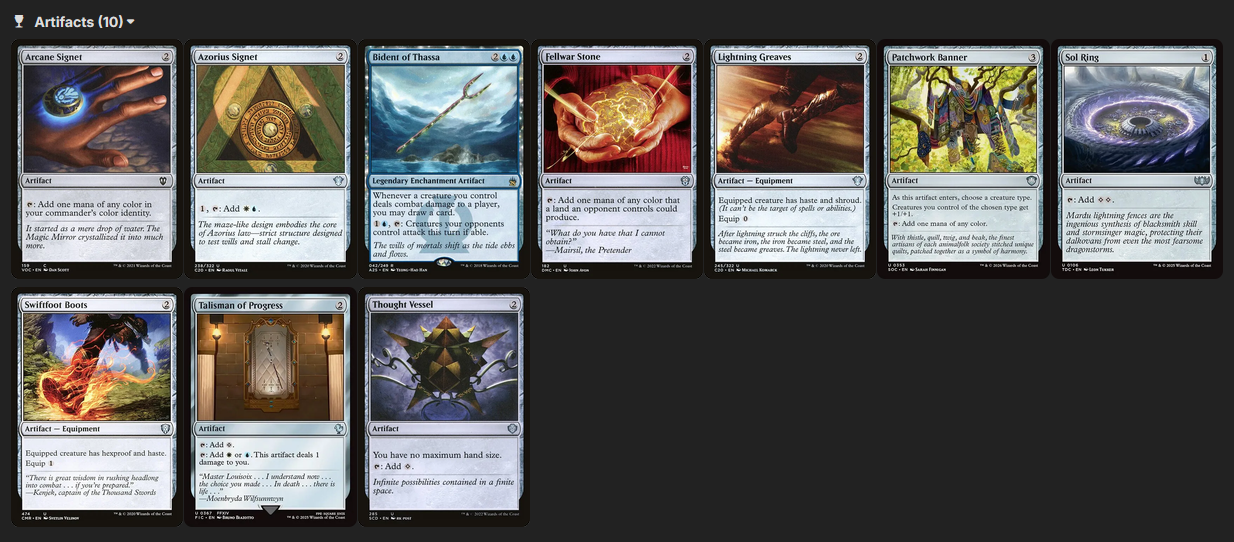
Traditional tribal pieces including Merrow Reejerey, Merrow Skyswimmer, Stonybrook Banneret, Patchwork Banner, and Reflections of Littjara turn that growing board into a more efficient and increasingly threatening engine. The result is a deck that develops incrementally, protects its important permanents, and rewards careful sequencing rather than simply committing creatures to combat at every opportunity.
Key Strategic Elements
Merfolk Development and Tap Synergy
The central engine revolves around producing Merfolk and finding productive ways to tap them. Deeproot Pilgrimage creates additional bodies as nontoken Merfolk become tapped, while Stonybrook Schoolmaster and Summon the School provide further token generation.
This naturally complements the deck's convoke cards and creatures such as Gravelgill Scoundrel and Wanderbrine Preacher, allowing the same board presence to contribute to spellcasting, utility effects, and future token production. The result is a layered engine where creatures remain strategically useful even when they are not attacking.
Evasive Combat and Card Advantage
Sygg's natural unblockability gives the deck a dependable combat connection, while Mist-Cloaked Herald, River Sneak, Triton Shorestalker, and other evasive Merfolk help keep damage flowing through developed boards.
Those attacks become meaningful sources of cards through Bident of Thassa, Reconnaissance Mission, Seafloor Oracle, and Sygg's Wanderwine Wisdom trigger. Distant Melody, Rhystic Study, Mindspring Merfolk, and Orysa, Tide Choreographer supplement those combat engines so the deck can continue developing without exhausting its hand.
Tempo and Disruption
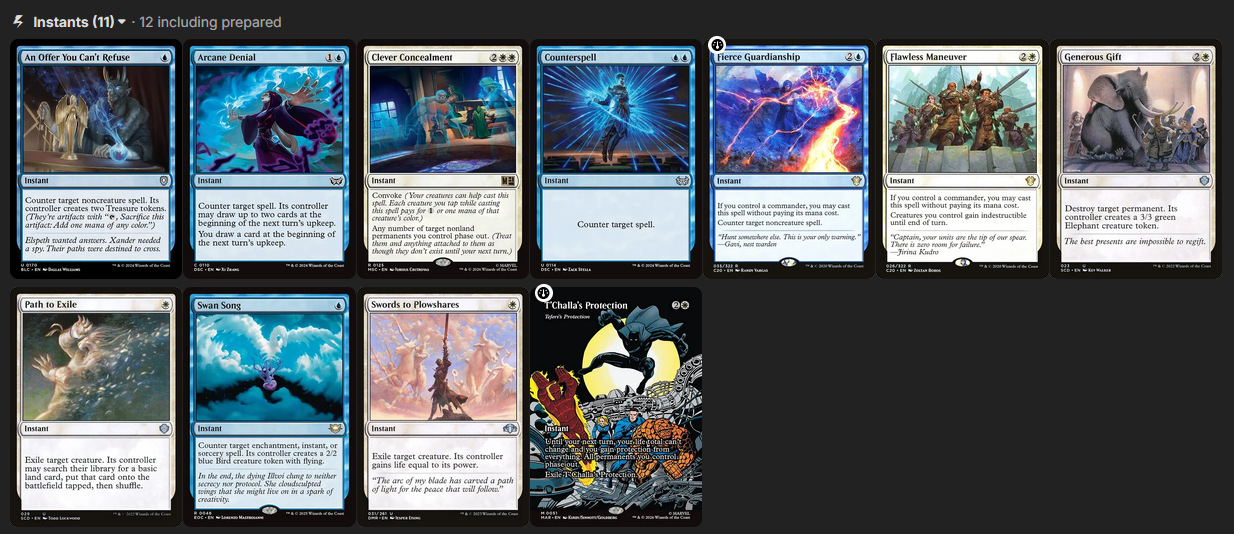
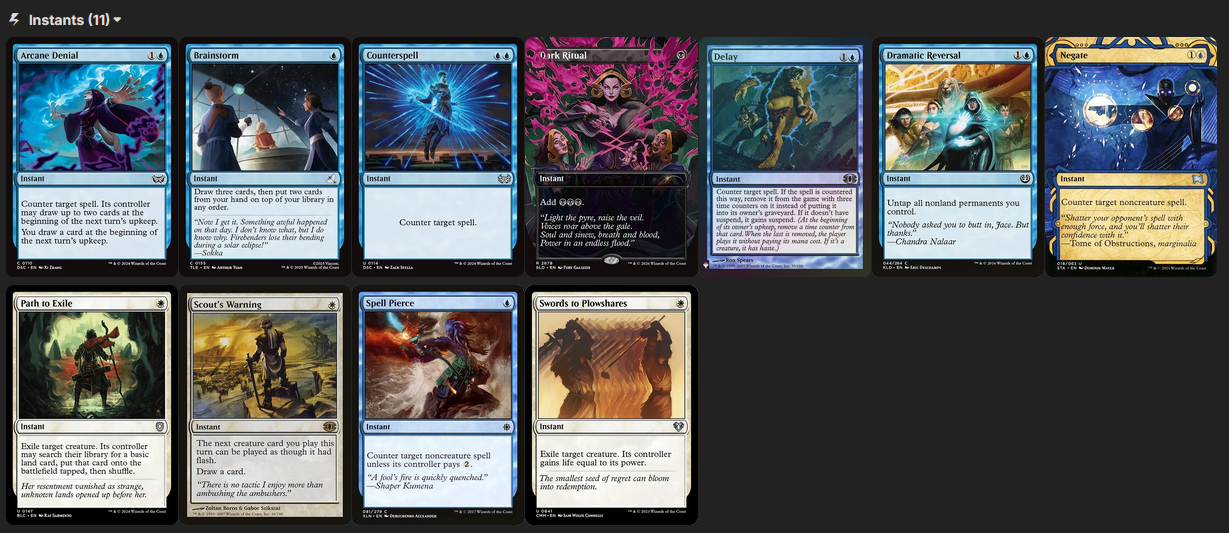
The interaction package is deliberately broad. Counterspell, Arcane Denial, Swan Song, An Offer You Can't Refuse, and Fierce Guardianship provide stack interaction, while Swords to Plowshares, Path to Exile, and Generous Gift answer resolved threats.
Harbinger of the Seas adds a more structural form of disruption by converting nonbasic lands into Islands. With a mana base containing a substantial basic-land component alongside Sol Ring, Arcane Signet, Azorius Signet, Fellwar Stone, Talisman of Progress, and other fixing, the deck is positioned to operate through that effect more comfortably than many opposing multicolor strategies.
Board Control and Resilience
Merfolk decks often need to commit multiple creatures before their engines become fully productive, so this build dedicates significant space to protecting that investment. Clever Concealment, Flawless Maneuver, Teferi's Protection, and Sygg's transformed protection ability give the deck multiple ways to preserve valuable creatures through removal and sweepers.
Ghostly Prison and Propaganda discourage retaliation while the Merfolk board develops, and Sun Titan provides a secondary recovery engine for many of the deck's lower-cost permanents. Winnowing, Wanderwine Farewell, and Summon: Leviathan provide larger-scale tools for reshaping boards when incremental interaction is no longer sufficient.
Closing the Game
The deck generally wins by turning accumulated Merfolk into overwhelming combat pressure rather than relying on a separate combo finish. Merrow Reejerey, Merrow Skyswimmer, Patchwork Banner, Deepchannel Duelist, and the deck's token engines allow a relatively modest battlefield to expand into a substantial attacking force.
Evasion helps convert that board directly into damage, while the combat-draw engines ensure successful attacks continue supplying resources. Because the deck can protect its developed position unusually well for a creature-focused strategy, it is capable of building toward a decisive combat turn without abandoning interaction.
Build Philosophy
This build is designed around synergy between Merfolk typal effects, tapping creatures, token generation, evasive combat, and efficient protection. Individual cards frequently serve more than one role: Merfolk can attack, convoke spells, trigger token engines, enable typal payoffs, or become protected utility pieces depending on the state of the game.
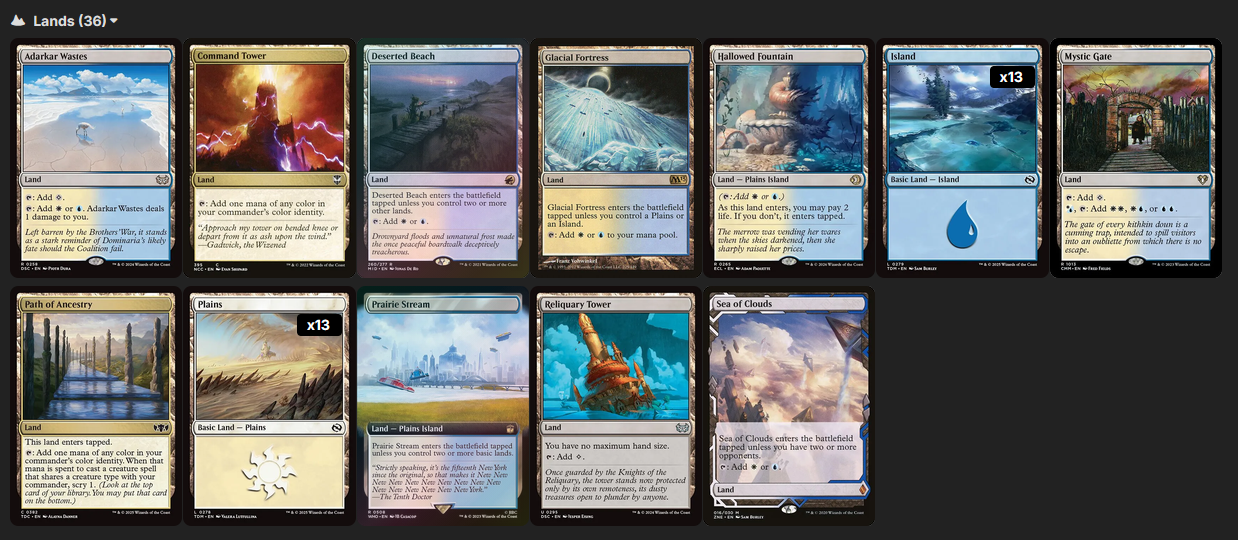
The mana base balances a substantial number of basic lands with established Azorius duals including Hallowed Fountain, Sea of Clouds, Mystic Gate, Glacial Fortress, Deserted Beach, Prairie Stream, and Adarkar Wastes. A concentrated two-mana artifact package supports smooth sequencing while leaving mana available for countermagic and protection.
Every inclusion is intended to reinforce a cohesive game plan: establish the Merfolk engine early, convert creature density into cards and tempo, preserve the developed battlefield, and eventually turn that accumulated advantage into combat damage.
Technical Details
100-card singleton Commander deck, legal for EDH
All cards in Near Mint to Lightly Played condition
Professionally sleeved and ready to play
Built for consistent performance and strategic depth
Ideal For Players Who:
Enjoy Merfolk strategies built around tokens, tapping synergies, and evasive combat
Prefer interactive Commander decks with substantial countermagic and board protection
Appreciate typal builds that combine established Merfolk staples with newer Lorwyn Eclipsed mechanics
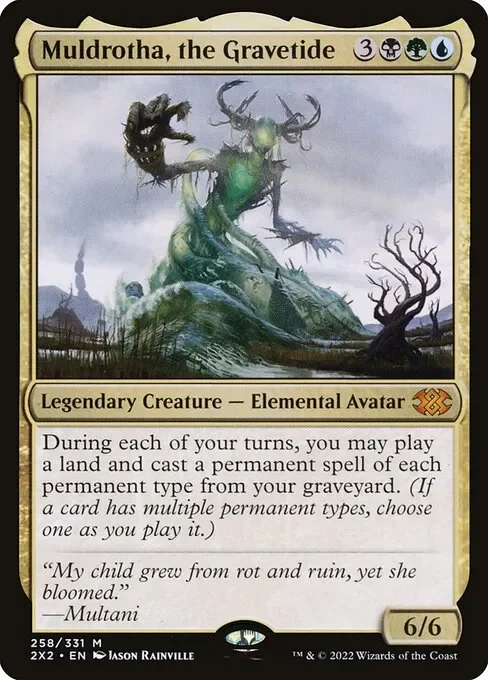
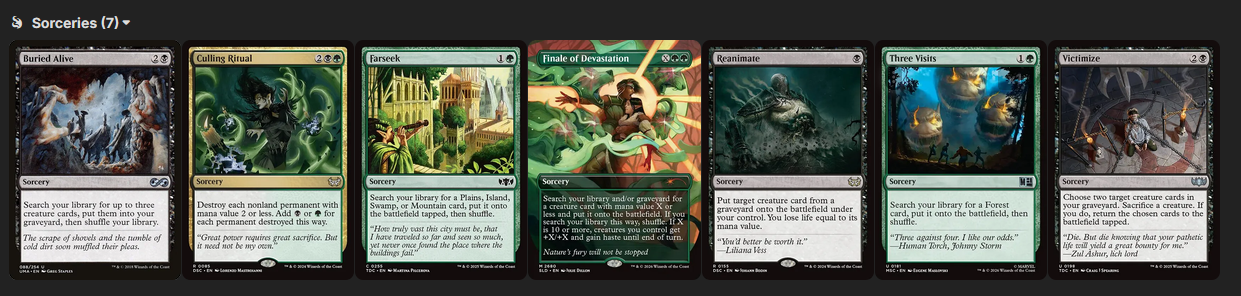
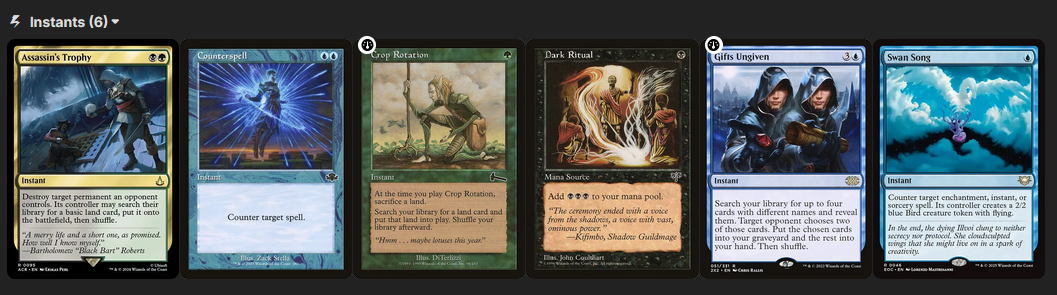
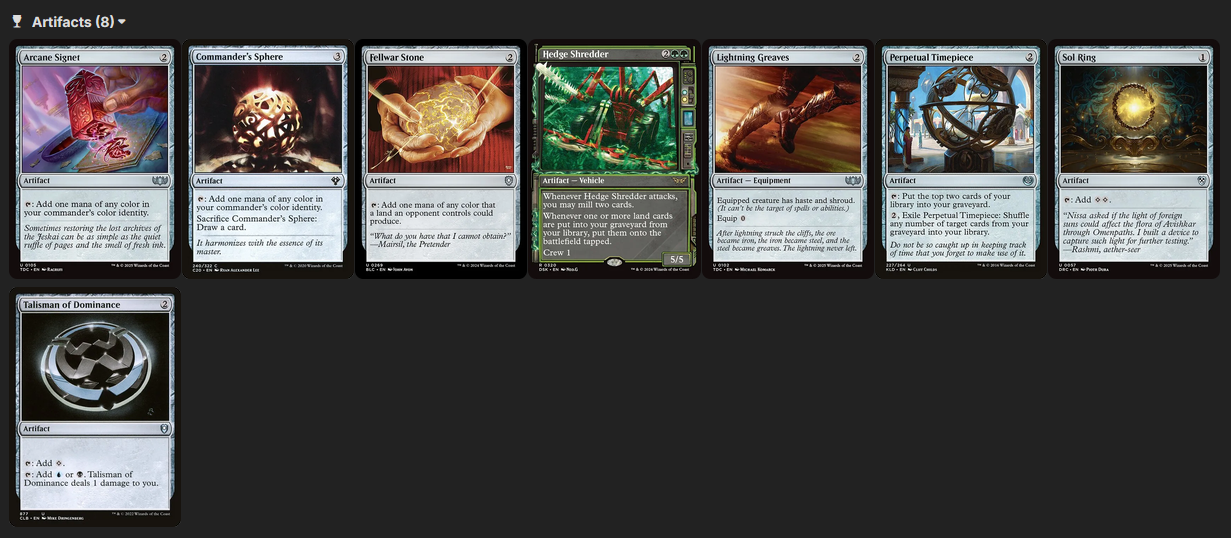
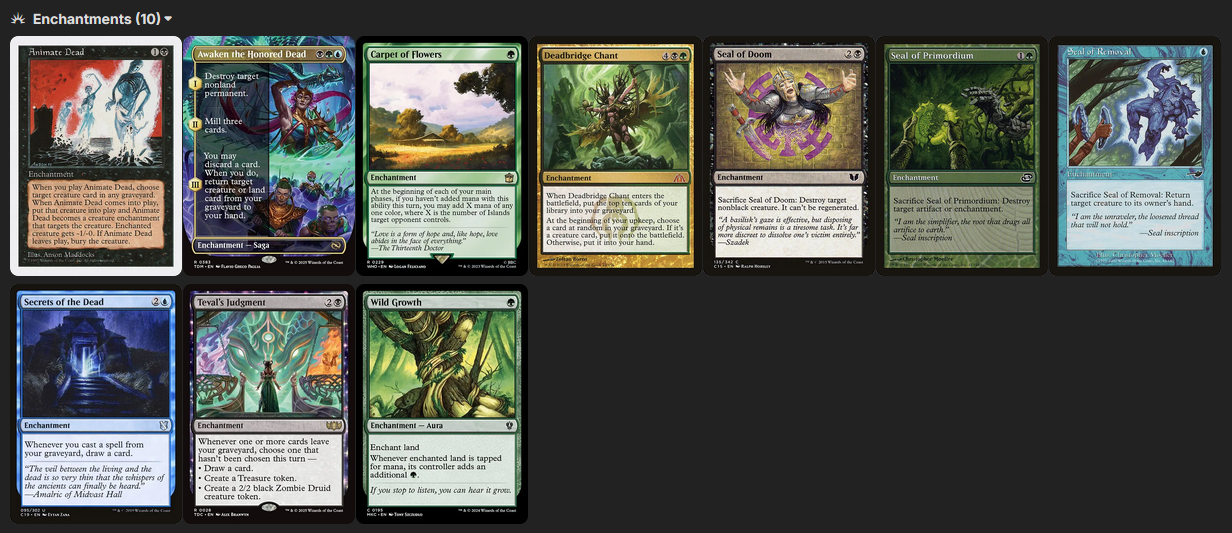
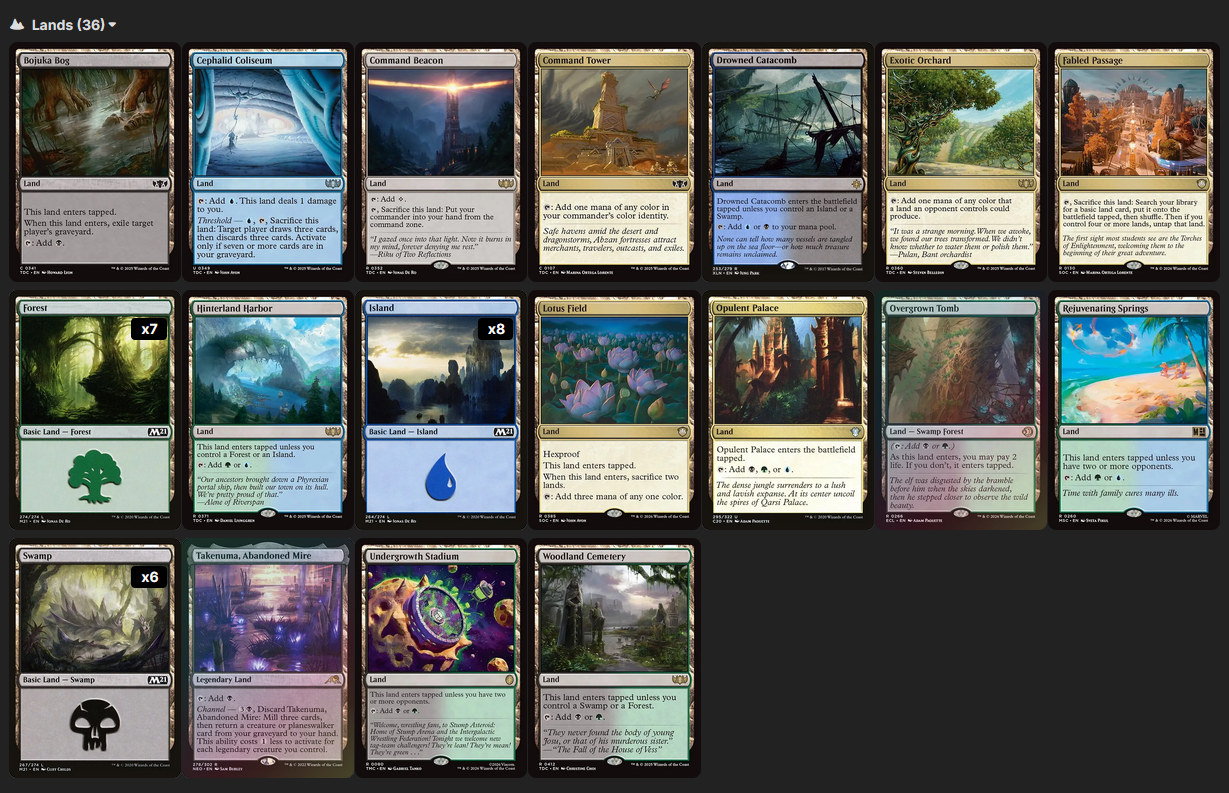
Muldrotha, the Gravetide leads a permanent-focused Sultai graveyard engine built to turn self-mill, sacrifice effects, and routine interaction into repeatable value. Rather than treating the graveyard as simple recursion, the deck uses it as an extension of the hand, repeatedly converting creatures, lands, artifacts, enchantments, and planeswalkers into reusable resources.
The build combines self-mill and land recursion with a dense package of permanents designed to generate value both when they enter the battlefield and when they are sacrificed. This gives Muldrotha a flexible, attrition-oriented play pattern capable of developing its own board while steadily exhausting opposing resources.
Deck Overview
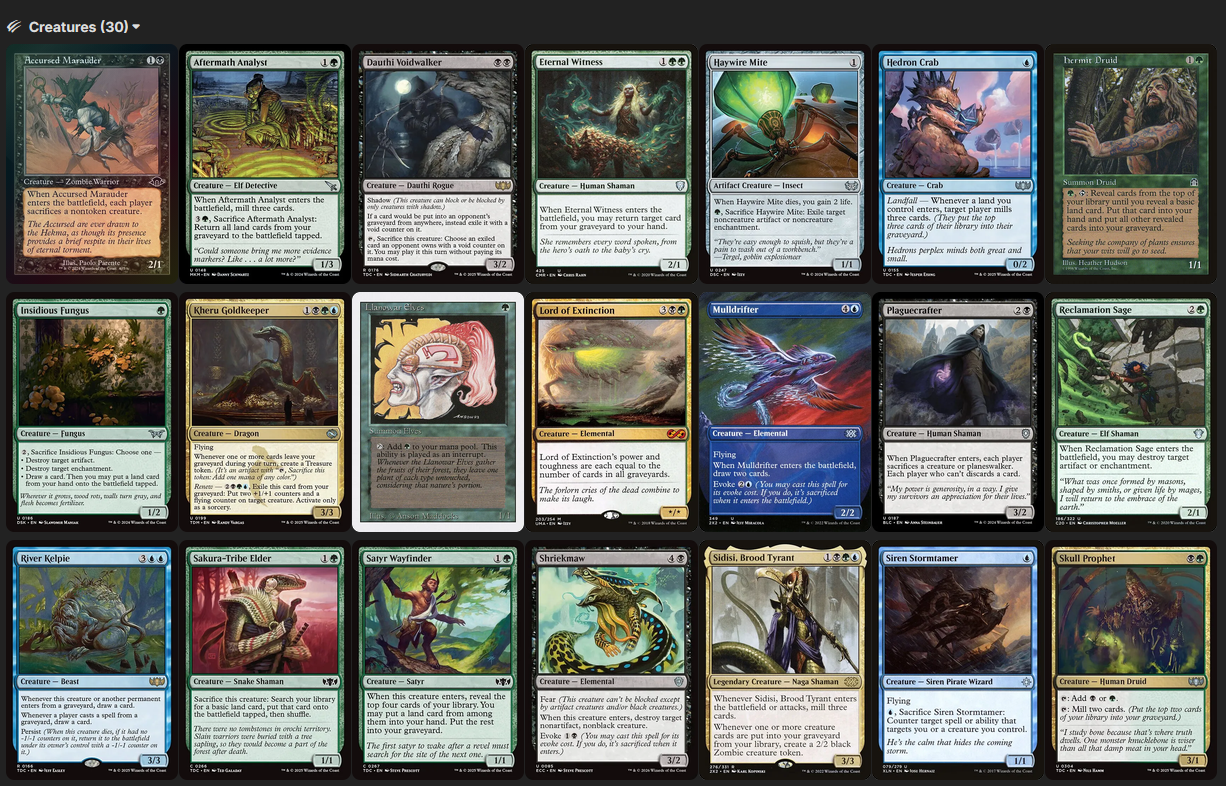
The deck centers on filling the graveyard efficiently and then extracting value from cards that remain useful after being milled or sacrificed. Hermit Druid, Stitcher's Supplier, Satyr Wayfinder, Hedron Crab, Perpetual Timepiece, Teval, the Balanced Scale, and Deadbridge Chant steadily stock the graveyard, while Buried Alive and Gifts Ungiven provide more deliberate setup.
Once Muldrotha is established, disposable permanents become recurring tools. Sakura-Tribe Elder, Haywire Mite, Insidious Fungus, Seal of Doom, Seal of Primordium, Seal of Removal, Plaguecrafter, Shriekmaw, and Reclamation Sage can repeatedly provide ramp, removal, or disruption while supplying additional permanent types to replay each turn.
The result is a graveyard deck that can shift naturally between development, control, and long-game inevitability rather than relying on a single recursion line.
Key Strategic Elements
Self-Mill and Graveyard Development
A broad self-mill package ensures the deck can establish its primary resource quickly. Stitcher's Supplier, Satyr Wayfinder, Hermit Druid, Hedron Crab, Skull Prophet, Teval, the Balanced Scale, Tamiyo, Collector of Tales, and Perpetual Timepiece move cards into the graveyard while continuing to advance the board.
Buried Alive provides targeted setup for creature recursion, while Deadbridge Chant combines additional milling with ongoing recovery. These effects make the graveyard deep enough that Muldrotha consistently has meaningful options across several permanent types.
Land Recursion and Mana Development
The land package functions as part of the graveyard engine rather than merely supporting it. Fabled Passage, Lotus Field, Cephalid Coliseum, Crop Rotation, Springbloom Druid, Sakura-Tribe Elder, and Aftermath Analyst create opportunities for lands to enter or leave the graveyard throughout the game.
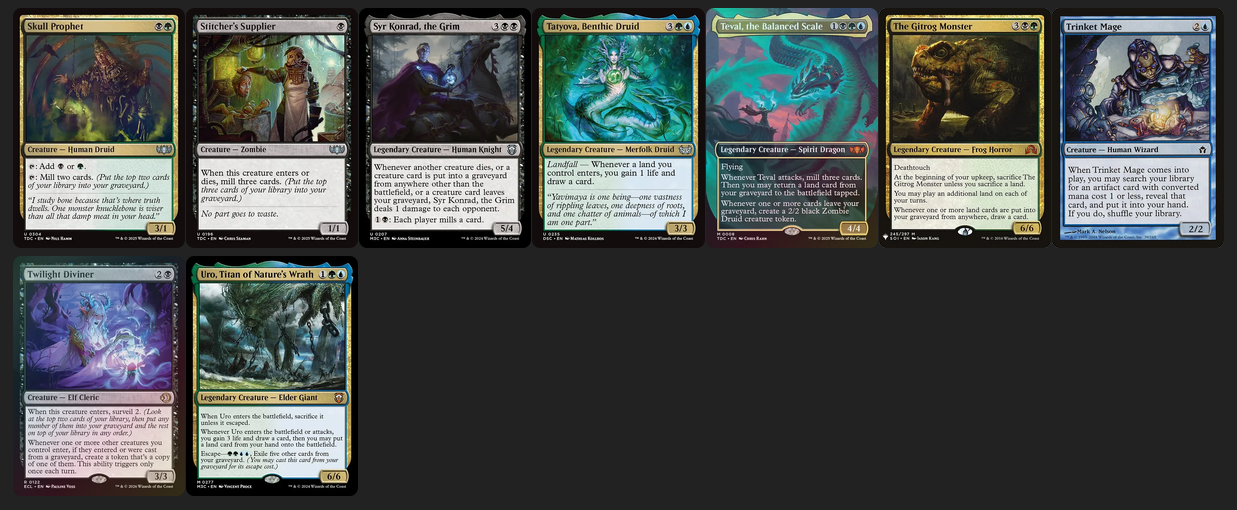
The Gitrog Monster rewards lands moving into the graveyard, while Tatyova, Benthic Druid converts recurring land drops into cards and life. Hedge Shredder further connects self-mill to mana development by turning milled lands into battlefield resources.
Traditional acceleration from Sol Ring, Arcane Signet, Fellwar Stone, Talisman of Dominance, Wild Growth, Farseek, Three Visits, and Llanowar Elves helps Muldrotha enter play early enough for the recursion engine to matter.
Repeatable Interaction and Board Control
Muldrotha is especially effective with permanents that sacrifice themselves for useful effects. Seal of Doom, Seal of Primordium, Seal of Removal, Haywire Mite, Insidious Fungus, Reclamation Sage, Shriekmaw, Accursed Marauder, and Plaguecrafter provide interaction that can later be replayed from the graveyard.
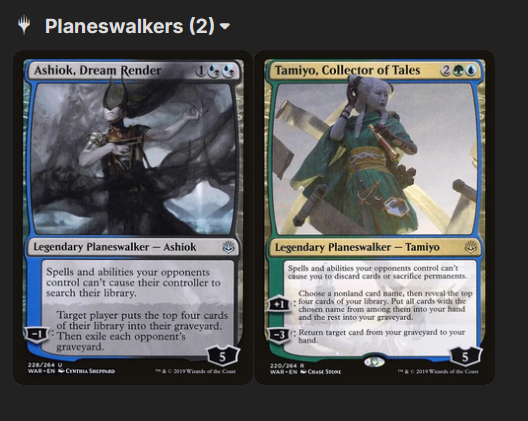
That recursive removal package is backed by efficient standalone answers including Assassin's Trophy, Counterspell, Swan Song, and Culling Ritual. Ashiok, Dream Render, Dauthi Voidwalker, and Bojuka Bog add graveyard disruption against opposing recursion strategies while limiting opposing resource development.
Recursion, Card Advantage, and Resilience
The deck contains several value engines that specifically reward operating from the graveyard. River Kelpie and Secrets of the Dead generate additional cards as spells and permanents are played from the graveyard, allowing Muldrotha's normal game plan to replenish the hand rather than simply exchange one resource for another.
Eternal Witness, Reanimate, Animate Dead, Victimize, Tamiyo, Collector of Tales, and Deadbridge Chant provide recursion independent of the commander, preventing the deck from becoming entirely reliant on keeping Muldrotha in play. Lightning Greaves protects the commander once deployed, while Command Beacon provides additional resilience when repeated removal makes commander tax restrictive.
Graveyard Payoffs and Closing the Game
The same graveyard activity that fuels the value engine also supplies the deck's finishing pressure. Syr Konrad, the Grim converts creatures moving through graveyards into direct damage, while Sidisi, Brood Tyrant and Teval, the Balanced Scale turn graveyard development into additional battlefield presence.
Lord of Extinction can become an exceptionally large threat as graveyards accumulate cards, and Uro, Titan of Nature's Wrath supplies recurring pressure, life, cards, and additional land development.
When the deck has established sufficient resources, Finale of Devastation converts accumulated mana and board presence into a decisive finishing sequence, allowing the deck to transition cleanly from incremental advantage into a game-ending attack.
Build Philosophy
This Muldrotha build is constructed around permanent density, ensuring that the commander's ability consistently has meaningful targets across multiple card types. Creatures and enchantments have been selected not only for their immediate effects but also for their ability to be sacrificed, milled, recast, or otherwise reused as part of a larger resource loop.
The mana base combines 36 lands with artifact, creature, enchantment, and spell-based acceleration, supporting smooth access to all three colors while preserving a high concentration of graveyard-relevant cards. Land-sacrifice effects and graveyard recursion are intentionally integrated into the mana package so that normal development continues to contribute to the deck's primary strategy.
Every major function has overlapping support: self-mill feeds recursion, recursion fuels card advantage, sacrificed permanents provide interaction, and land movement generates additional value. The result is a cohesive Sultai engine designed for sustained performance through longer multiplayer games.
Technical Details
100-card singleton Commander deck, legal for EDH
All cards in Near Mint to Lightly Played condition
Professionally sleeved and ready to play
Built for consistent performance and strategic depth
Ideal For Players Who:
Enjoy graveyard strategies built around recursion, self-mill, and resource management
Prefer interactive Commander decks that generate value through reusable permanents
Appreciate layered Sultai engines with multiple overlapping paths to card advantage and board control
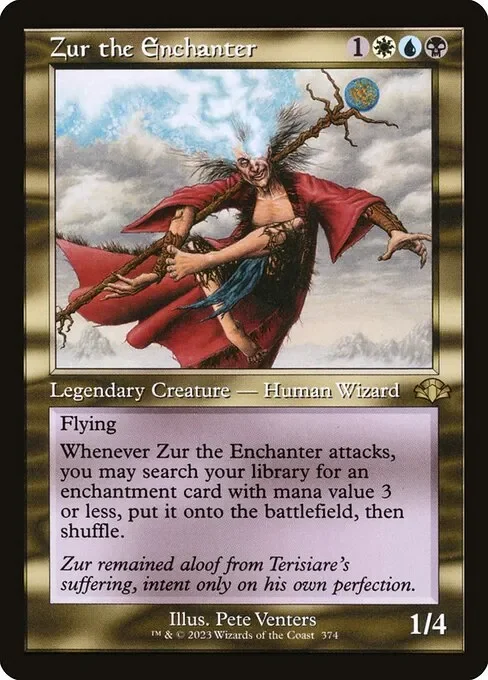
Zur the Enchanter leads an Esper control deck built around repeatable enchantment tutoring, layered disruption, and a compact Voltron plan. Rather than relying on a single linear route, the deck uses Zur’s attack trigger to assemble the exact combination of protection, removal, card advantage, or pressure required for the current board state.
The result is a highly modular control shell in which many of the deck’s strongest interactive pieces can be placed directly onto the battlefield. Efficient countermagic, restrictive permanents, resilient defensive engines, and several alternate paths to victory allow the deck to transition naturally between establishing control and converting that control into a decisive advantage.
Deck Overview
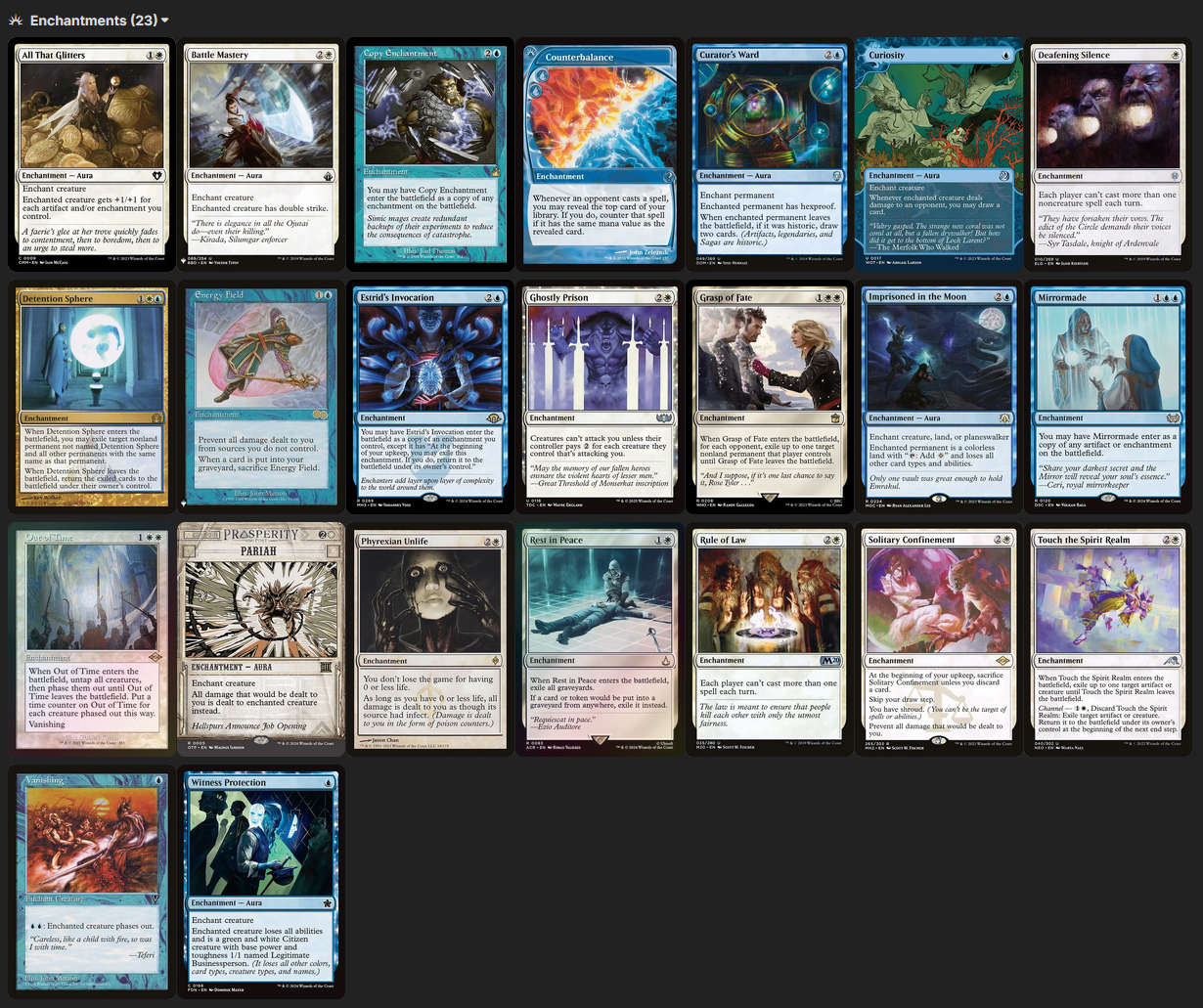
The core of the deck is an Esper Enchantments Control and Voltron hybrid. Zur can search for any enchantment with mana value 3 or less whenever he attacks, turning cards such as Vanishing, Rest in Peace, Rule of Law, Solitary Confinement, Grasp of Fate, All That Glitters, and Battle Mastery into a flexible toolbox rather than isolated draws.
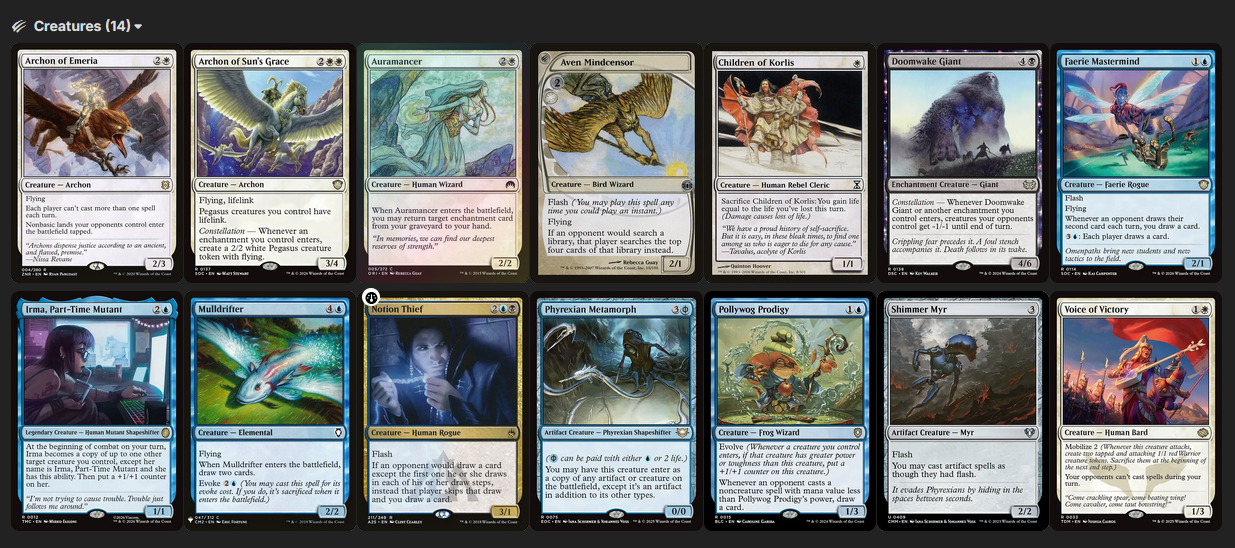
That toolbox is reinforced by enchantment-copying effects including Copy Enchantment, Estrid’s Invocation, and Mirrormade, allowing particularly useful permanents to be duplicated as the board develops. Archon of Sun’s Grace and Doomwake Giant extend the enchantment theme beyond Zur himself, rewarding repeated enchantment deployment with additional board presence and creature suppression.
The creature package largely supports this controlling structure. Archon of Emeria, Aven Mindcensor, Notion Thief, Faerie Mastermind, Pollywog Prodigy, and Voice of Victory create additional pressure on opposing resources while providing meaningful bodies once the game begins to stabilize.
Key Strategic Elements
Enchantment Tutoring and Toolbox Control
Zur is the deck’s primary engine. Once he is able to attack, his trigger can immediately find the enchantment best suited to the current situation without requiring additional mana.
Removal options include Grasp of Fate, Detention Sphere, Imprisoned in the Moon, Touch the Spirit Realm, and Witness Protection. Defensive pieces such as Ghostly Prison, Energy Field, Solitary Confinement, and Phyrexian Unlife help insulate the deck from opposing pressure, while Vanishing provides a particularly efficient method of protecting Zur from removal and board wipes.
Because many of these cards occupy the same low portion of the mana curve, Zur functions as both card selection and virtual redundancy for the deck’s most important effects.
Tempo, Stax, and Disruption
The deck incorporates several overlapping restrictions designed to reduce opponents’ ability to execute explosive turns. Rule of Law, Deafening Silence, and Archon of Emeria limit spell sequencing, while Aven Mindcensor interferes with opposing tutors and fetch effects.
Notion Thief attacks supplemental card draw, and Voice of Victory restricts interaction during the deck’s own turn while creating additional attackers through its mobilize ability. These effects are backed by Counterspell, Arcane Denial, Delay, Negate, Spell Pierce, Path to Exile, and Swords to Plowshares, giving the deck substantial control over both stack-based and permanent-based threats.
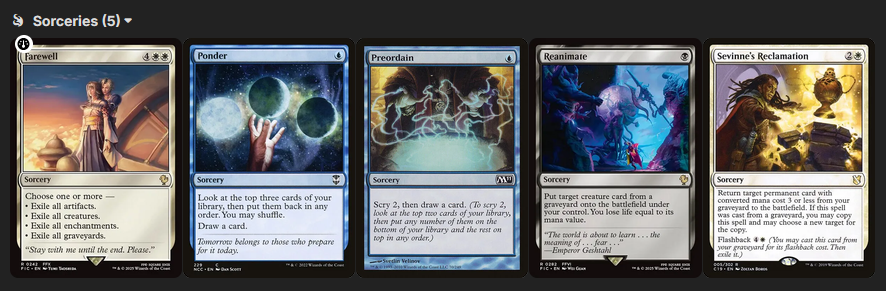
Counterbalance adds another persistent source of disruption, with Brainstorm, Ponder, and Preordain helping manipulate upcoming cards while improving overall draw quality.
Defensive Engines and Resilience
Several enchantments form particularly durable defensive structures. Rest in Peace works naturally alongside Energy Field, preventing cards from reaching the graveyard and therefore making Energy Field significantly more difficult to remove through its own sacrifice condition.
Solitary Confinement provides another powerful layer of protection, supported by supplemental card-advantage sources such as Faerie Mastermind, Curiosity, Pollywog Prodigy, and Mulldrifter. Phyrexian Unlife provides additional insulation against lethal damage, while Pariah can redirect incoming damage when an appropriate creature is available.
The deck also contains meaningful recovery tools. Auramancer returns key enchantments, Sevinne’s Reclamation restores low-cost permanents, and Reanimate provides efficient creature recursion. Farewell offers a comprehensive reset when incremental interaction is no longer sufficient.
Enchantment Value and Utility
The enchantment package is designed to provide utility even when Zur is not immediately available. Archon of Sun’s Grace turns enchantment development into an evasive token engine, while Doomwake Giant converts constellation triggers into repeatable creature suppression.
Copy Enchantment, Estrid’s Invocation, and Mirrormade expand the utility of the deck by copying whichever enchantment or artifact is most valuable at the time. This can produce additional removal, defensive pieces, value engines, or offensive enhancements depending on board state.
Out of Time provides a specialized creature reset that fits directly within Zur’s tutoring range, giving the commander access to a broad board-control effect from the command zone.
Closing the Game
The most direct route to victory is commander damage. All That Glitters scales Zur with the deck’s dense artifact and enchantment presence, while Battle Mastery gives him double strike and dramatically accelerates the commander-damage clock. Vanishing, Curator’s Ward, Lightning Greaves, and the deck’s countermagic help preserve Zur once he becomes the primary threat.
The deck can also win through accumulated creature advantage. Archon of Sun’s Grace creates a growing force of flying Pegasus tokens, while disruption creatures and copied threats gradually become an effective battlefield of their own.
Irma, Part-Time Mutant provides an additional tactical angle by copying another creature at the beginning of combat. Copying Zur allows Irma to retain her own name while gaining Zur’s attack-triggered tutoring ability, creating the potential for multiple enchantment searches during combat without conflicting with the legend rule. Alternatively, she can copy whichever utility or disruptive creature is most relevant at the time.
Build Philosophy
This build is structured around maximizing the consistency and flexibility of Zur’s unique tutoring ability rather than simply filling the deck with isolated enchantment payoffs. The low-cost enchantment package provides removal, protection, card advantage, disruption, and offensive scaling, ensuring that Zur’s trigger remains relevant across widely different board states.
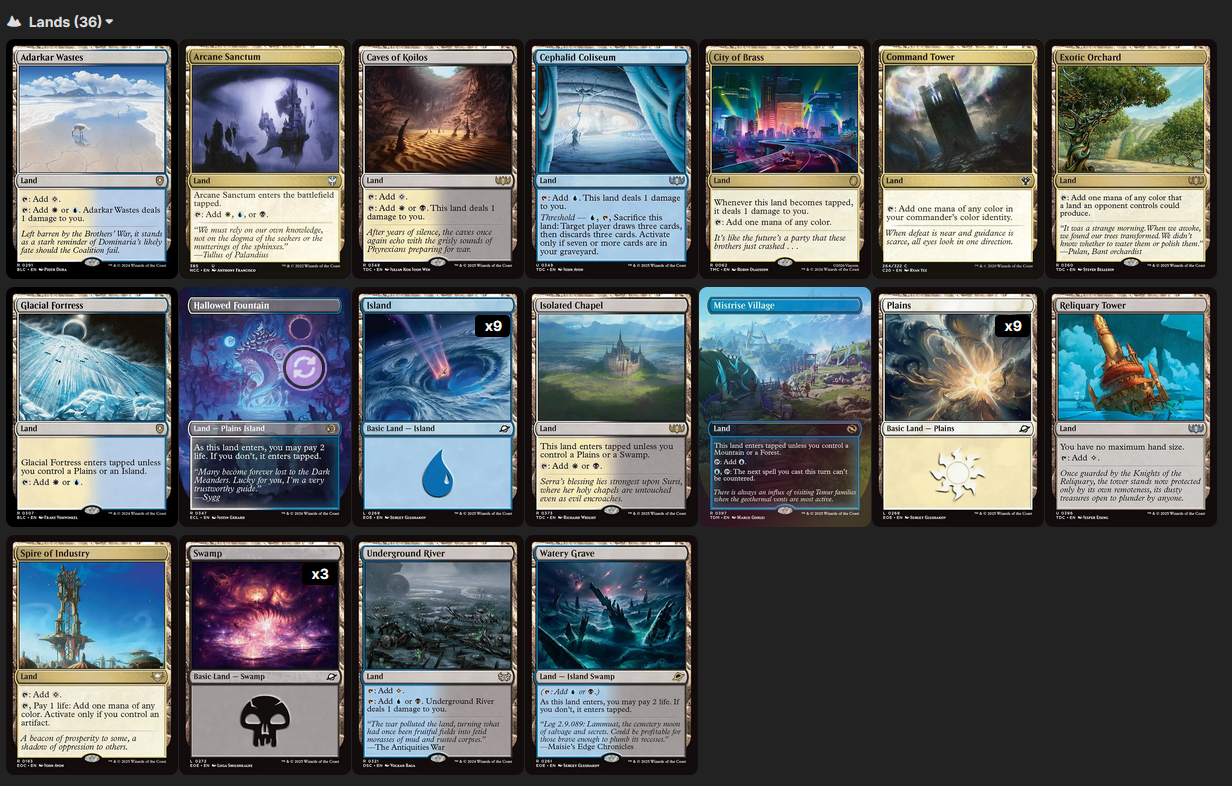
The surrounding control suite is deliberately efficient. Cheap countermagic and removal protect the deck while its permanent-based restrictions establish control, while a substantial artifact ramp package accelerates Zur and supports a demanding Esper mana base.
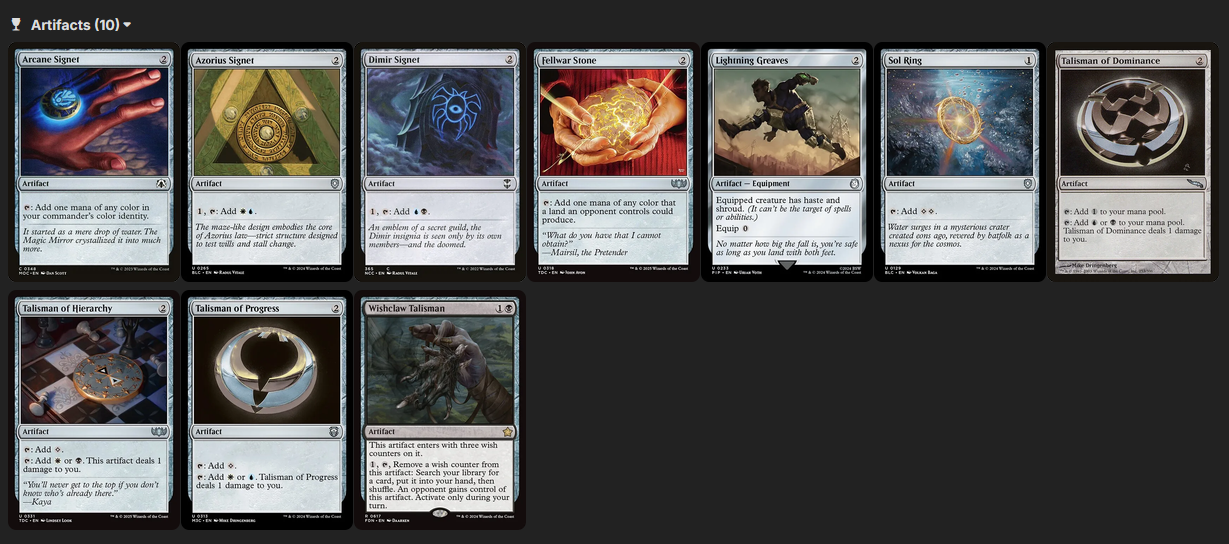
Mana sequencing is supported by Arcane Signet, Azorius Signet, Dimir Signet, Fellwar Stone, Sol Ring, Talisman of Dominance, Talisman of Hierarchy, and Talisman of Progress, alongside a balanced three-color land base. Each inclusion contributes either to establishing Zur, protecting the resulting board state, restricting opposing development, or converting that position into a win.
Technical Details
100-card singleton Commander deck, legal for EDH
All cards in Near Mint to Lightly Played condition
Professionally sleeved and ready to play
Built for consistent performance and strategic depth
Ideal For Players Who:
Enjoy Esper control decks with extensive tutoring and decision-driven play
Prefer enchantment strategies combining stax effects, protection, removal, and Voltron pressure
Appreciate cohesive Commander builds with multiple overlapping lines of interaction and victory
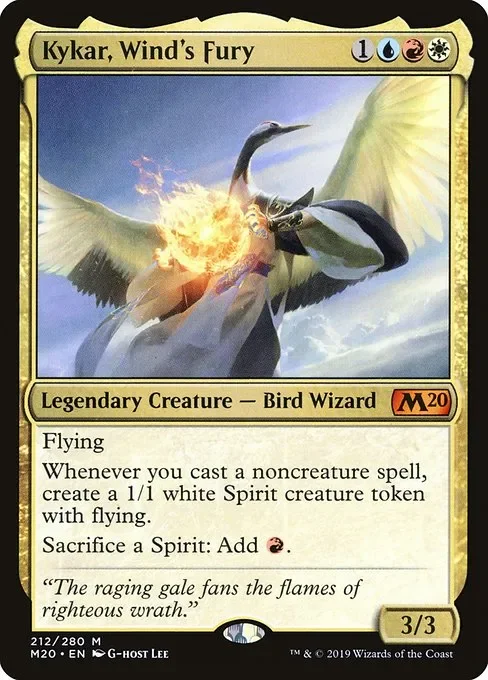
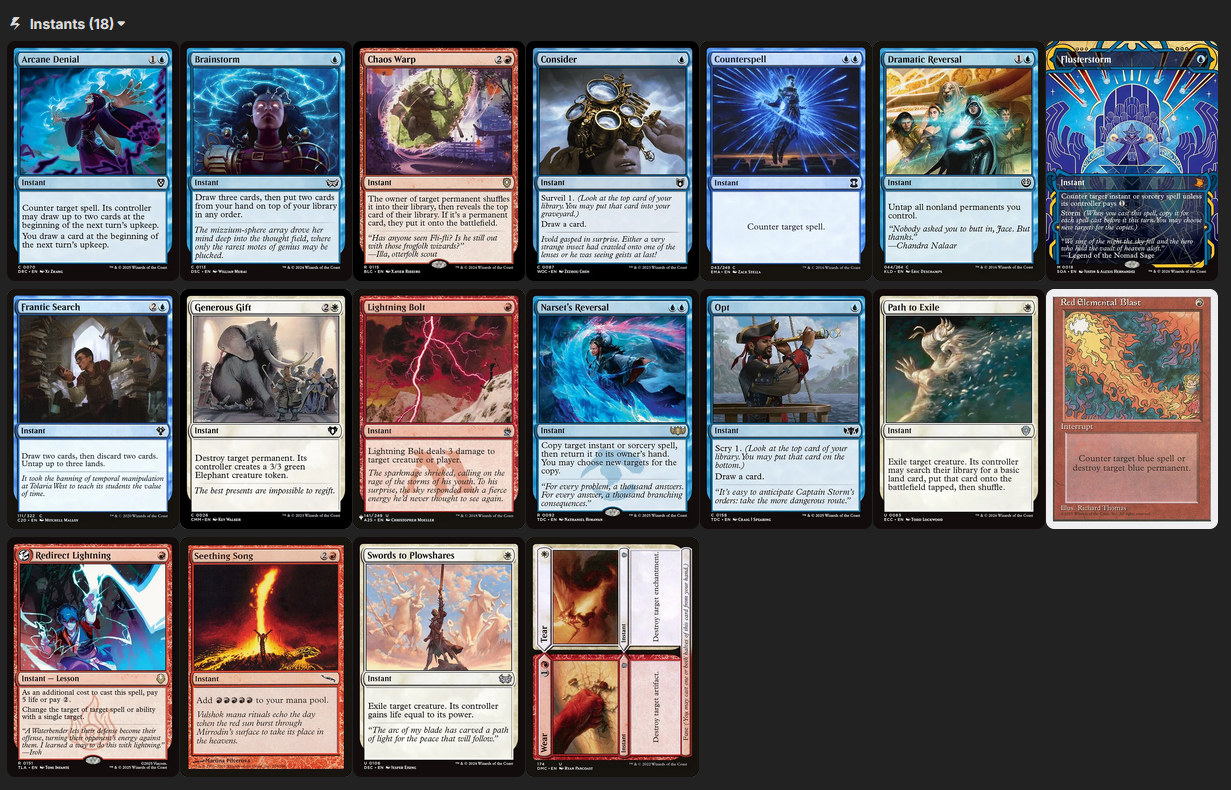
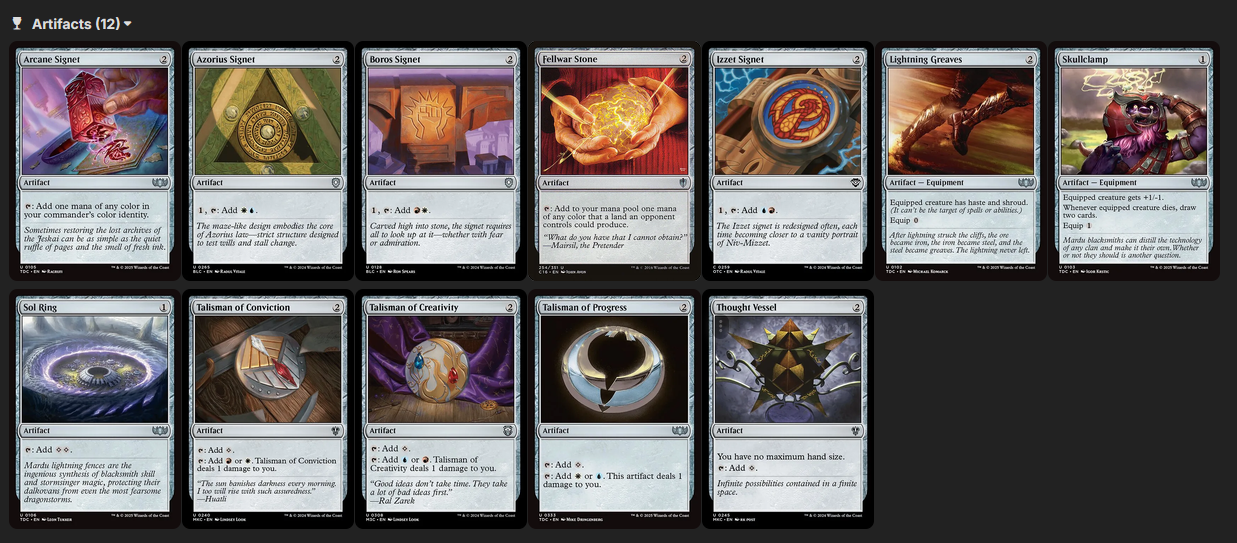
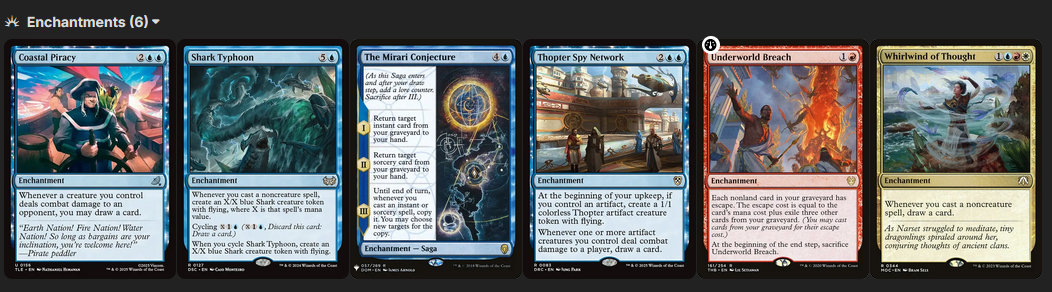
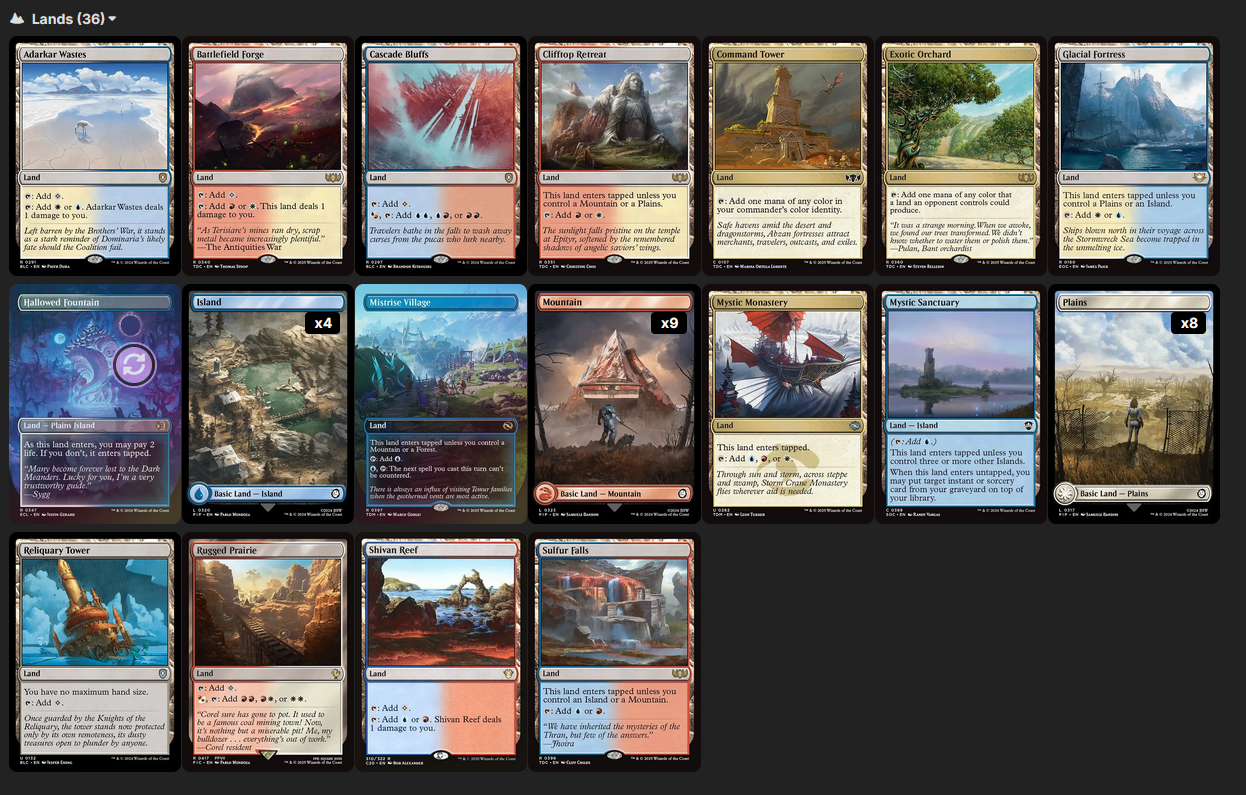
Kykar, Wind’s Fury leads a Jeskai spellslinger deck built to convert a dense suite of noncreature spells into mana, creatures, cards, and escalating value. Rather than relying on a single combo line, the deck layers token generators, cast triggers, cost-efficient interaction, and spell recursion so that ordinary cantrips and removal spells steadily build toward explosive turns.
Kykar sits at the center of that engine, producing evasive Spirits from every noncreature spell and converting those Spirits into red mana when additional resources are needed. The result is a flexible play pattern that can shift between developing a token army, controlling the table, chaining spells for value, or compressing several turns of development into a single decisive sequence.
Deck Overview
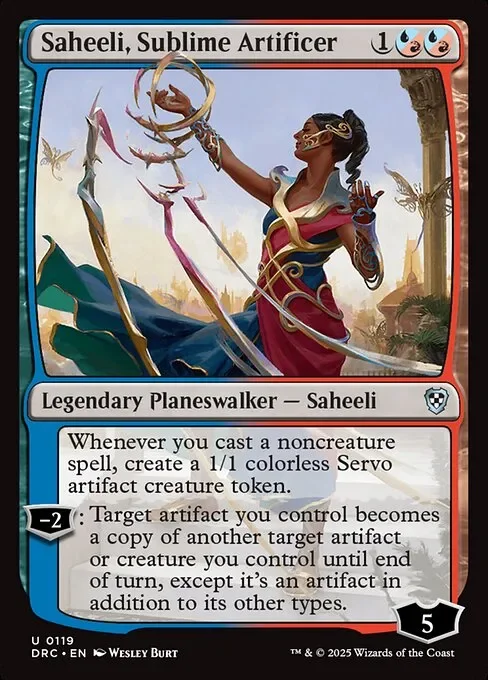
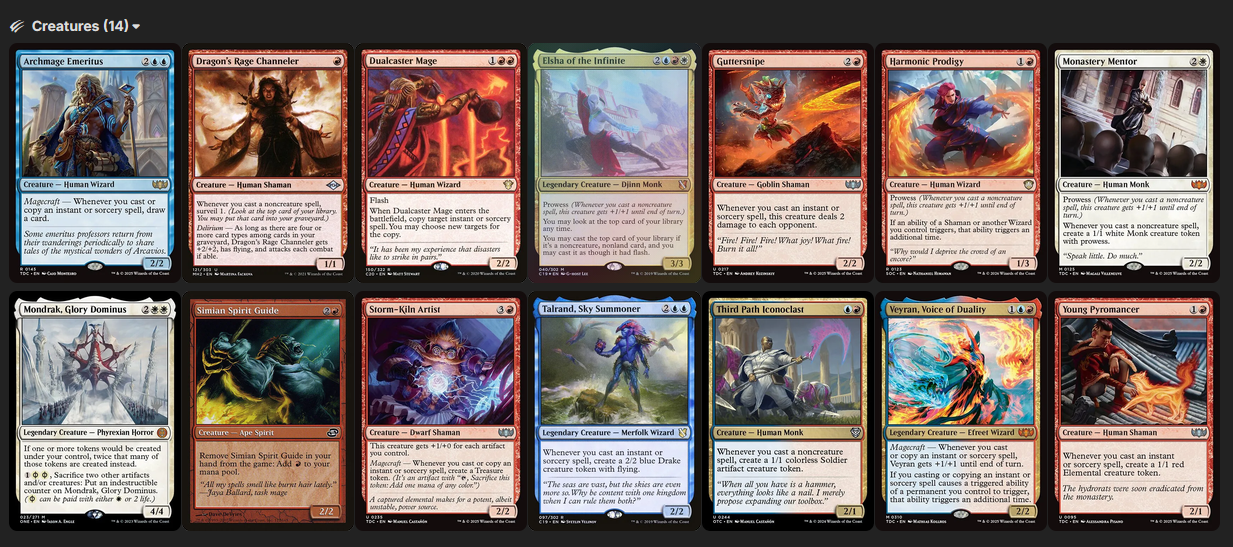
This build combines Jeskai Spellslinger, Token Swarm, and Storm-style value engines. Kykar is supported by an unusually deep group of secondary token producers, including Monastery Mentor, Talrand, Sky Summoner, Young Pyromancer, Third Path Iconoclast, Saheeli, Sublime Artificer, and Shark Typhoon. Each rewards the same core action—casting spells—while producing different forms of board presence.
The deck also emphasizes triggered-ability multiplication. Veyran, Voice of Duality and Harmonic Prodigy increase the output of important cast and Magecraft triggers, while Mondrak, Glory Dominus doubles the creature tokens those engines create. This allows even short spell sequences to generate substantial material without requiring the deck to commit heavily to traditional creature development.
Spell Velocity and Card Advantage
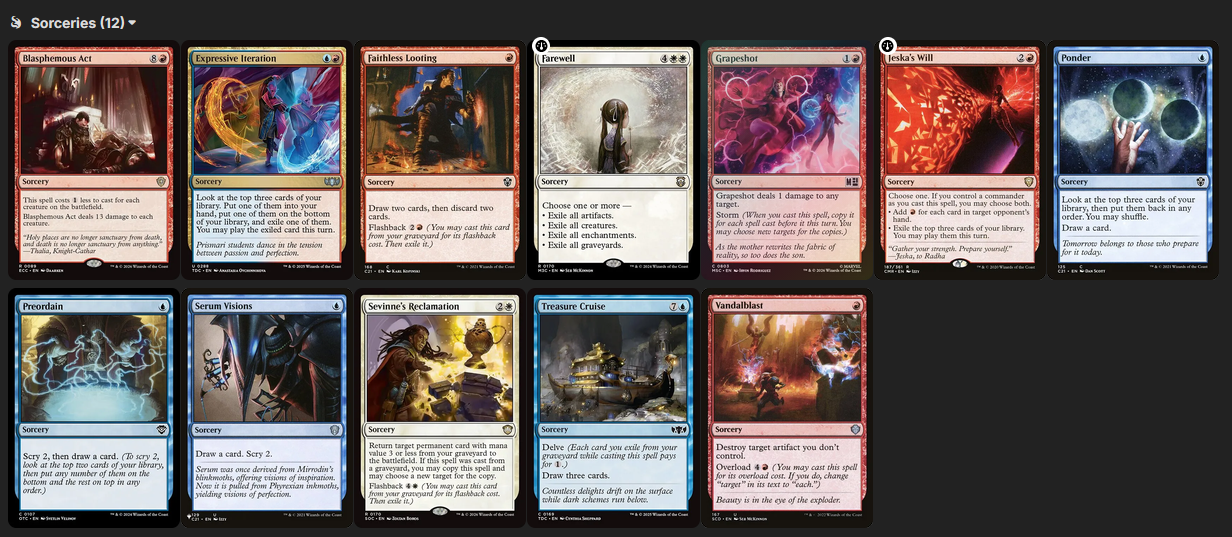
Low-cost selection from Brainstorm, Ponder, Preordain, Opt, Consider, Serum Visions, Faithless Looting, and Expressive Iteration keeps the deck moving while simultaneously triggering Kykar and the supporting spellslinger permanents.
More substantial draw engines reward sustained spellcasting. Archmage Emeritus converts Magecraft triggers into cards, Whirlwind of Thought draws from each noncreature spell, and Elsha of the Infinite allows the top of the library to function as an additional resource. Coastal Piracy provides another avenue for card advantage once the deck's flying Spirits, Drakes, Servos, and other tokens begin connecting in combat.
Skullclamp is particularly efficient with Kykar. Spirits can be converted into cards when appropriate, while Kykar's sacrifice ability provides an alternate way to turn excess creatures into the red mana needed to continue a spell sequence.
Token Production and Trigger Multiplication
The deck is constructed so that a single spell can advance several resources simultaneously. Kykar creates Spirits, Young Pyromancer produces Elementals, Third Path Iconoclast creates Soldiers, Saheeli, Sublime Artificer produces artifact Servos, and Talrand, Sky Summoner develops an evasive Drake force.
Monastery Mentor adds a more aggressive dimension by creating prowess-capable Monks, while Shark Typhoon turns later noncreature spells into increasingly substantial flying threats.
The interaction between these permanents and Veyran, Voice of Duality, Harmonic Prodigy, and Mondrak, Glory Dominus gives the deck significant scaling potential. Instead of treating token generation as a secondary theme, the deck uses it as a central resource system supporting combat, card draw, and Kykar's mana ability.
Mana Development and Explosive Turns
A substantial artifact package supports reliable Jeskai sequencing through Sol Ring, Arcane Signet, Fellwar Stone, Azorius Signet, Boros Signet, Izzet Signet, and all three on-color Talismans.
Once Kykar is established, Spirit tokens provide another layer of mana conversion. Storm-Kiln Artist creates Treasures as spells are cast or copied, while Jeska's Will, Seething Song, Simian Spirit Guide, and Dramatic Reversal provide additional opportunities to generate or reclaim mana during larger turns.
This layered mana structure is important to the deck's identity: token production is not simply a route to combat damage, but part of the infrastructure that allows the deck to continue casting spells after its conventional mana sources would normally be exhausted.
Interaction and Resilience
The control package remains broad without pulling the deck away from its primary plan. Counterspell, Arcane Denial, Flusterstorm, Red Elemental Blast, and Narset's Reversal provide stack interaction, while Swords to Plowshares, Path to Exile, Generous Gift, Chaos Warp, Lightning Bolt, and Wear // Tear address established permanents.
Vandalblast, Blasphemous Act, and Farewell provide scalable answers when individual interaction is insufficient. Because most of the deck's creatures are generated incidentally through spellcasting, rebuilding after a board wipe is often more efficient than it would be for a conventional creature deck.
Recursion adds another layer of resilience. Sevinne's Reclamation restores important low-cost permanents, The Mirari Conjecture recovers spells before eventually copying them, and Underworld Breach allows the graveyard to become a temporary extension of the hand during critical turns.
Closing the Game
The deck can convert its accumulated advantage through several overlapping routes rather than depending on one dedicated finisher.
Large boards of Spirits, Monks, Drakes, Soldiers, Servos, and Sharks can overwhelm opponents through combat, particularly after token production has been multiplied by Mondrak. Guttersnipe turns repeated spellcasting directly into damage, with its triggered ability becoming particularly threatening alongside Veyran or Harmonic Prodigy.
Grapeshot provides a storm-based payoff for turns involving multiple cantrips, rituals, mana-producing permanents, and recursive spell access. Even when it is not immediately lethal, it can remove creatures or substantially reduce opposing life totals before the token army finishes the game.
Build Philosophy
This Kykar build is designed around functional overlap. Cantrips improve card quality while producing tokens; tokens become attackers, cards, or mana; interaction protects the engine while advancing Kykar triggers; and recursion allows the deck to reuse the spells that best fit the current board state.
The mana base combines established Jeskai fixing such as Hallowed Fountain, Shivan Reef, Adarkar Wastes, Battlefield Forge, Cascade Bluffs, Rugged Prairie, and Command Tower with a balanced basic-land foundation. Combined with the extensive artifact acceleration package, the deck is structured for dependable color access and efficient sequencing across all stages of the game.
Every major component reinforces the same central plan: establish one or more spell-payoff permanents, maintain a steady flow of efficient noncreature spells, and compound those actions into enough cards, mana, creatures, and damage to take control of the table.
Technical Details
100-card singleton Commander deck, legal for EDH
All cards in Near Mint to Lightly Played condition
Professionally sleeved and ready to play
Built for consistent performance and strategic depth
Ideal For Players Who:
Enjoy Jeskai spellslinger decks with extensive token generation and layered cast triggers
Prefer flexible Commander builds capable of shifting between control, combat, and storm-style turns
Appreciate cohesive, professionally constructed decks with multiple interconnected value engines
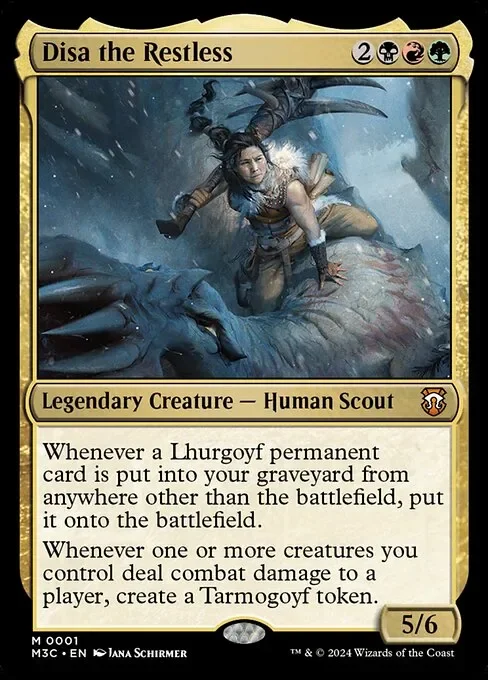
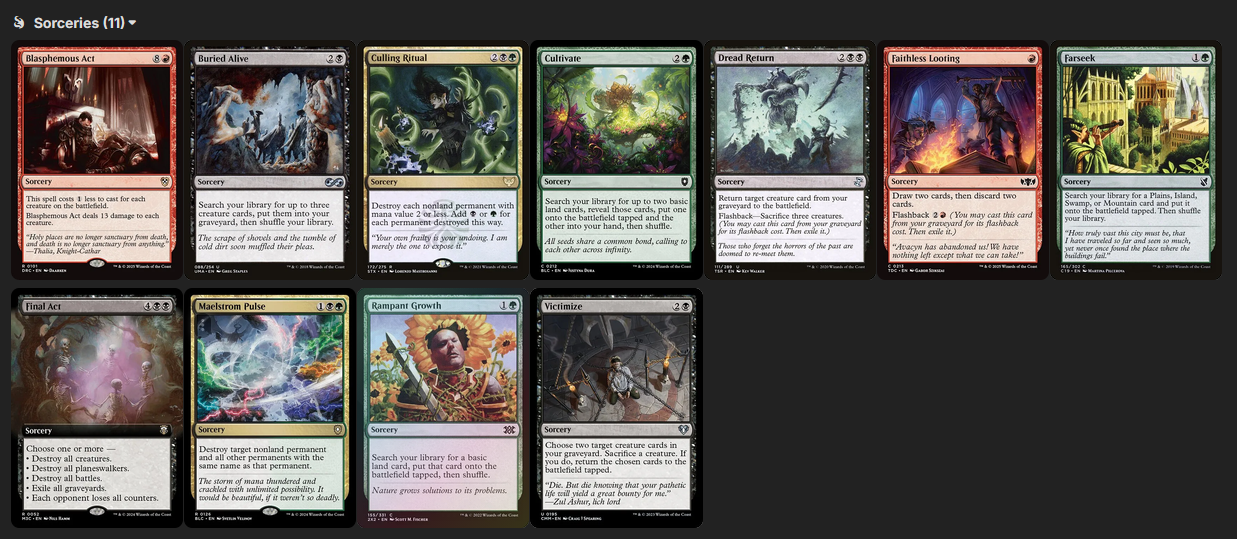
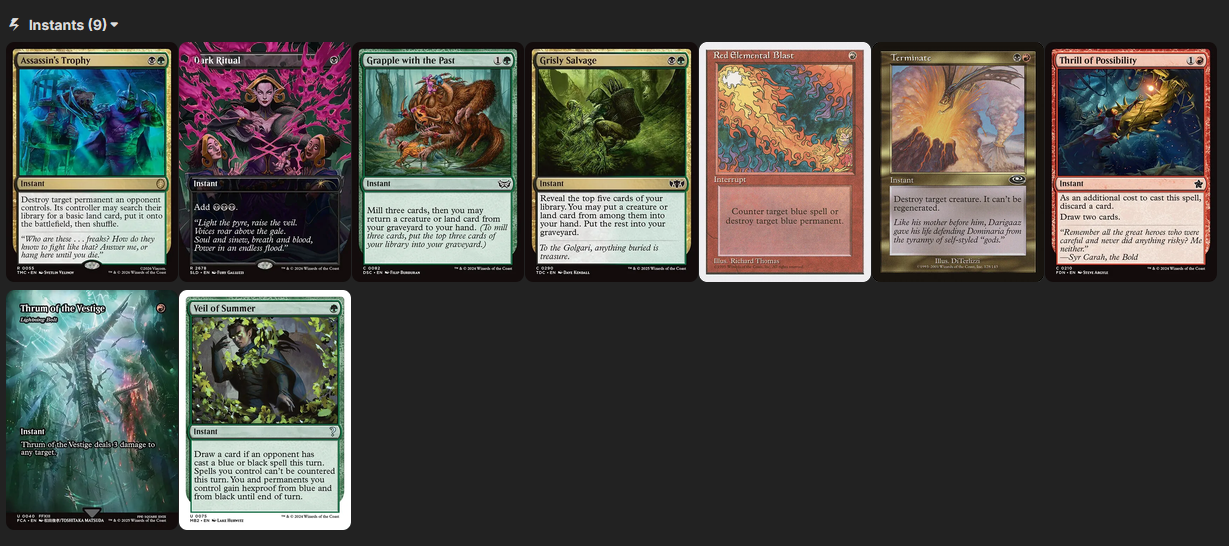
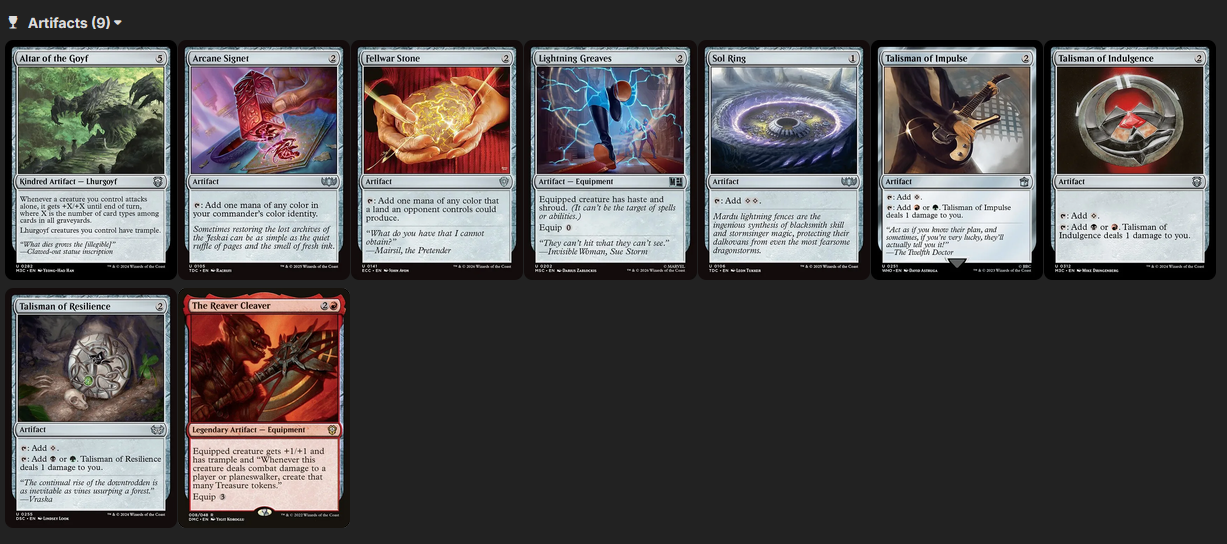
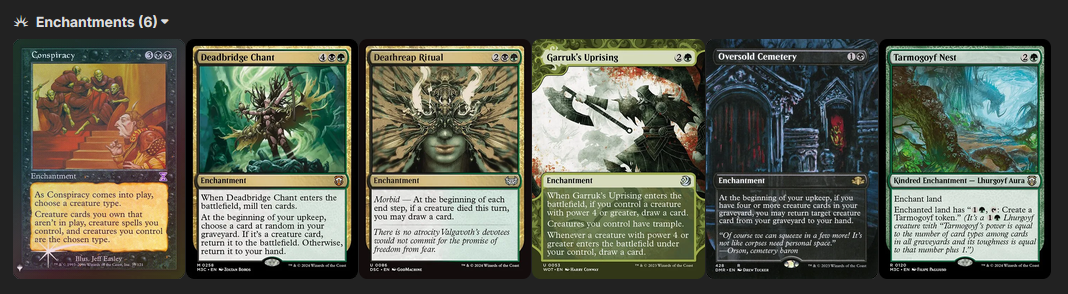
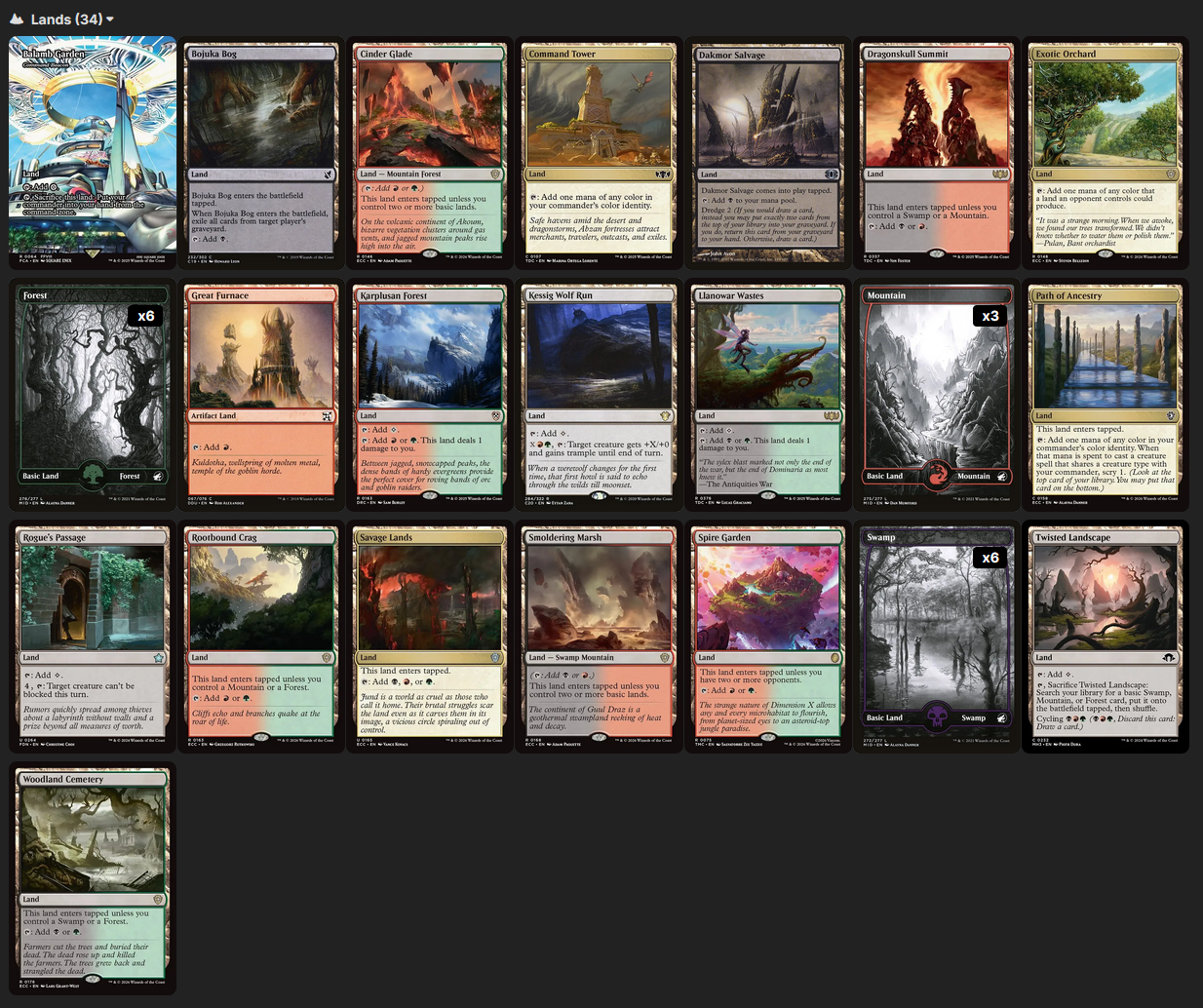
Disa the Restless leads a Jund graveyard deck built around Lhurgoyfs, self-mill, creature recursion, and combat-driven value. The deck deliberately fills graveyards to increase the size of its primary threats while using Disa to convert milled or discarded Lhurgoyfs directly into battlefield presence.
The result is a layered graveyard strategy that can develop through conventional casting, recursive value, or explosive sequences that place multiple creatures directly onto the battlefield. Combat is equally important: every opponent reached in combat can produce another Tarmogoyf token, allowing the deck to turn early graveyard development into a steadily expanding board.
Deck Overview
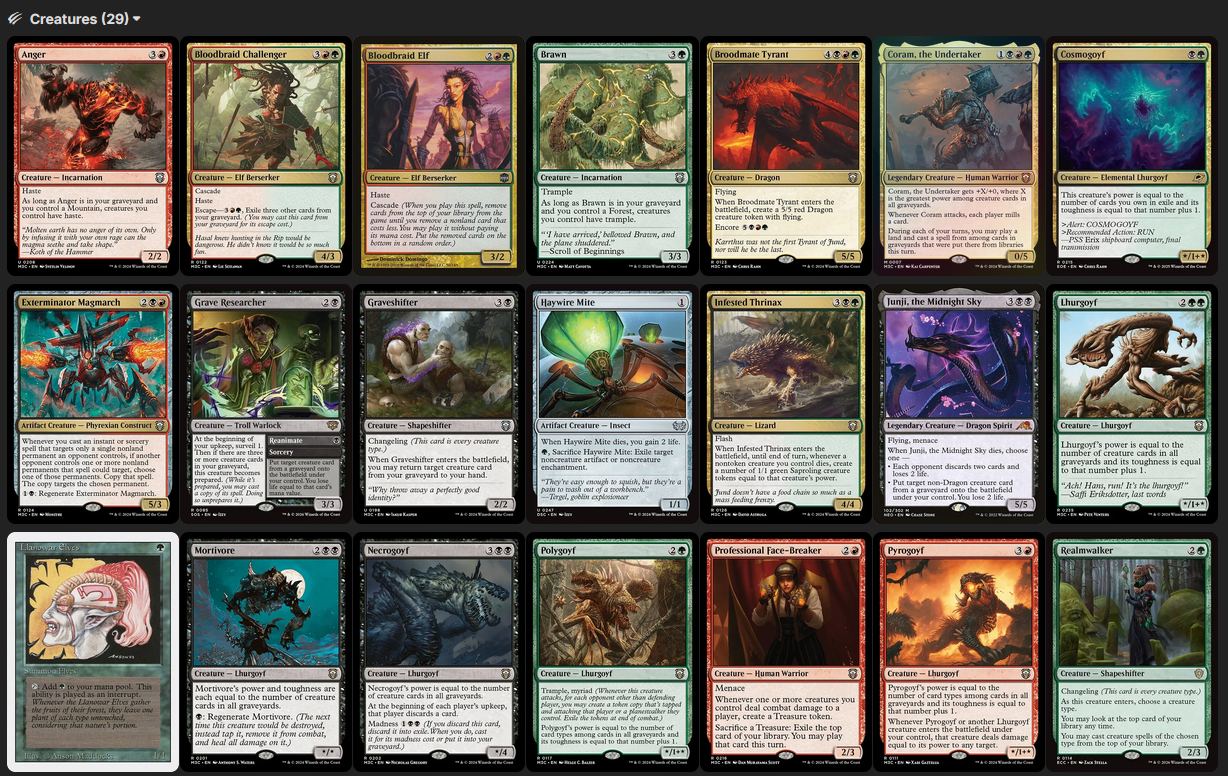
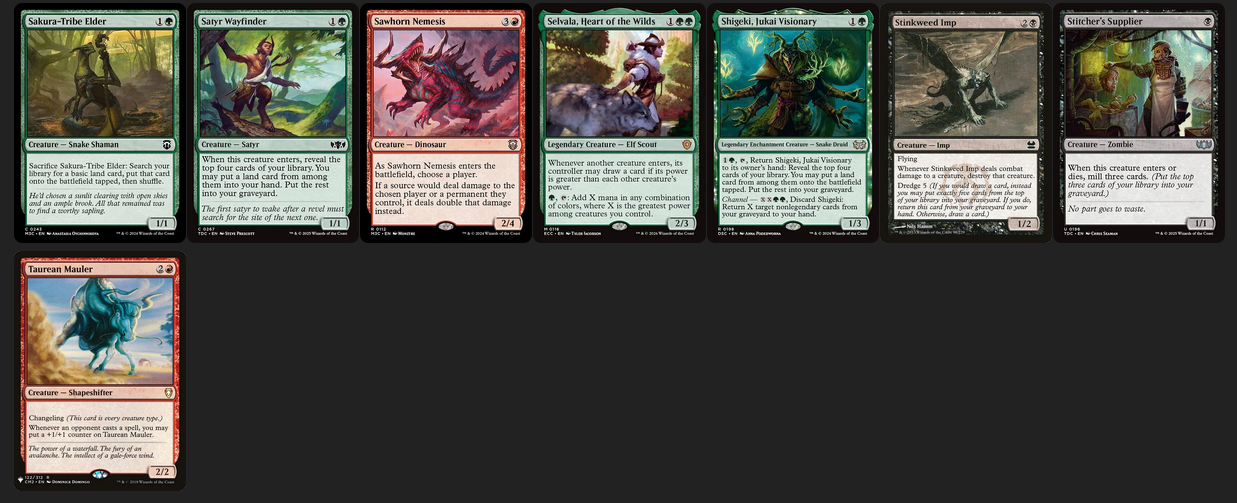
This build combines Lhurgoyf typal synergy, graveyard value, self-mill, and Jund midrange interaction. Cards such as Lhurgoyf, Mortivore, Necrogoyf, Cosmogoyf, Polygoyf, and Pyrogoyf reward the deck for stocking graveyards, while Stitcher's Supplier, Satyr Wayfinder, Grisly Salvage, Buried Alive, Faithless Looting, and Stinkweed Imp provide efficient ways to establish that resource.
Conspiracy is one of the deck's most significant synergy pieces. Naming Lhurgoyf causes creature cards outside the battlefield to carry the relevant creature type, allowing Disa to turn future milling and discard effects into a much broader deployment engine. This interaction is supported by a separate recursion package for creatures that actually die from the battlefield, where Disa's first ability does not apply.
Key Strategic Elements
Graveyard Setup and Lhurgoyf Engines
The deck actively develops its graveyard rather than waiting for normal game actions to fill it. Stitcher's Supplier, Satyr Wayfinder, Grisly Salvage, Grapple with the Past, Faithless Looting, Thrill of Possibility, Shigeki, Jukai Visionary, and Stinkweed Imp create a steady flow of cards into the graveyard while maintaining card selection or additional utility.
That setup directly improves threats such as Lhurgoyf, Mortivore, Necrogoyf, Cosmogoyf, and Pyrogoyf, allowing the deck's creatures to scale naturally as the game progresses.
Disa, Conspiracy, and Typal Synergy
Disa immediately returns a Lhurgoyf permanent card that reaches the graveyard from somewhere other than the battlefield. Natural Lhurgoyfs and changelings such as Graveshifter and Realmwalker therefore interact especially well with the deck's milling and discard effects.
Conspiracy expands that interaction substantially by naming Lhurgoyf and applying the type to the deck's creature cards outside the battlefield. Once established, effects such as Buried Alive and the deck's self-mill package can function as direct deployment tools rather than simply graveyard setup.
Combat Pressure and Token Production
Disa's second ability rewards connecting with opponents by creating Tarmogoyf tokens, giving the deck a repeatable way to translate combat into additional threats. Polygoyf is particularly well suited to this plan because myriad can pressure multiple opponents during the same combat.
Anger and Brawn reward being placed into the graveyard by granting haste and trample respectively, while Garruk's Uprising, Kessig Wolf Run, and Rogue's Passage help large creatures convert their size into meaningful combat damage. Professional Face-Breaker and The Reaver Cleaver further reward successful attacks by producing Treasure and extending the deck's ability to develop after combat.
Recursion, Control, and Resilience
Because Disa does not trigger when a Lhurgoyf dies from the battlefield, the deck includes independent recursion through Dread Return, Victimize, Oversold Cemetery, Deadbridge Chant, Graveshifter, and Shigeki, Jukai Visionary. This allows important creatures to remain relevant after removal and gives the deck additional ways to rebuild.
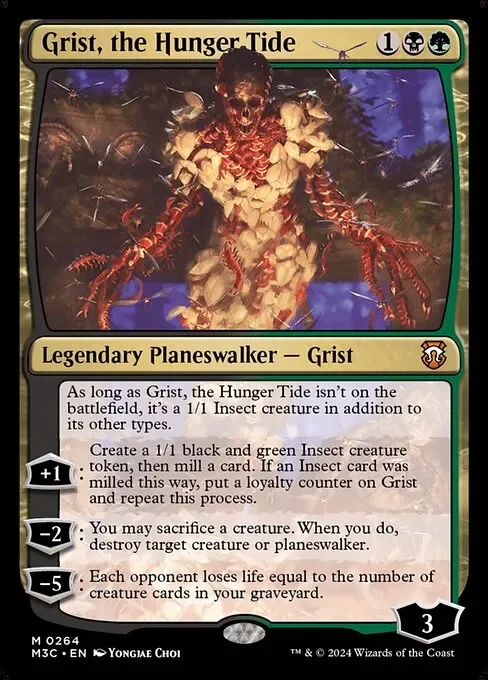
Interaction is spread across several permanent types. Assassin's Trophy, Terminate, Maelstrom Pulse, Haywire Mite, Blasphemous Act, Culling Ritual, and Final Act address opposing boards, while Red Elemental Blast and Veil of Summer provide efficient protection or disruption in common Commander exchanges. Grist, the Hunger Tide reinforces the graveyard plan while providing repeatable creature production and removal.
Closing the Game
The deck is designed to win through accumulated graveyard advantage rather than depending on a single line. Large Tarmogoyf tokens, Mortivore, Necrogoyf, Lhurgoyf, Cosmogoyf, and Polygoyf create substantial combat pressure as graveyards grow.
Pyrogoyf converts additional Lhurgoyf entries into direct damage, while Grist, the Hunger Tide can turn a heavily stocked creature graveyard into life loss across the entire table. Trample from Brawn, Garruk's Uprising, Altar of the Goyf, and Kessig Wolf Run ensures that increasing creature size remains relevant even against developed boards.
Build Philosophy
This Disa build is structured so that graveyard development, creature scaling, and combat progression reinforce one another. Self-mill is not included solely as setup: it can generate immediate Disa triggers, improve Lhurgoyf statistics, enable recursion, and place utility cards such as Anger and Brawn where their abilities become active.
The mana base combines efficient fixing, land-based utility, and artifact acceleration through Sol Ring, Arcane Signet, Fellwar Stone, the three Jund Talismans, Cultivate, Farseek, Rampant Growth, Sakura-Tribe Elder, and Llanowar Elves. The overall construction maintains a balance between proactive graveyard development, interaction, recovery, and methods of converting an established board into a finish.
Technical Details
100-card singleton Commander deck, legal for EDH
All cards in Near Mint to Lightly Played condition
Professionally sleeved and ready to play
Built for consistent performance and strategic depth
Ideal For Players Who:
Enjoy Jund graveyard decks built around self-mill, recursion, and scalable creatures
Prefer typal strategies with interactions extending beyond conventional tribal support
Appreciate Commander decks that combine graveyard engines with midrange combat and flexible interaction
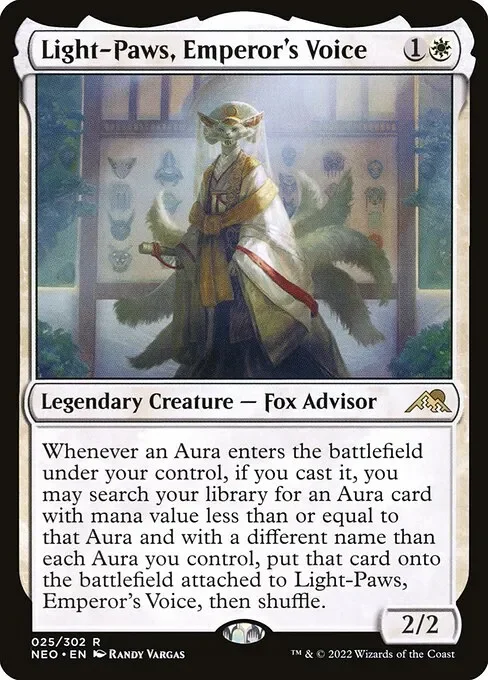
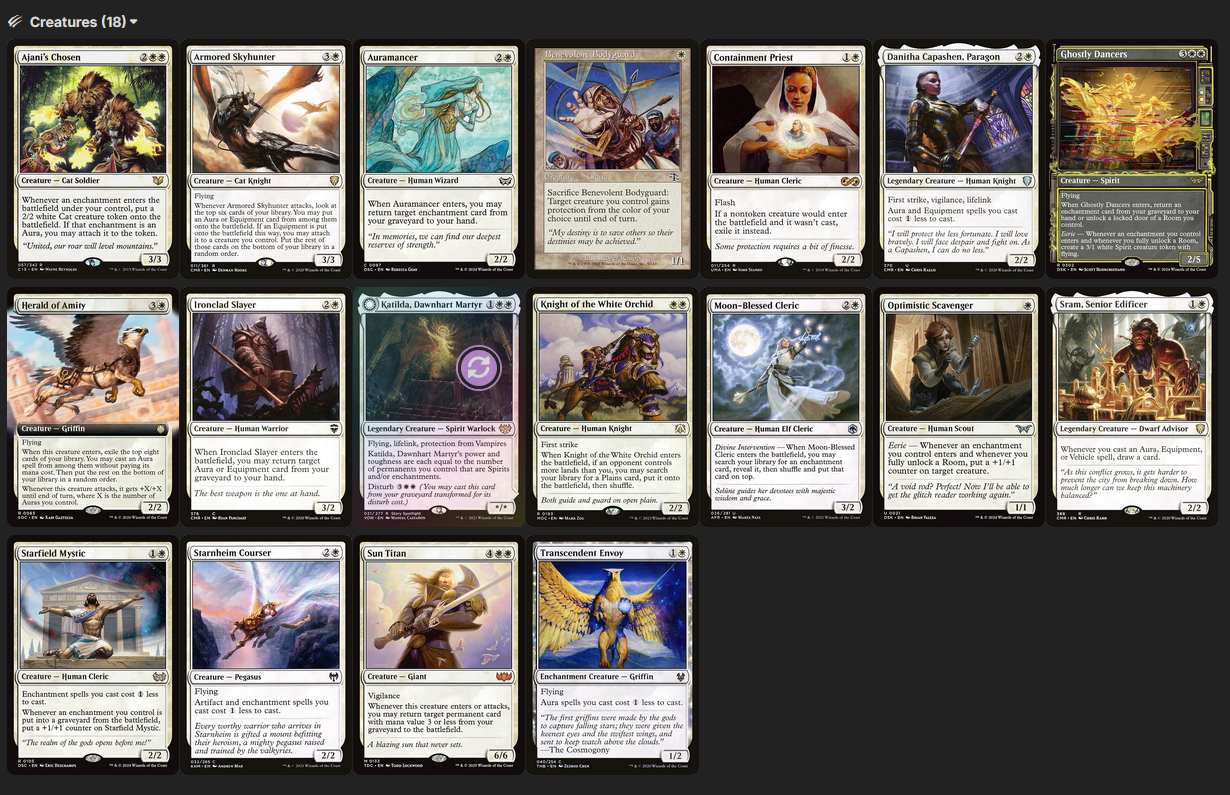
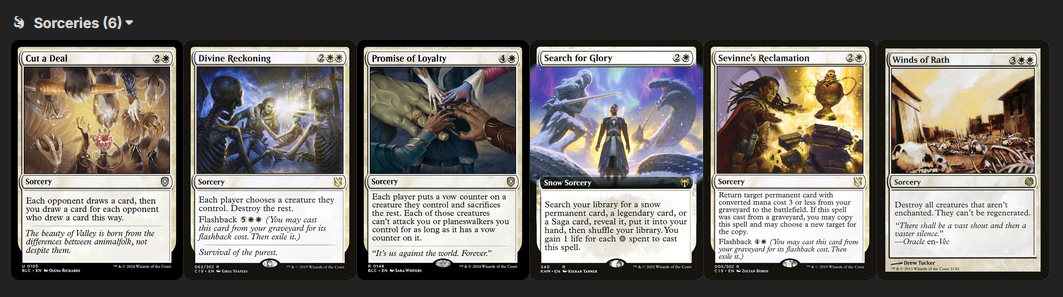
Light-Paws, Emperor’s Voice leads a focused mono-white Aura strategy built around efficient tutoring, layered protection, and commander-damage pressure. Each Aura cast can turn into a second Aura directly from the library, allowing the deck to assemble the exact combination of power, evasion, protection, or utility needed for the current board.
The deck is constructed as an Aura Voltron shell with a substantial enchantment-value package behind it. Rather than relying entirely on a single large attacker, cards such as Sram, Senior Edificer, Optimistic Scavenger, Ajani’s Chosen, Ghostly Dancers, and Katilda, Dawnhart Martyr ensure that repeated enchantment development continues generating value across the battlefield.
Deck Overview
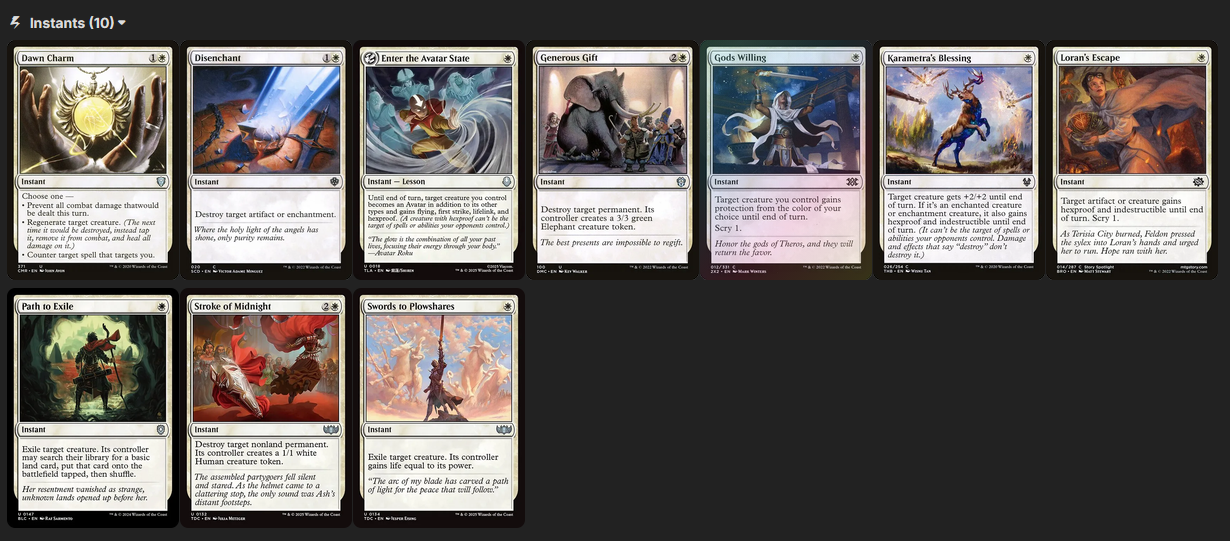
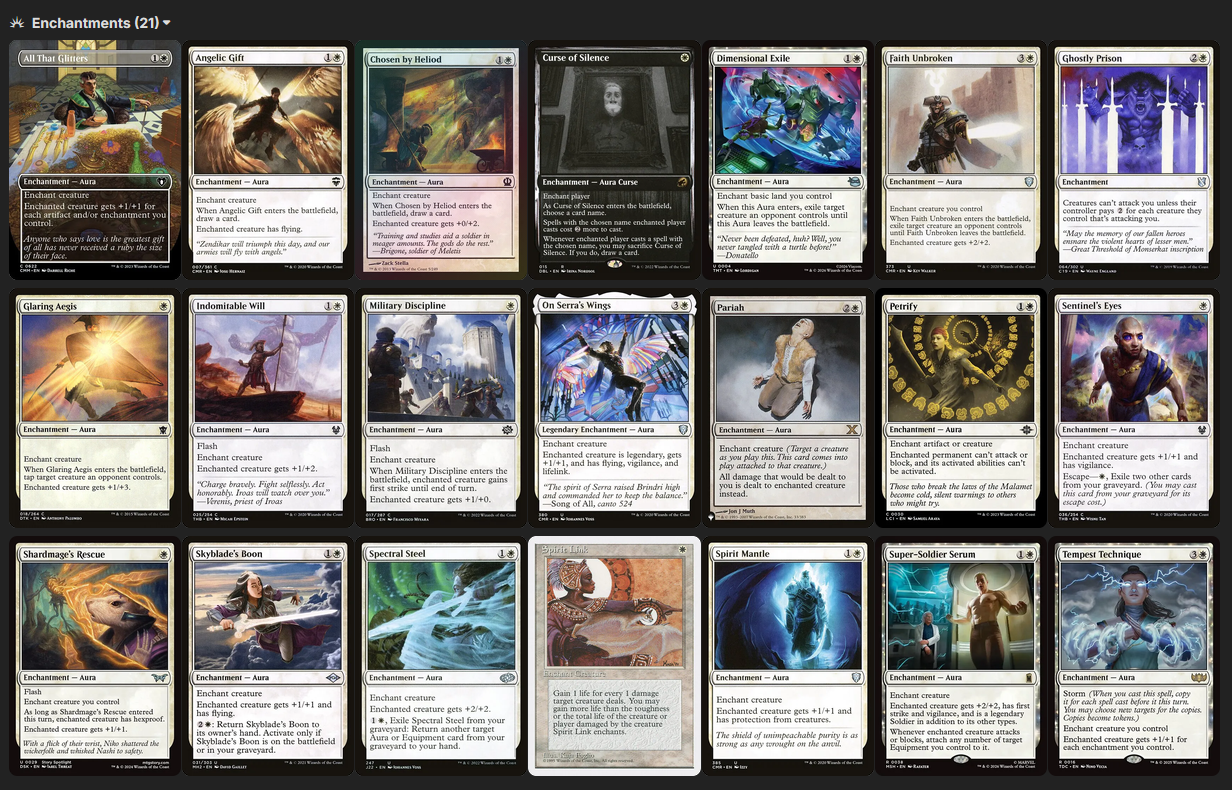
Light-Paws converts every properly sequenced Aura into a toolbox effect. Low-cost Auras such as Angelic Gift, Chosen by Heliod, Glaring Aegis, Military Discipline, Sentinel’s Eyes, and Shardmage’s Rescue establish early momentum while opening access to additional effects from the library.
The deck can then transition into more substantial enhancements such as All That Glitters, On Serra’s Wings, Spirit Mantle, Faith Unbroken, and Super-Soldier Serum. This creates a commander that can scale quickly while gaining the evasion and resilience necessary to convert that investment into commander damage.
Importantly, the Aura package is not limited to enhancement effects. Petrify, Dimensional Exile, and Faith Unbroken provide interaction while still advancing the commander’s Aura engine, allowing removal spells to contribute directly to the deck’s central strategy.
Aura Tutoring and Enchantment Value
Light-Paws, Emperor’s Voice is the primary engine, turning each cast Aura into another appropriately costed Aura attached directly to the commander. Careful sequencing allows individual Aura casts to build toward specific combinations rather than simply accumulating interchangeable stat bonuses.
Sram, Senior Edificer adds card draw to repeated Aura casting, while Starfield Mystic, Transcendent Envoy, Danitha Capashen, Paragon, and Starnheim Courser reduce the mana required to develop the enchantment package.
Armored Skyhunter provides another route for placing Auras directly onto the battlefield, and Moon-Blessed Cleric supplies additional enchantment selection when a particular effect is required.
Protection, Evasion, and Combat Pressure
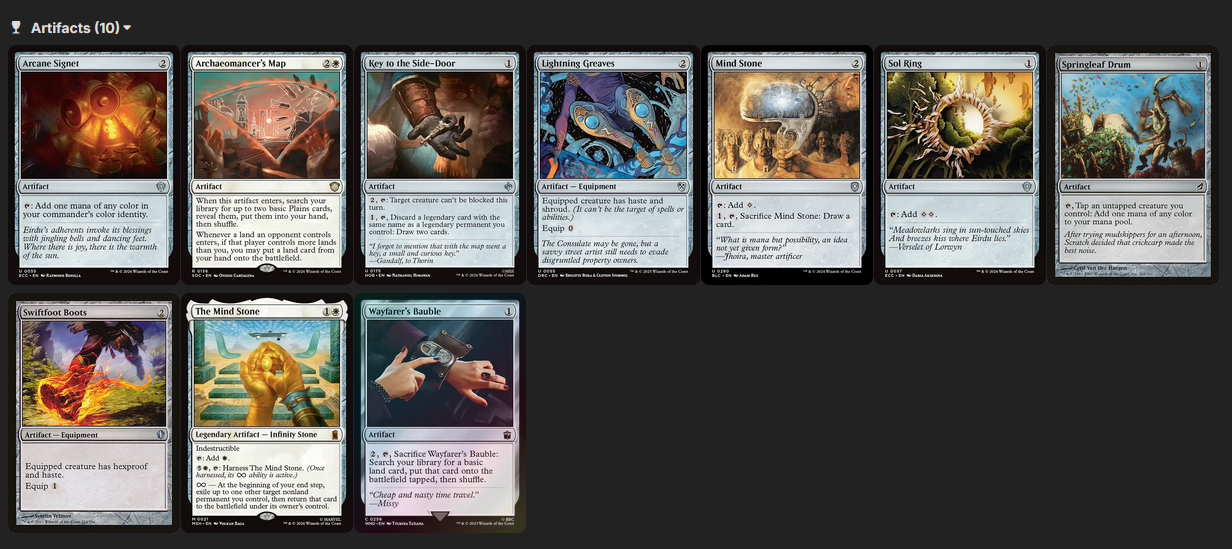
Because Light-Paws naturally becomes the center of the battlefield, the deck includes several overlapping methods of protecting that investment. Gods Willing, Karametra’s Blessing, Loran’s Escape, Benevolent Bodyguard, Swiftfoot Boots, Lightning Greaves, and Shardmage’s Rescue help preserve the commander through targeted interaction.
Evasion is incorporated directly into the Aura package. Angelic Gift, Skyblade’s Boon, On Serra’s Wings, and Spirit Mantle make blocking increasingly difficult, while All That Glitters provides substantial scaling as artifacts and enchantments accumulate.
Spirit Link and On Serra’s Wings add life-gain utility to aggressive combat lines, giving the deck additional stability while continuing to pressure opponents through commander damage.
Board Control and Resilience
The removal suite is designed to coexist with an Aura-heavy battlefield. Swords to Plowshares, Path to Exile, Generous Gift, Stroke of Midnight, Disenchant, and Petrify provide efficient answers to a broad range of threats.
The sweepers are particularly well matched to the deck’s structure. Winds of Rath can preserve enchanted creatures while clearing unenchanted boards, while Divine Reckoning and Promise of Loyalty allow Light-Paws or another developed threat to survive effects that dramatically reduce opposing board presence.
Ghostly Prison, Curse of Silence, Containment Priest, and Ghostly Dancers provide additional disruption, slowing combat or interfering with opposing development without requiring the deck to abandon its proactive Aura plan.
Recursion and Staying Power
The deck includes multiple ways to recover important pieces after removal. Auramancer and Ironclad Slayer return enchantments and Auras to hand, while Sevinne’s Reclamation and Sun Titan recover a wide range of low-cost permanents.
Several Auras also provide their own form of graveyard utility. Sentinel’s Eyes, Skyblade’s Boon, and Spectral Steel can continue contributing after reaching the graveyard, helping the deck rebuild rather than exhausting its resources after an answered Voltron threat.
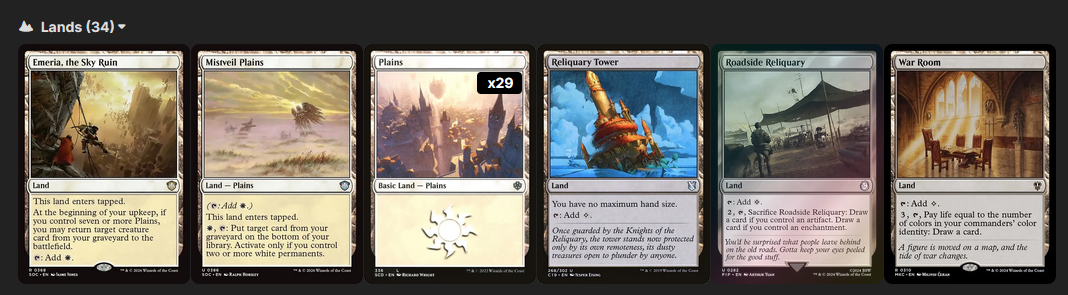
Emeria, the Sky Ruin adds a further late-game recursion engine in a mana base heavily concentrated around Plains.
Mana Development and Card Access
The mana package combines Sol Ring, Arcane Signet, Mind Stone, The Mind Stone, Springleaf Drum, and Wayfarer’s Bauble with white’s land-parity tools. Archaeomancer’s Map and Knight of the White Orchid help maintain land development against faster opponents.
War Room and Roadside Reliquary provide card access from the mana base, complementing Sram, Aura cantrips such as Angelic Gift and Chosen by Heliod, and multiplayer draw from Cut a Deal.
Closing the Game
The primary finishing plan is commander damage. Light-Paws can rapidly accumulate power while simultaneously finding flying, protection from creatures, vigilance, lifelink, or other combat abilities suited to the current board.
The deck also develops secondary threats through Optimistic Scavenger, Ajani’s Chosen, Ghostly Dancers, Herald of Amity, and Katilda, Dawnhart Martyr, ensuring that the enchantment engine can still create meaningful pressure when opponents devote substantial interaction to the commander.
Build Philosophy
This build is centered on making Light-Paws function as a true Aura toolbox rather than simply assembling the largest possible stack of enhancements. Aura mana values, protection effects, removal pieces, recursion, and cost reduction are distributed deliberately so that individual casts create useful follow-up options throughout the game.
The mono-white mana base supports consistent early sequencing while Archaeomancer’s Map, Knight of the White Orchid, artifact acceleration, and utility lands provide additional stability. Interaction and board wipes were selected to complement an enchanted commander, giving the deck a cohesive path from early development through a protected commander-damage finish.
Technical Details
100-card singleton Commander deck, legal for EDH
All cards in Near Mint to Lightly Played condition
Professionally sleeved and ready to play
Built for consistent performance and strategic depth
Ideal For Players Who:
Enjoy Aura-based Voltron strategies with extensive tutoring and sequencing decisions
Prefer proactive Commander decks backed by protection, recursion, and efficient interaction
Appreciate mono-white builds that combine commander damage with a broader enchantment-value engine
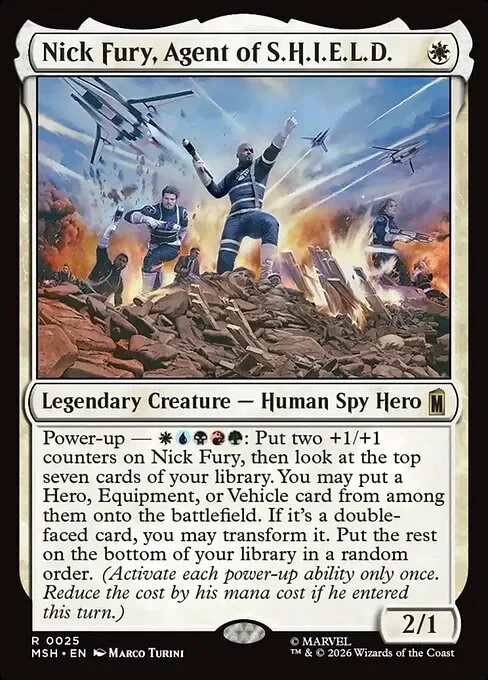
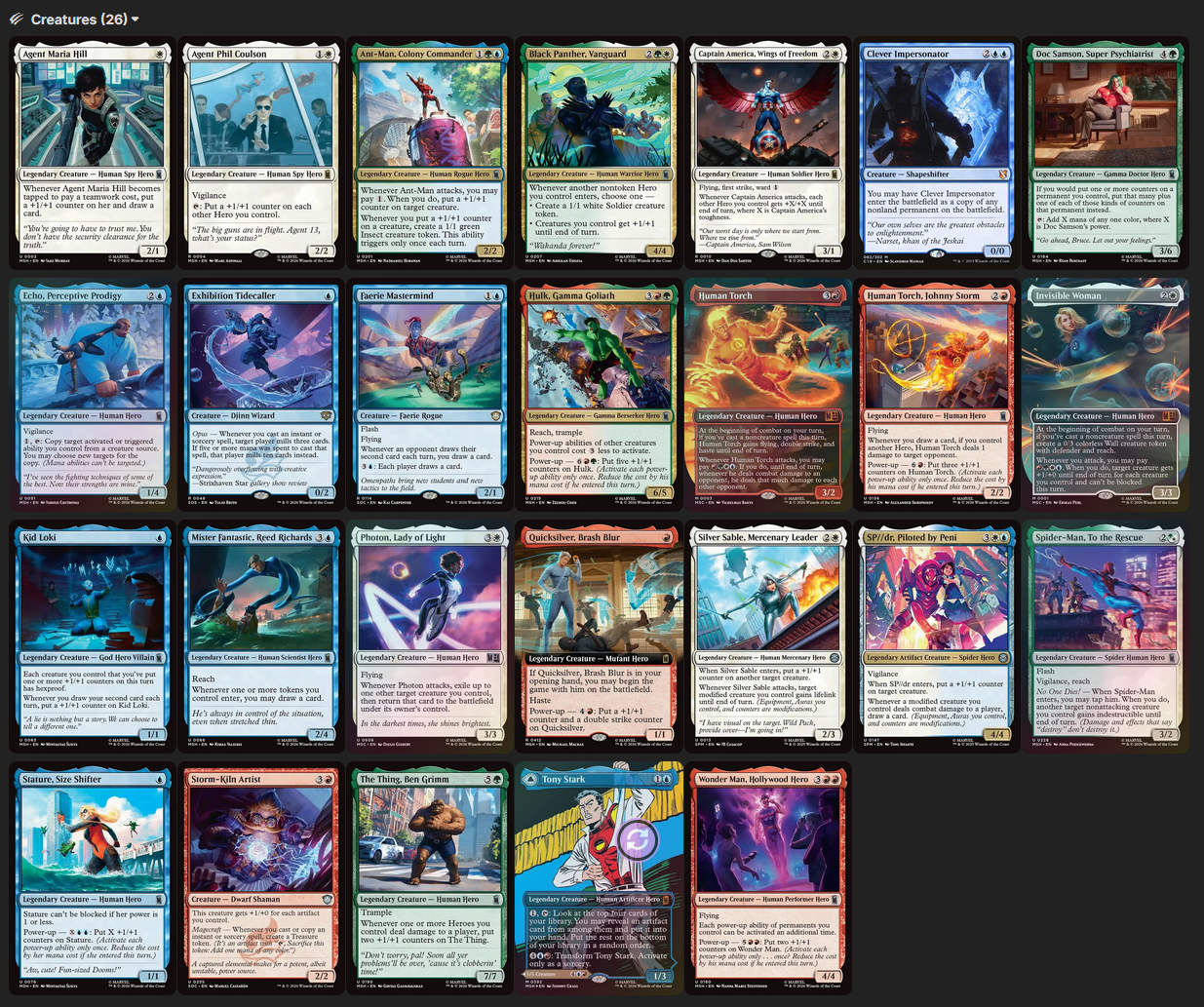
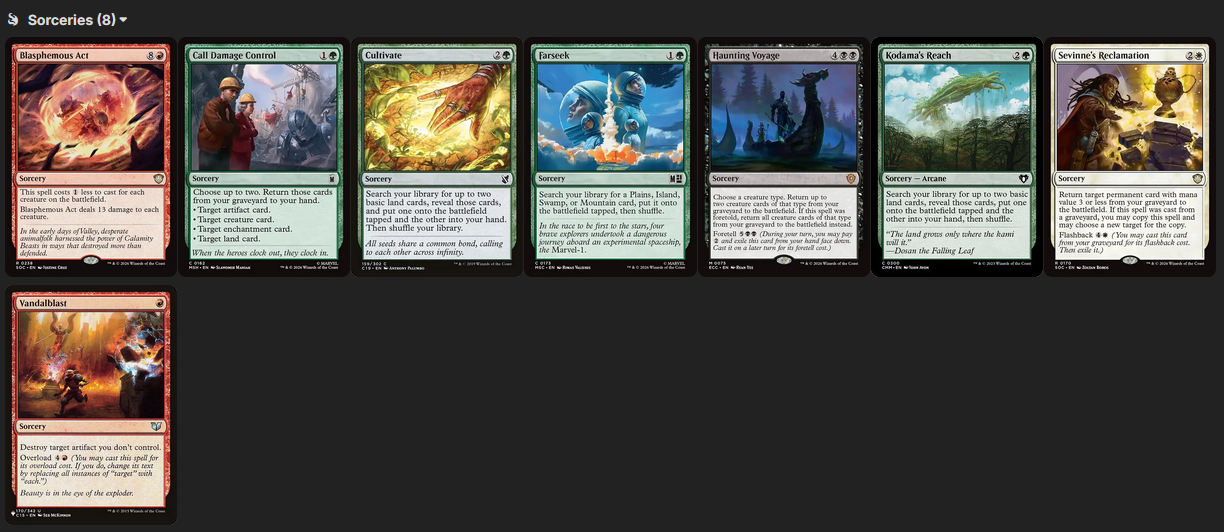
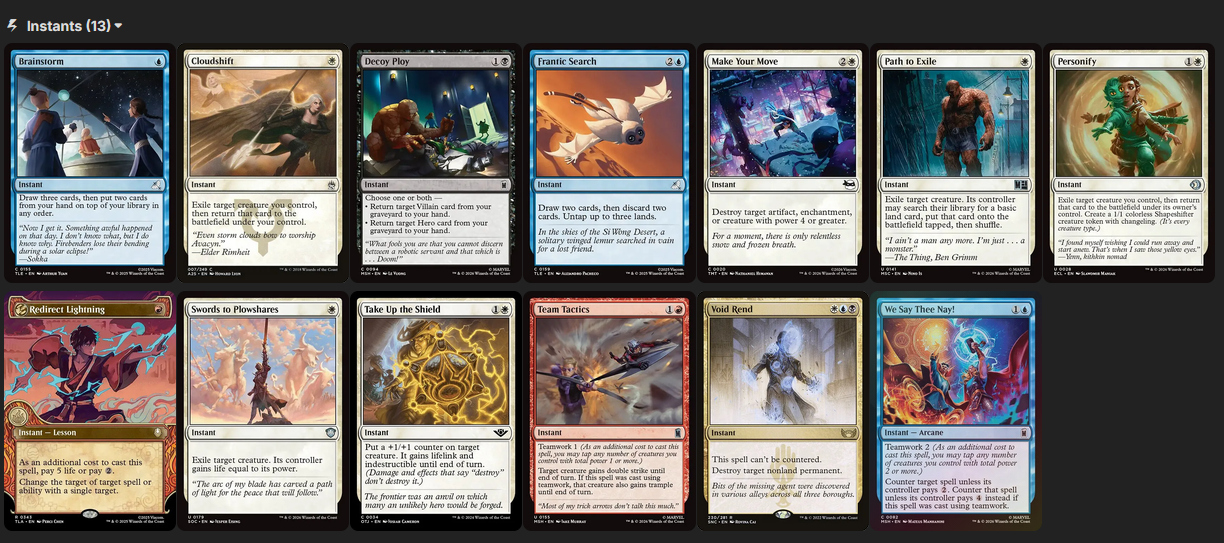
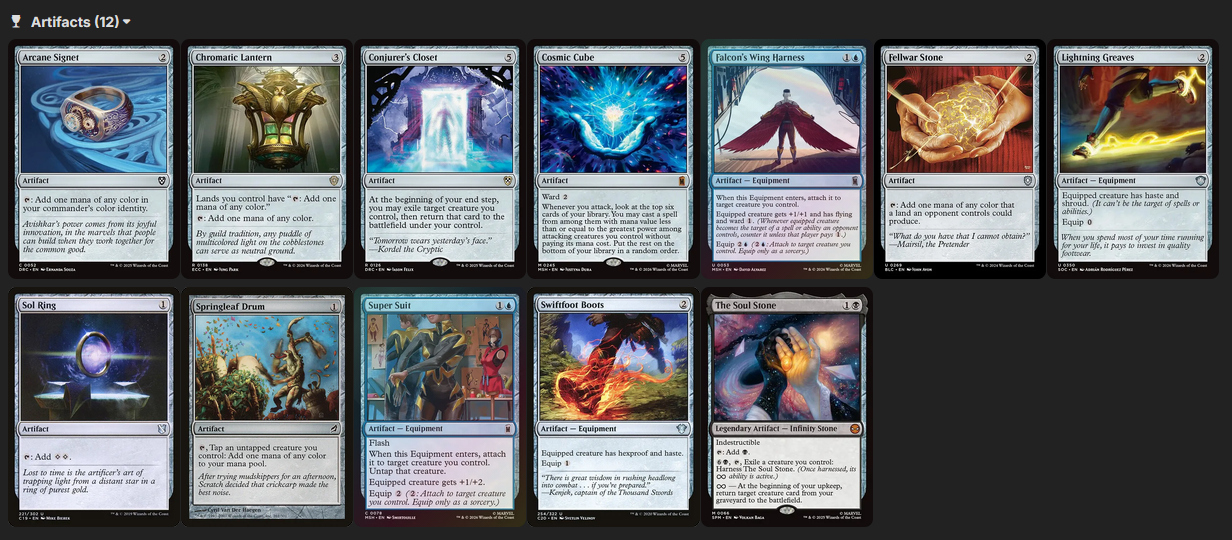
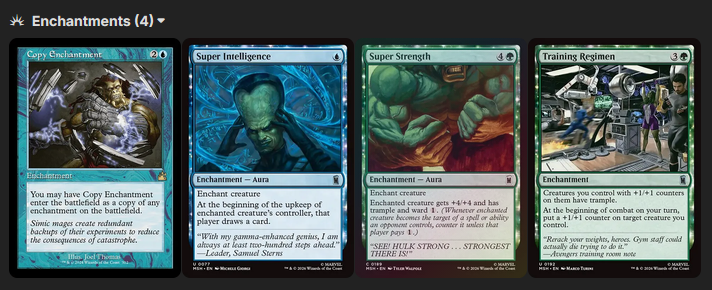
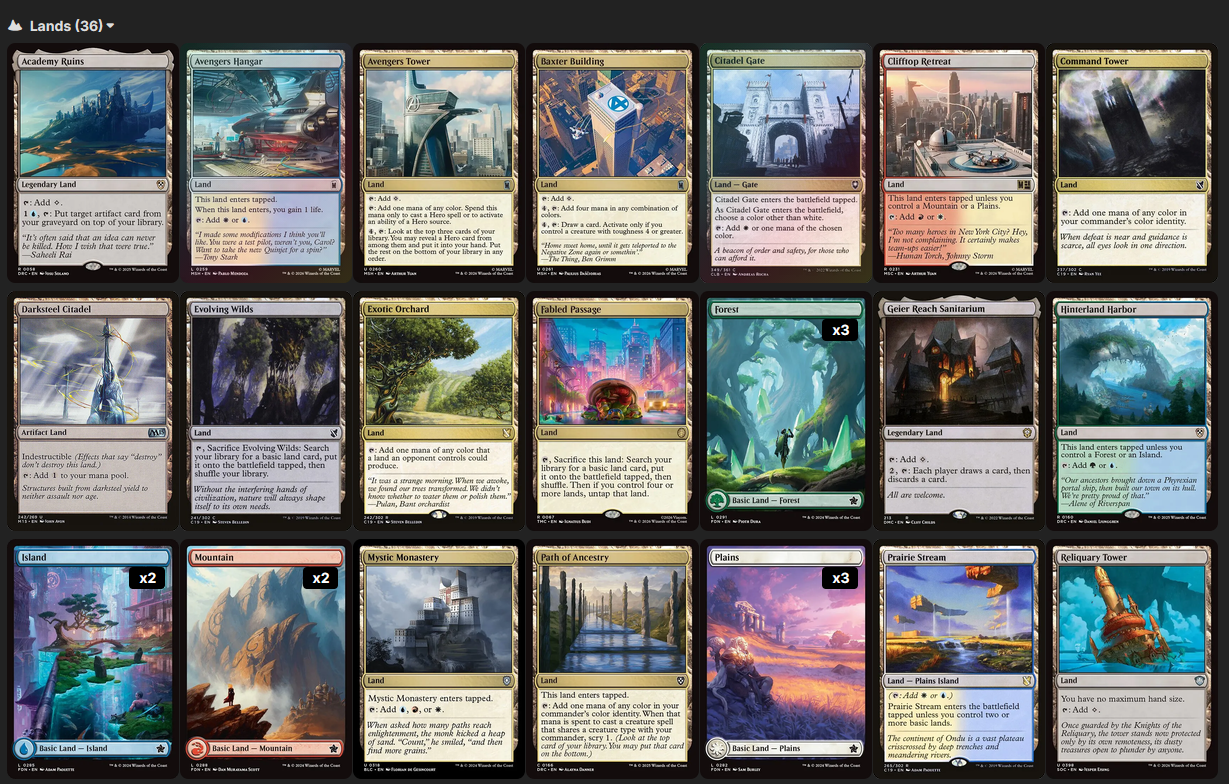
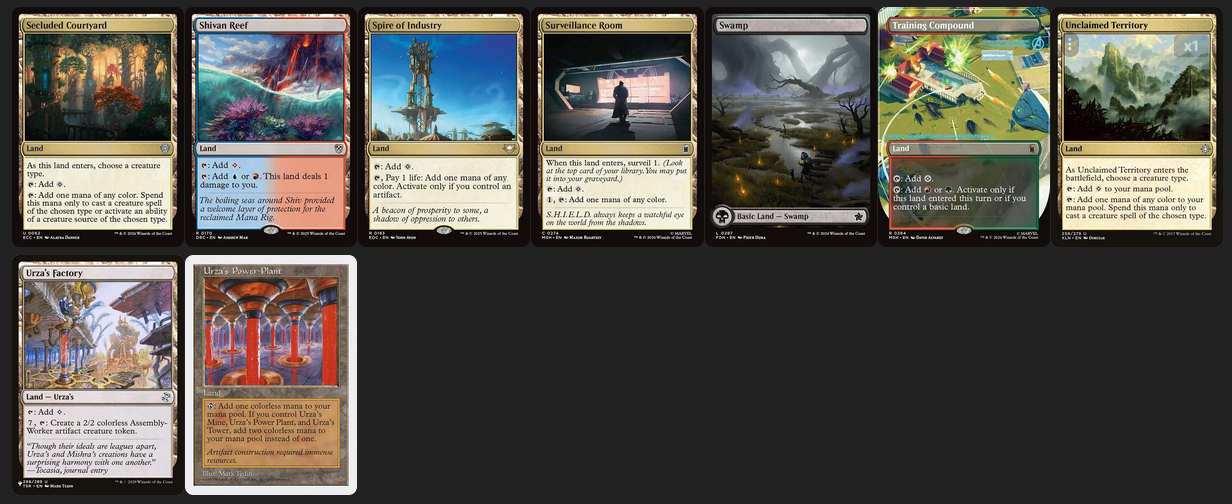
Nick Fury, Agent of S.H.I.E.L.D. leads a five-color Hero deck built around Power-up abilities, +1/+1 counter scaling, and repeated deployment of Marvel characters directly from the library. Fury functions as both a growing battlefield threat and a card-selection engine, using his Power-up ability to examine the top seven cards and place a Hero, Equipment, or Vehicle directly onto the battlefield.
The deck combines a dense Hero package with blink effects, counter synergies, and carefully distributed interaction. Rather than relying on a single linear sequence, it develops through layered value engines that reward repeatedly deploying, modifying, and reusing its creatures.
Deck Overview
At its core, this is a five-color Hero typal and Power-up midrange deck. Nick Fury provides the primary engine, converting a Power-up activation into both permanent growth and a substantial look at the library. The high concentration of Heroes makes those activations consistent, while cards such as Tony Stark, Hulk, Gamma Goliath, Wonder Man, Hollywood Hero, Black Panther, Vanguard, and Captain America, Wings of Freedom give Fury meaningful battlefield hits at multiple points on the curve.
The supporting package is designed around the mechanics established by the Marvel cards themselves. +1/+1 counters turn creatures into increasingly relevant combat threats, Power-up abilities create additional progression after deployment, and blink effects allow important Heroes to re-enter as new objects, refreshing enter-the-battlefield abilities and giving Power-up creatures new opportunities to develop.
Key Strategic Elements
Hero Deployment and Power-Up Engine
Nick Fury is the central source of card advantage and board development. His Power-up ability places two +1/+1 counters on him before looking seven cards deep for a Hero, Equipment, or Vehicle, allowing the deck to convert mana directly into battlefield presence rather than simply drawing additional cards.
Wonder Man, Hollywood Hero allows Power-up abilities to be activated an additional time, substantially increasing the ceiling of Fury and the deck's other Power-up creatures. Echo, Perceptive Prodigy can copy an activated ability from a creature, providing another way to duplicate a productive Fury activation without requiring a second activation of the ability itself.
Hulk, Gamma Goliath supports the broader Power-up package by reducing the generic activation costs of other creatures, while his own Power-up ability can rapidly convert him into a large trampling threat. Creatures put into play by Fury are particularly well positioned to make use of the Power-up mechanic's mana-cost reduction for permanents that entered that turn.
+1/+1 Counters and Modified Creatures
Counters operate as a second interconnected engine rather than simply a way to increase power. Doc Samson, Super Psychiatrist increases the number of counters placed on permanents, amplifying Fury's own growth and the numerous effects distributed throughout the creature suite.
Agent Phil Coulson places counters across the Hero board, while Ant-Man, Colony Commander rewards additional counter placement with token production. Silver Sable, Mercenary Leader, SP//dr, Piloted by Peni, The Thing, Ben Grimm, and other modified-creature payoffs translate those counters into combat value, card advantage, or additional pressure.
This structure allows incremental development to compound over several turns rather than requiring the deck to commit everything to one attack.
Blink, Reuse, and Recursion
Blink effects provide an important layer of flexibility. Cloudshift, Photon, Lady of Light, Personify, and Conjurer's Closet can reuse valuable creatures while also resetting permanents as new objects. For Power-up creatures, that interaction is especially useful because it creates another opportunity to access an ability that would otherwise have a limited number of activations.
Blinking Nick Fury also causes him to re-enter the battlefield, allowing his Power-up cost to benefit from his mana-cost reduction during that turn. The same package can instead reuse supporting Heroes when their enter-the-battlefield effects are more important.
The graveyard is supported by Haunting Voyage, which can name Hero to recover members of the deck's primary creature type, alongside Sevinne's Reclamation, The Soul Stone, Call Damage Control, and other recovery effects. This gives the deck multiple ways to rebuild after interaction rather than relying exclusively on the commander.
Interaction and Board Resilience
The interaction suite is distributed across all five colors. Swords to Plowshares, Path to Exile, Void Rend, Make Your Move, Vandalblast, and Blasphemous Act cover creatures, artifacts, enchantments, and larger board states without requiring the deck to abandon its own development.
We Say Thee Nay! and Team Tactics incorporate the Marvel Teamwork mechanic into the interaction package, while Agent Maria Hill provides additional value when she is tapped to pay a Teamwork cost. Spider-Man, To the Rescue, Redirect Lightning, and the equipment package give the deck additional means of protecting important creatures and preserving established engines.
Card Advantage and Closing the Game
The deck supplements Fury's selection with Faerie Mastermind, Brainstorm, Frantic Search, Cosmic Cube, Super Intelligence, and creature-based value engines. These effects keep the deck moving when Fury is unavailable and help find the mana, interaction, or supporting permanent required for the next stage of development.
Once the Hero board is established, the deck closes through increasingly large modified creatures rather than a single dedicated combo. Captain America, Wings of Freedom converts a developed Hero board into additional combat pressure, The Thing, Ben Grimm continues to grow from successful Hero attacks, and Hulk, Gamma Goliath provides immediate trampling size. Human Torch, Johnny Storm and the broader combat package provide additional ways to translate continued development into damage.
Build Philosophy
This build is designed around making Nick Fury's Power-up ability a reliable engine while ensuring the deck remains functional without continuous commander access. The Hero count is intentionally high, and the surrounding noncreature cards focus on mana development, interaction, blink effects, counters, protection, and recursion rather than competing with the central strategy.
The five-color mana base combines Command Tower, Exotic Orchard, Avengers Tower, Path of Ancestry, Secluded Courtyard, Unclaimed Territory, typed dual lands, fetch-style fixing, and a complete basic-land package. Chromatic Lantern, Arcane Signet, Fellwar Stone, Sol Ring, Farseek, Cultivate, and Kodama's Reach reinforce color access and help establish the demanding mana requirements of a five-color Power-up commander.
Every section of the deck is intended to contribute to the same play pattern: establish Heroes, accumulate counters and value, reuse key permanents when appropriate, and convert the resulting board into sustained combat pressure.
Technical Details
100-card singleton Commander deck, legal for EDH
All cards in Near Mint to Lightly Played condition
Professionally sleeved and ready to play
Built for consistent performance and strategic depth
Ideal For Players Who:
Enjoy five-color Hero decks built around Power-up abilities and +1/+1 counter synergies
Prefer Commander strategies with blink, recursion, and layered creature-based value
Appreciate cohesive Marvel theming supported by deliberate mechanical interactions
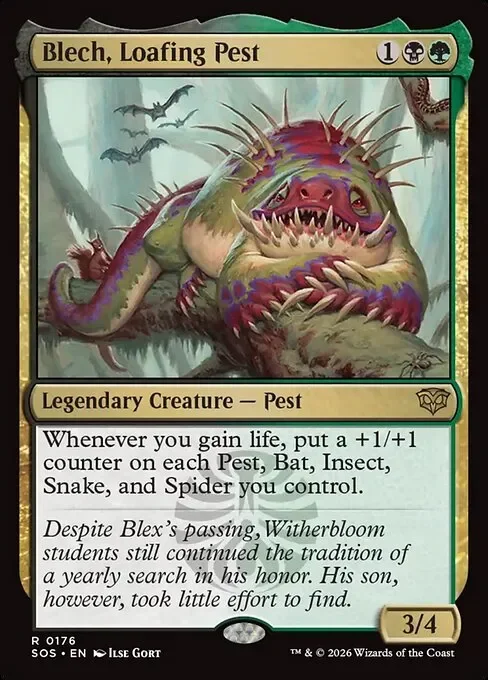
Blech, Loafing Pest leads a Golgari creature deck built around repeated lifegain, +1/+1 counters, and an unusually broad typal package spanning Pests, Bats, Insects, Snakes, and Spiders. Rather than relying on a single creature type, the deck fills the battlefield with creatures that naturally qualify for Blech’s ability while using incremental lifegain to develop the entire board at once.
The result is a layered creature strategy that combines token production, sacrifice value, graveyard recursion, and scalable combat pressure. Individual lifegain triggers become permanent board development, allowing otherwise modest utility creatures and tokens to grow into meaningful threats over the course of the game.
Deck Overview
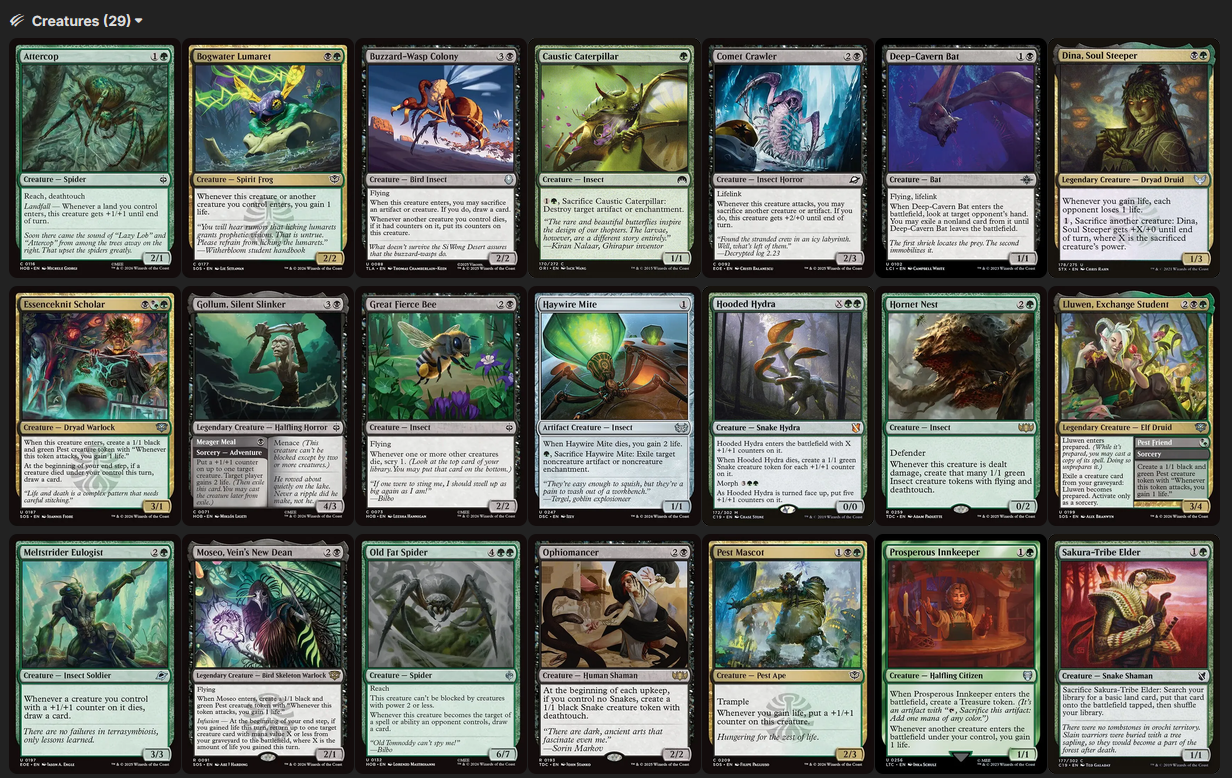
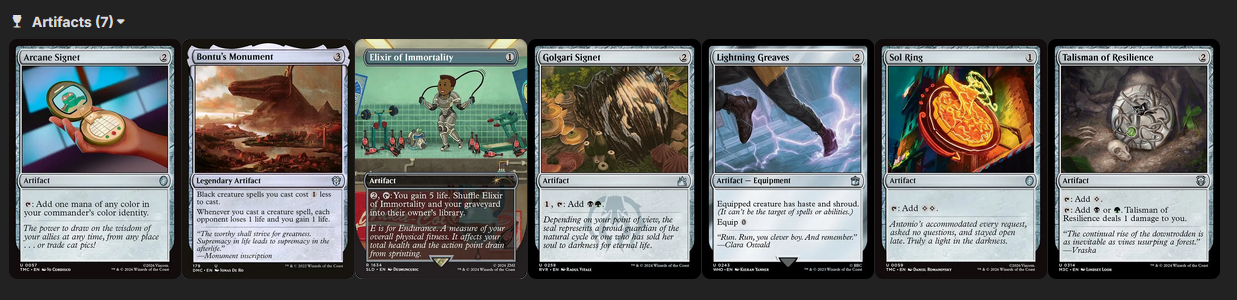
Blech rewards frequency rather than quantity: each instance of gaining life places a +1/+1 counter on every Pest, Bat, Insect, Snake, and Spider under your control. Prosperous Innkeeper, Bogwater Lumaret, Bontu’s Monument, Dina, Soul Steeper, and several Pest-based effects provide recurring lifegain while the deck steadily expands its qualifying creature base.
The typal package is intentionally diverse. Ophiomancer supplies Snakes, Spider Spawning rebuilds with Spider tokens, Hornet Nest produces Insects, and creatures such as Deep-Cavern Bat, Attercop, Great Fierce Bee, Skyfisher Spider, Haywire Mite, and Caustic Caterpillar contribute utility without stepping outside Blech’s supported creature types.
Lifegain and Counter Development
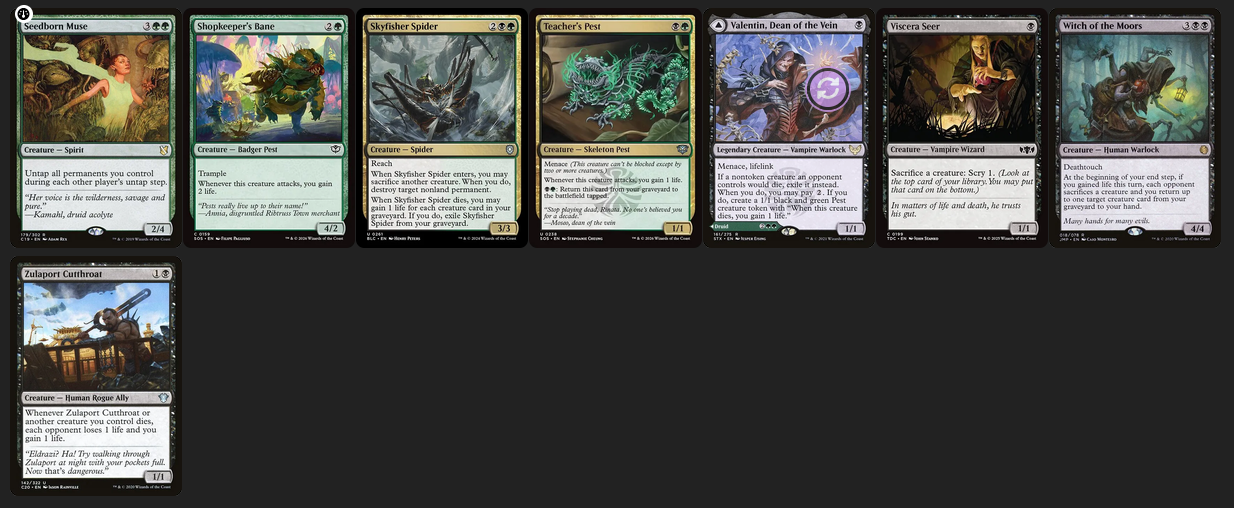
The commander converts routine lifegain into permanent power across the battlefield. Prosperous Innkeeper and Bogwater Lumaret reward creatures entering play, while Bontu’s Monument turns black creature spells into additional life swings. Dina, Soul Steeper adds another layer of pressure by converting lifegain into opponent life loss.
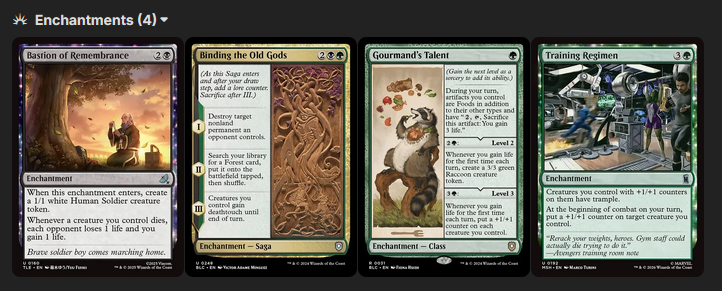
Pest Mascot independently rewards the same lifegain plan, while Training Regimen provides another avenue for building +1/+1 counters. These effects allow the deck to establish threats gradually without committing entirely to one large creature.
Tokens and Creature Density
Token production gives Blech multiple bodies to enhance from a single trigger. Ophiomancer continually generates Snake tokens, Hornet Nest can create a substantial Insect presence, and Hooded Hydra leaves behind Snakes when it dies.
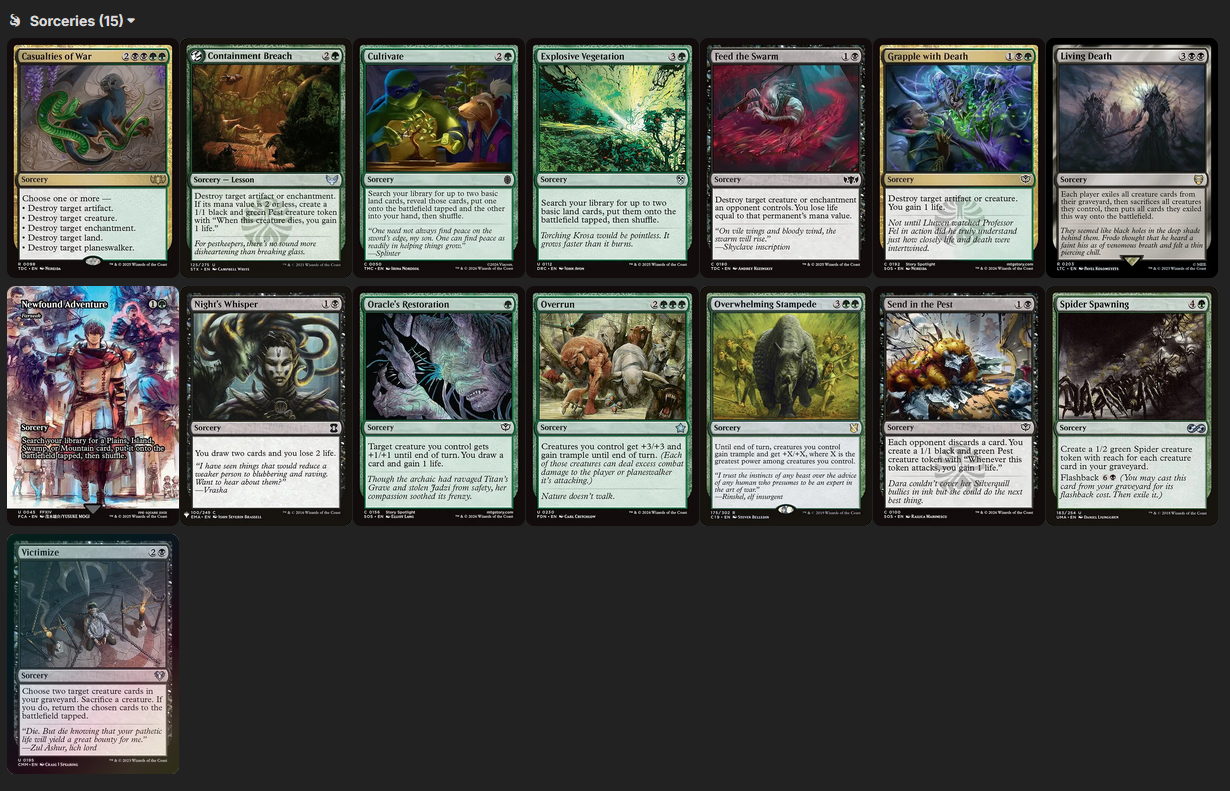
Spider Spawning provides one of the deck’s strongest rebuilding tools, turning a stocked graveyard into a new board of qualifying creatures. Pest-producing cards throughout the list further reinforce the commander while supporting the deck’s sacrifice and lifegain engines.
Sacrifice, Recursion, and Resilience
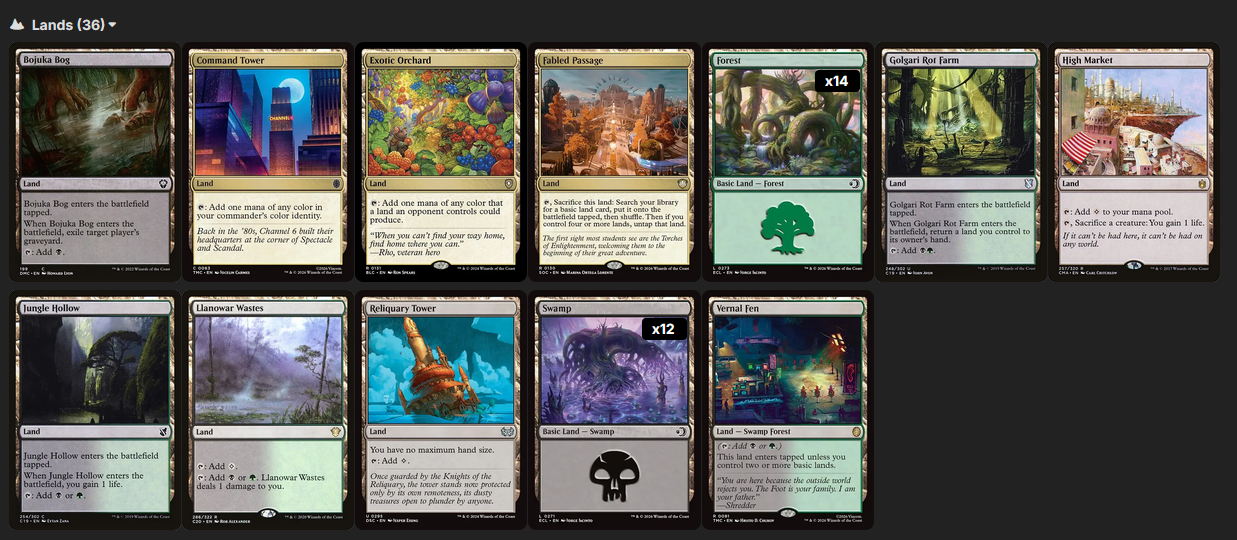
The deck is structured to extract value when creatures leave the battlefield rather than simply losing its accumulated board. Viscera Seer and High Market provide sacrifice outlets, while Bastion of Remembrance and Zulaport Cutthroat convert creature deaths into additional life swings.
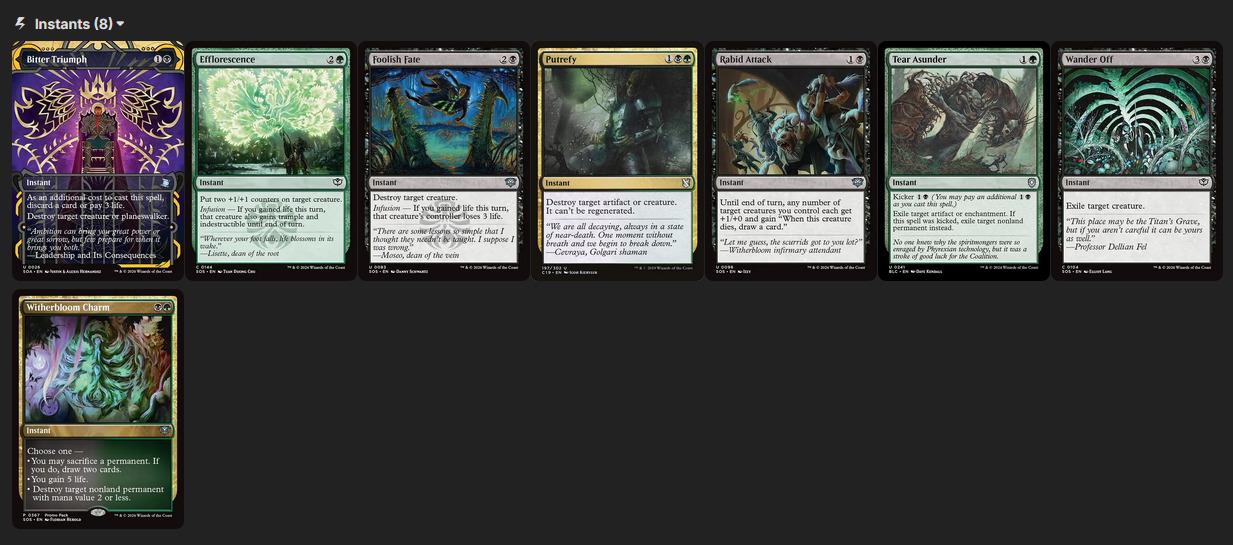
Victimize, Oracle’s Restoration, and Living Death provide meaningful recovery from removal. Living Death is particularly well suited to a creature-dense strategy, allowing the deck to transition from a developed graveyard back into a populated battlefield. Elixir of Immortality adds another layer of long-game recursion when necessary.
Interaction and Board Control
The removal suite covers creatures, artifacts, enchantments, graveyards, and larger battlefield problems without interfering with the primary creature plan. Casualties of War, Putrefy, Bitter Triumph, Feed the Swarm, Tear Asunder, and Binding the Old Gods provide broad answers across permanent types.
Utility creatures such as Caustic Caterpillar, Haywire Mite, and Skyfisher Spider contribute interaction while simultaneously fitting Blech’s typal requirements. Bojuka Bog supplies incidental graveyard disruption from the mana base.
Closing the Game
Blech naturally creates a battlefield where multiple small creatures become progressively larger with every lifegain trigger. Once sufficient bodies have accumulated, Overrun and Overwhelming Stampede convert that distributed board advantage into a decisive combat step.
The deck therefore does not need to rely on a single oversized threat. Its strongest positions are created by developing several qualifying creatures, repeatedly triggering Blech, and eventually giving the entire board the power and evasion needed to finish the game.
Build Philosophy
This build treats Blech’s five supported creature types as a functional toolbox rather than a restrictive tribal requirement. Pests, Bats, Insects, Snakes, and Spiders are selected for the utility they contribute—token production, removal, sacrifice value, recursion, or card advantage—while still benefiting from the commander’s counters.
Ramp from Sol Ring, Arcane Signet, Golgari Signet, Talisman of Resilience, Cultivate, Explosive Vegetation, and Sakura-Tribe Elder supports consistent development, while the 36-land mana base provides a stable Golgari foundation. Every major package reinforces either the lifegain engine, creature density, graveyard plan, or the deck’s ability to convert incremental value into combat pressure.
Technical Details
100-card singleton Commander deck, legal for EDH
All cards in Near Mint to Lightly Played condition
Professionally sleeved and ready to play
Built for consistent performance and strategic depth
Ideal For Players Who:
Enjoy Golgari creature decks built around lifegain, counters, and sacrifice value
Prefer typal strategies that use several interconnected creature types rather than a single tribe
Appreciate Commander builds with recursion, token production, and scalable combat finishes
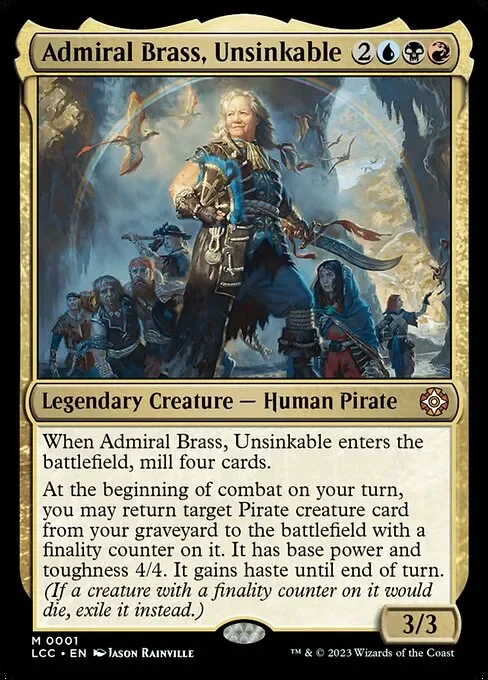
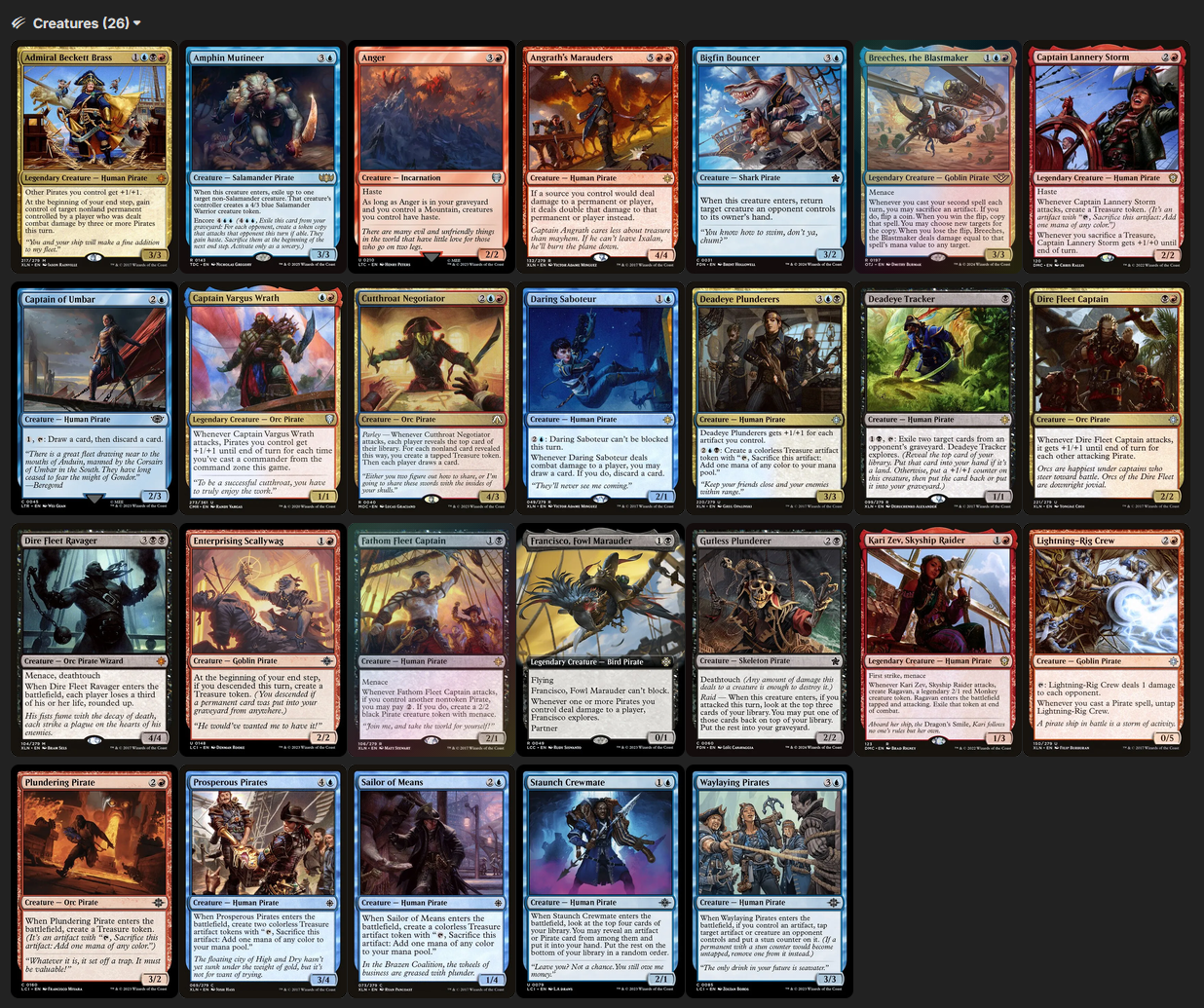
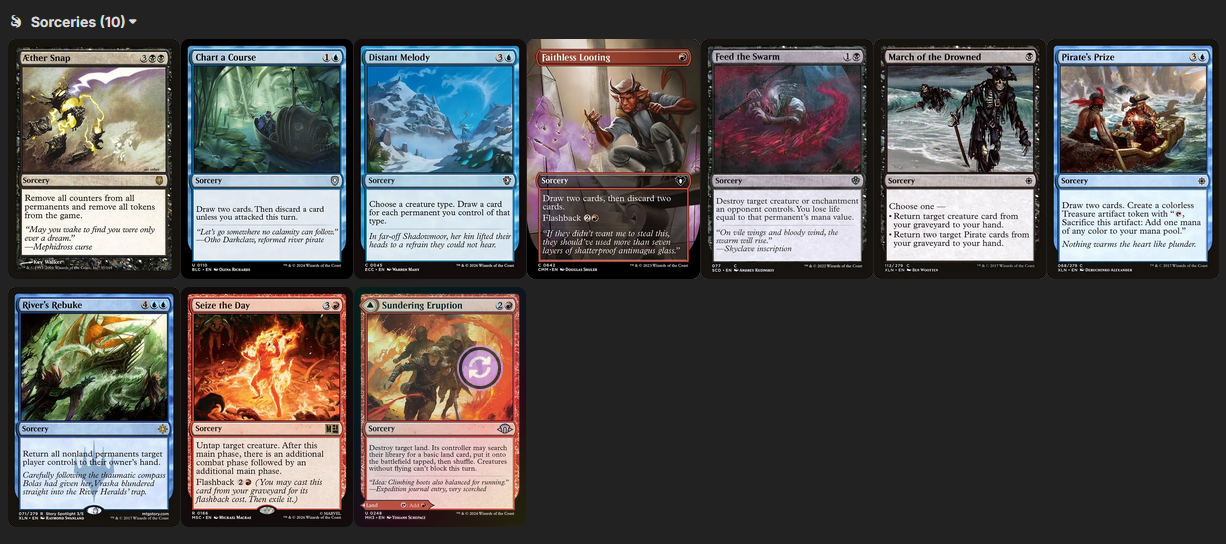
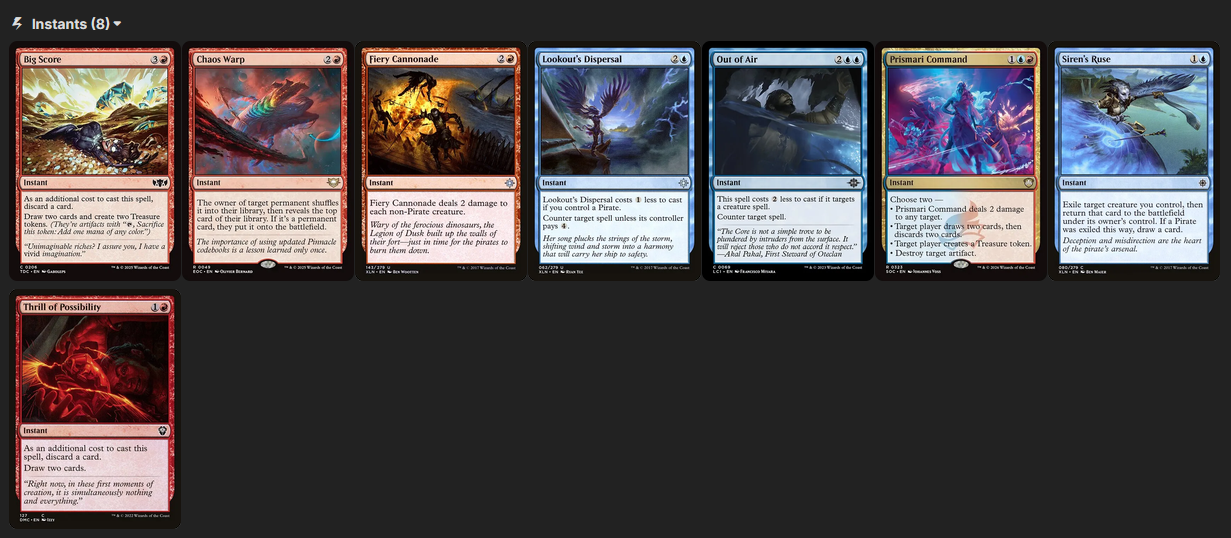
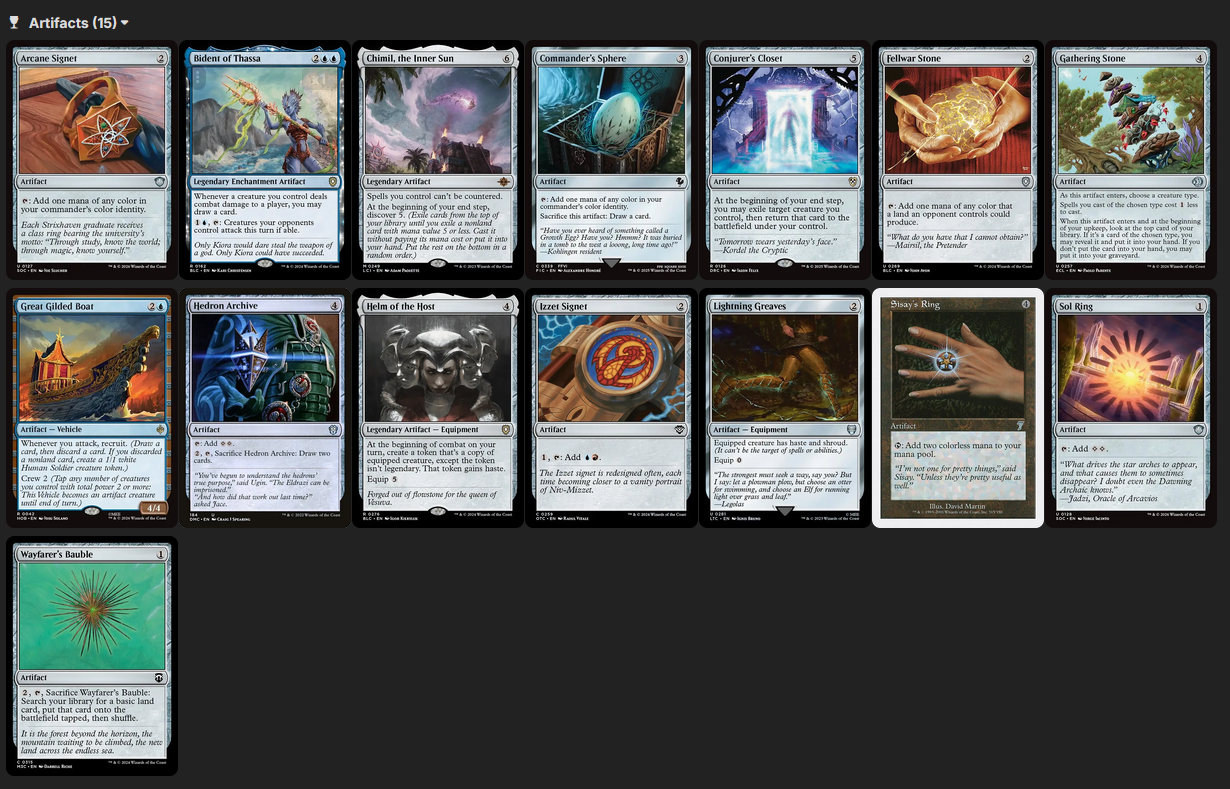
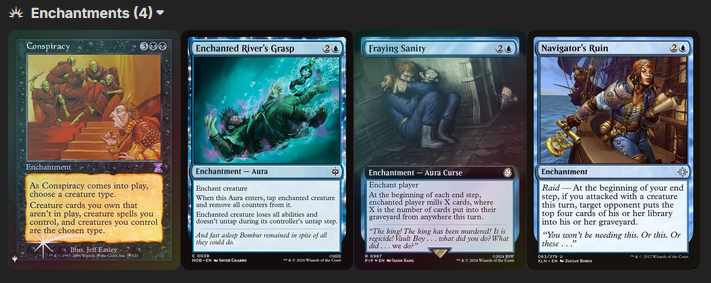
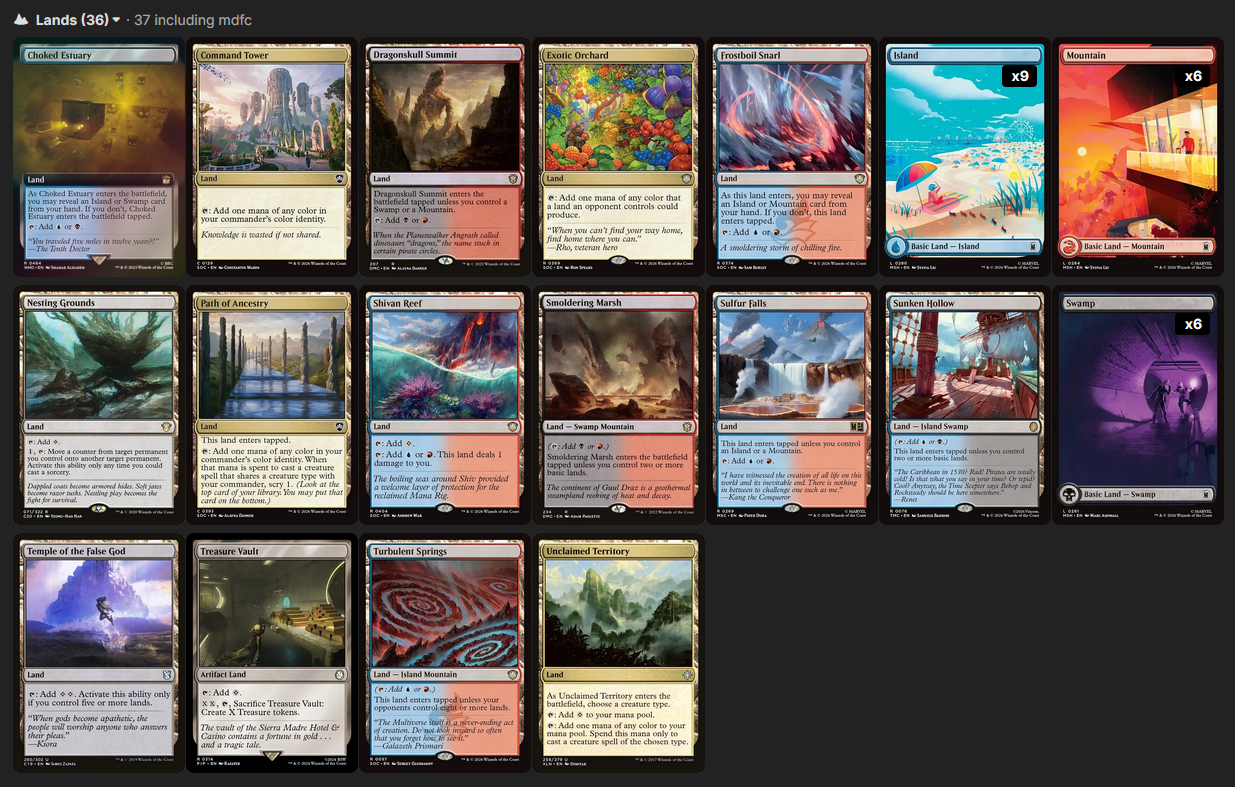
Admiral Brass, Unsinkable leads a Grixis Pirate strategy built around graveyard setup, repeatable creature recursion, Treasure generation, and combat-driven value. Brass mills cards on entry, then converts the graveyard into an extension of the hand by returning a Pirate as a hasty 4/4 at the beginning of each combat. The deck is constructed to exploit that recursion repeatedly rather than treating the finality counter as a one-time limitation.
The result is a tribal midrange deck with a strong mechanical identity: establish Pirates and mana, stock the graveyard through milling and discard, then use Brass to continually rebuild pressure while extracting additional value from enter-the-battlefield and attack triggers.
Deck Overview
This build combines Pirate tribal, graveyard recursion, Treasure production, and tempo control within a cohesive Grixis shell. Faithless Looting, Thrill of Possibility, Chart a Course, Big Score, and Prismari Command provide card selection while deliberately placing useful creatures into the graveyard for Admiral Brass.
The Pirate suite ranges from efficient value pieces such as Captain Lannery Storm, Prosperous Pirates, Sailor of Means, and Plundering Pirate to larger payoff creatures including Angrath's Marauders, Dire Fleet Ravager, and Admiral Beckett Brass. The deck also contains several unusually effective tools for removing or circumventing Brass's finality counters, allowing key creatures to be recycled multiple times over the course of a game.
Graveyard Setup and Recursion
Admiral Brass provides the central engine by milling four cards whenever she enters the battlefield and returning a Pirate from the graveyard at the beginning of combat. Faithless Looting, Thrill of Possibility, Big Score, Chart a Course, and Prismari Command supplement that mill with controlled discard, allowing larger Pirates or situational creatures to be positioned directly for recursion.
March of the Drowned provides additional recovery outside the commander's ability, while Conspiracy expands the recursion package by making every creature in the deck a Pirate, including cards such as Anger that would not ordinarily qualify for Brass's ability.
Pirate Tribal and Treasure Value
The deck maintains a substantial Pirate density so its tribal payoffs remain active throughout the game. Captain Lannery Storm, Prosperous Pirates, Sailor of Means, Plundering Pirate, Enterprising Scallywag, and Cutthroat Negotiator generate Treasure or other incremental resources while advancing the board.
Bident of Thassa and Distant Melody turn a developed Pirate force into sustained card advantage, while Captain Vargus Wrath, Dire Fleet Captain, Fathom Fleet Captain, and Admiral Beckett Brass reward the deck for continuing to attack. Gathering Stone further supports the creature-heavy tribal structure alongside the deck's conventional artifact acceleration.
Finality Counter Management and Recursion Loops
A defining element of the construction is its ability to preserve creatures returned by Admiral Brass. Nesting Grounds can move a finality counter away from a resurrected Pirate, allowing that creature to enter the graveyard normally when it dies and become available for future recursion.
Conjurer's Closet and Siren's Ruse can exile and return resurrected creatures as new objects, removing the finality counter while also retriggering useful enter-the-battlefield abilities. Aether Snap provides another method of clearing counters from the board, giving the deck multiple independent ways to extend the life of Brass's recursion engine.
These interactions allow the commander to function as a genuine repeatable value engine rather than simply producing temporary attackers.
Board Control and Tempo
The interaction package is designed to preserve offensive momentum without abandoning the tribal plan. Chaos Warp and Feed the Swarm answer problematic permanents, while Lookout's Dispersal and Out of Air provide countermagic that fits naturally into the deck's creature sequencing.
Amphin Mutineer, Bigfin Bouncer, Waylaying Pirates, Fiery Cannonade, and River's Rebuke offer additional board management at different scales. Several of these effects are attached to creatures, making them especially valuable when they can later be recovered by Admiral Brass.
Closing the Game
The deck converts its accumulated Pirate presence into increasingly dangerous combat steps. Angrath's Marauders dramatically increases combat damage, while Captain Vargus Wrath and Dire Fleet Captain reward a broad attacking board. Admiral Beckett Brass provides an additional payoff by turning successful Pirate combat damage into control of opposing permanents.
Seize the Day is particularly effective with Admiral Brass because an additional combat creates another beginning-of-combat opportunity for the commander to return a Pirate. This allows the deck to add another hasty attacker immediately while increasing the value of existing combat-triggered effects.
Helm of the Host supplies another late-game scaling engine, particularly when copying high-impact creatures such as Angrath's Marauders or other Pirates with valuable triggered abilities. Navigator's Ruin and Fraying Sanity also provide a secondary mill component that can apply pressure outside conventional combat.
Build Philosophy
This deck is constructed around Admiral Brass rather than simply functioning as a generic Grixis Pirate collection. Looting effects serve both card selection and graveyard setup, tribal creatures provide meaningful value when cast or recurred, and the finality-counter package directly addresses the commander's principal limitation.
The mana base combines appropriate Grixis fixing with tribal support from Path of Ancestry and Unclaimed Territory, while Arcane Signet, Izzet Signet, Fellwar Stone, Sol Ring, Commander's Sphere, Hedron Archive, and other mana artifacts support consistent development. Treasure production provides further color flexibility as the game progresses.
Every major package contributes to the same play pattern: develop resources, fill the graveyard, establish Admiral Brass, and continually convert Pirates into reusable combat and enter-the-battlefield value.
Technical Details
100-card singleton Commander deck, legal for EDH
All cards in Near Mint to Lightly Played condition
Professionally sleeved and ready to play
Built for consistent performance and strategic depth
Ideal For Players Who:
Enjoy Pirate tribal decks with graveyard recursion and Treasure-based value
Prefer combat strategies supported by tempo interaction and reusable creature effects
Appreciate Commander builds with deliberate mechanical interactions and layered synergy
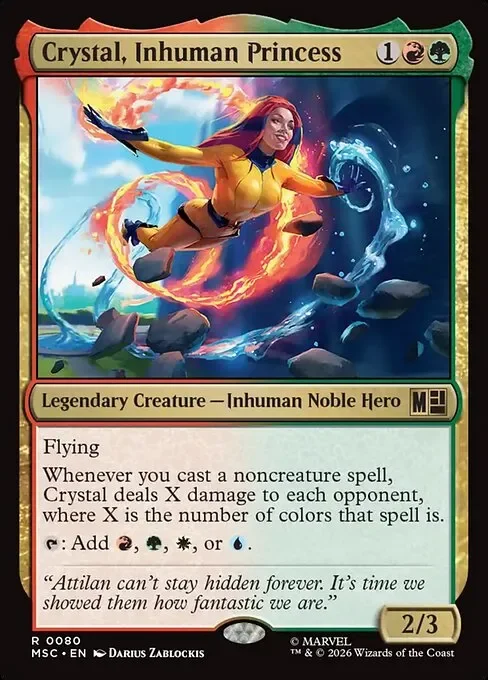
Crystal, Inhuman Princess leads a four-color noncreature-spells strategy that turns routine interaction, card selection, and utility spells into steady pressure against the entire table. Her triggered ability rewards multicolored casting with increased damage while her activated mana ability helps support the deck’s demanding red, green, white, and blue requirements.
Rather than functioning as an all-in storm deck, this build uses Crystal as the centerpiece of a layered spells-matter engine. Cheap instants and sorceries keep the deck active throughout each turn cycle, while Fantastic Four and other Marvel-themed permanents convert those casts into cards, creatures, counters, mana, and additional damage.
Deck Overview
The deck combines four-color spellslinger, tempo, and midrange elements, using a dense package of low-cost noncreature spells to repeatedly trigger Crystal and the supporting permanents around her.
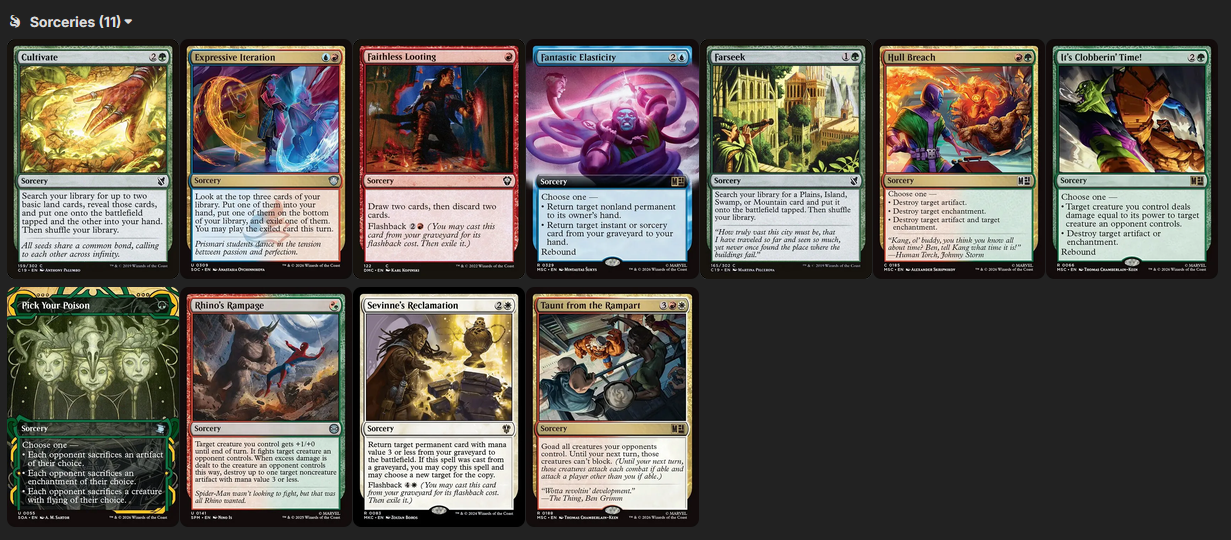
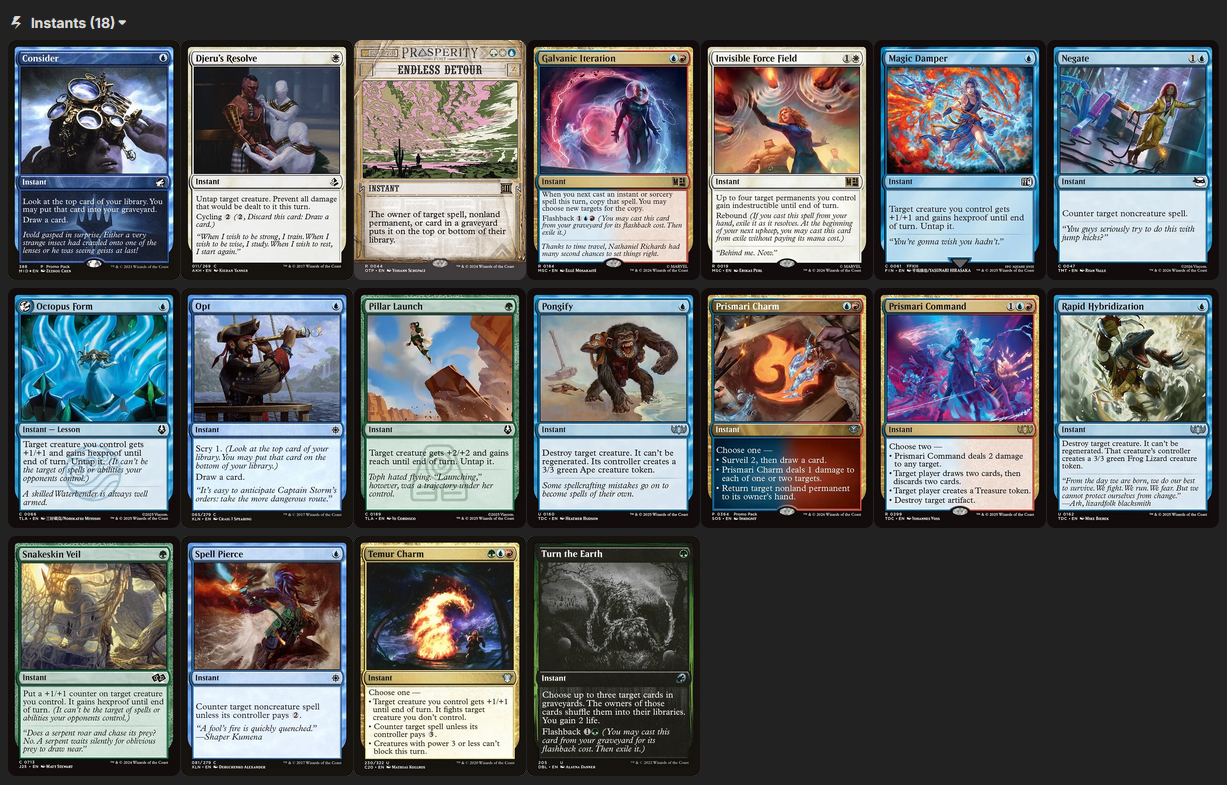
Cards such as Consider, Opt, Faithless Looting, Expressive Iteration, Prismari Charm, and Prismari Command provide efficient card flow and flexibility, while Pongify, Rapid Hybridization, Hull Breach, Endless Detour, Negate, Spell Pierce, and Pick Your Poison allow the deck to interact without stepping away from its central game plan.
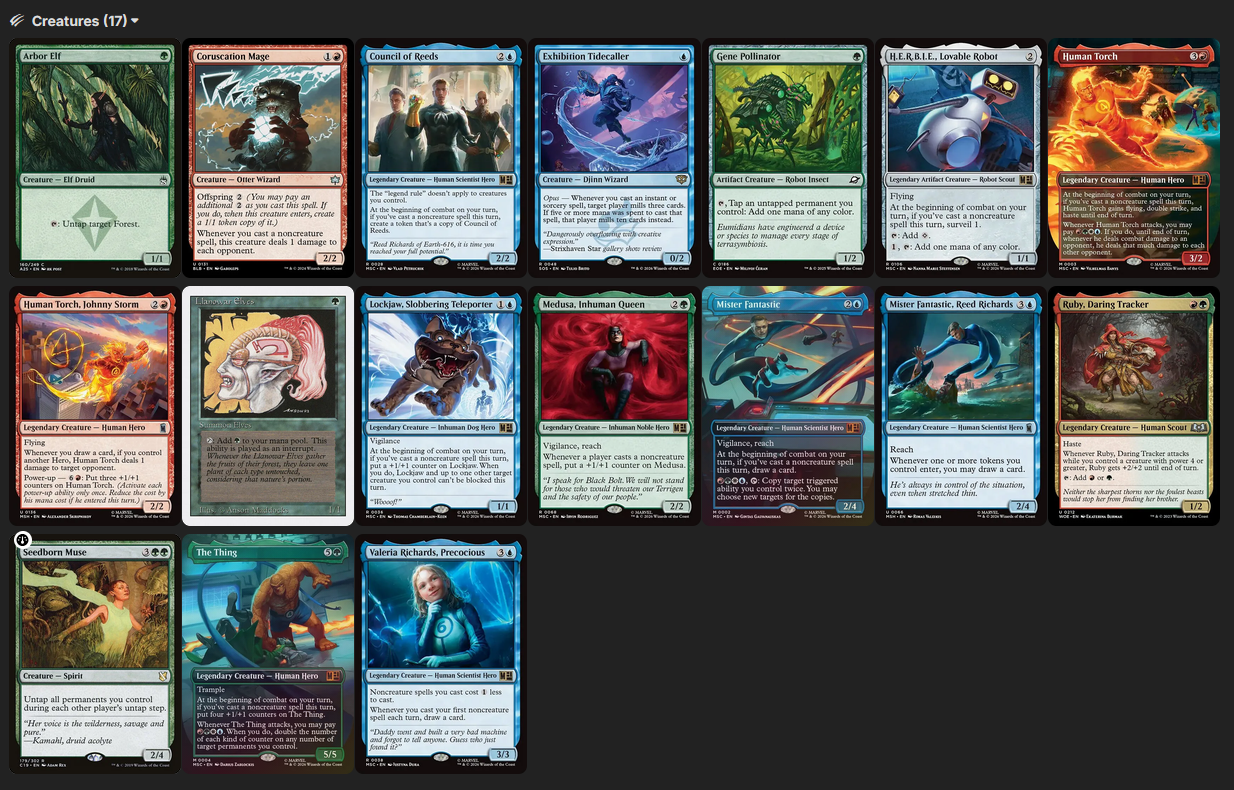
The creature suite reinforces that structure rather than replacing it. Valeria Richards, Precocious, Coruscation Mage, Council of Reeds, The Thing, Medusa, Inhuman Queen, Human Torch, Mister Fantastic, and H.E.R.B.I.E., Lovable Robot all reward the deck for continuing to cast noncreature spells while maintaining a cohesive Fantastic Four identity.
Key Strategic Elements
Noncreature Spell Engine
Crystal rewards every noncreature spell with direct damage to each opponent, with multicolored spells producing larger triggers. This makes flexible gold cards such as Temur Charm, Prismari Charm, Prismari Command, Endless Detour, Galvanic Iteration, and Hull Breach especially efficient, as they combine useful interaction or card selection with increased damage output.
Cheap cantrips such as Consider and Opt keep the deck moving at minimal mana investment, while Whirlwind of Thought and Valeria Richards, Precocious provide additional card advantage for maintaining a steady casting rhythm.
Incremental Damage and Board Development
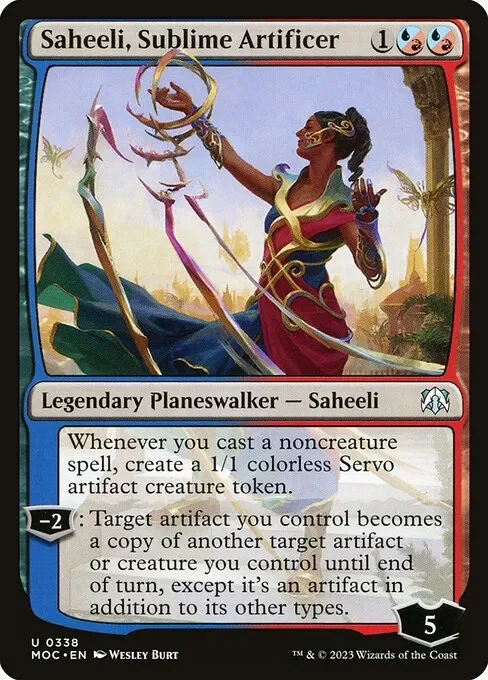
The deck layers multiple rewards onto the same basic action. Coruscation Mage adds another source of opponent-wide damage, while Saheeli, Sublime Artificer creates Servo tokens whenever a noncreature spell is cast.
Council of Reeds, Medusa, Inhuman Queen, Human Torch, Mister Fantastic, and The Thing provide additional ways to translate spellcasting into battlefield development and combat pressure. This allows the deck to advance its board while Crystal steadily reduces opposing life totals.
Board Control and Resilience
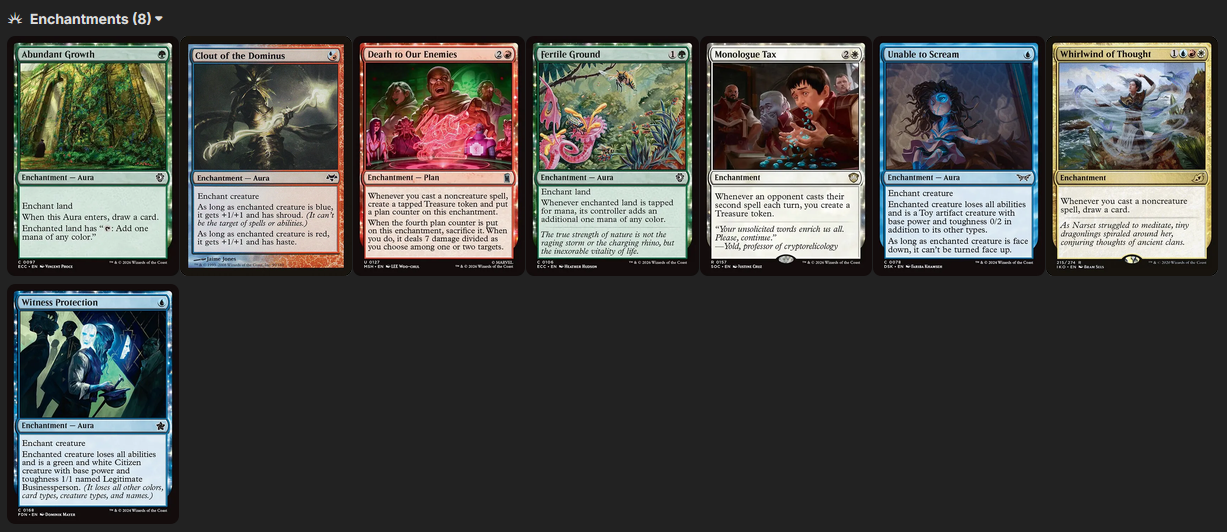
A broad interaction suite gives the deck answers across multiple permanent types. Pongify, Rapid Hybridization, Unable to Scream, Witness Protection, Rhino's Rampage, Hull Breach, Pick Your Poison, and It's Clobberin' Time! provide targeted answers, while Negate, Spell Pierce, Temur Charm, and Endless Detour help protect important positions or interrupt opposing plays.
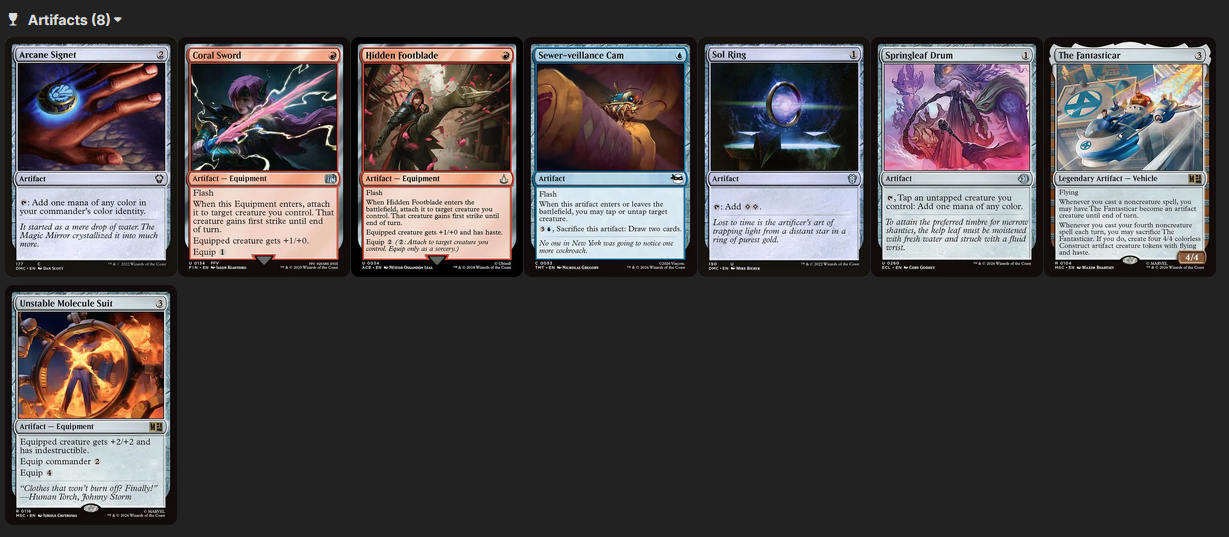
Sevinne's Reclamation adds recovery for important lower-cost permanents, while protection pieces such as Snakeskin Veil, Djeru's Resolve, Invisible Force Field, Coral Sword, Hidden Footblade, and Unstable Molecule Suit help preserve key creatures and maintain board presence.
Mana Development and Utility
Four-color sequencing is supported through a combination of land-based acceleration and flexible mana sources. Farseek, Cultivate, Fertile Ground, Abundant Growth, Arbor Elf, Llanowar Elves, Arcane Signet, Sol Ring, Springleaf Drum, and Crystal herself help establish the colors required to cast the deck efficiently.
Seedborn Muse provides particularly strong utility in a list with numerous instants and activated abilities, allowing the deck to untap its resources during each opposing turn and continue operating at instant speed.
Closing the Game
Crystal provides the primary long-term win condition by converting repeated noncreature casting into unavoidable damage across the table. Because many of the deck's spells are inexpensive and functional on their own, this pressure accumulates naturally through normal interaction rather than requiring a dedicated combo sequence.
At the same time, Saheeli's Servo production, Council of Reeds, Medusa, The Thing, Human Torch, Mister Fantastic, and the broader Fantastic Four package create a developing battlefield that opponents cannot safely ignore. The deck can therefore close through accumulated burn, combat damage, or a combination of both.
Build Philosophy
This build is designed around maintaining a high density of cards that remain useful independently while also contributing to Crystal's central engine. Interaction, card selection, ramp, protection, and utility spells all serve multiple purposes, allowing the deck to generate value without relying exclusively on its commander.
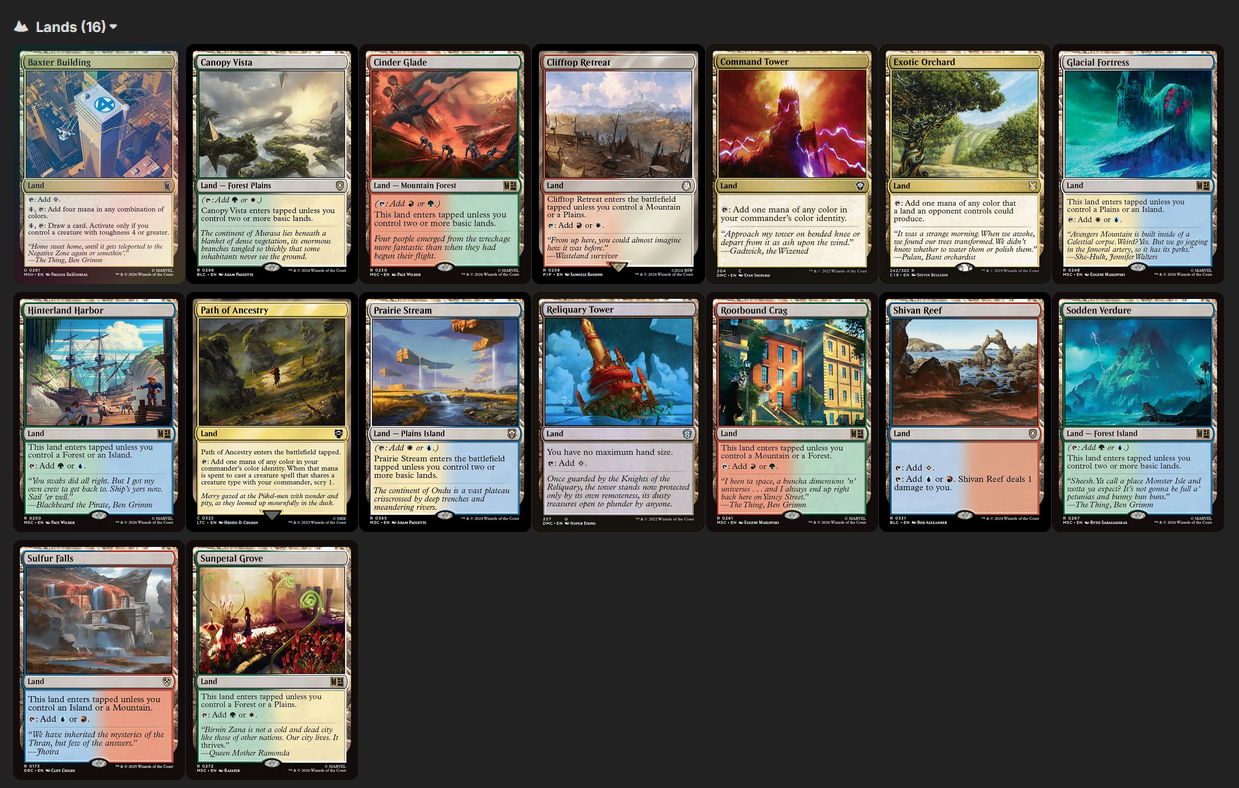
The mana base and acceleration package are structured to support consistent four-color sequencing, while the creature suite provides redundant spells-matter payoffs and a strong thematic connection to Crystal and the Fantastic Four. Each component supports the same underlying play pattern: cast efficiently, interact frequently, and allow repeated noncreature spells to compound into material and life-total advantage.
Technical Details
100-card singleton Commander deck, legal for EDH
All cards in Near Mint to Lightly Played condition
Professionally sleeved and ready to play
Built for consistent performance and strategic depth
Ideal For Players Who:
Enjoy spellslinger decks that combine interaction, incremental damage, and battlefield development
Prefer Commander builds where Fantastic Four flavor is integrated directly into the mechanical strategy
Appreciate four-color decks built around flexible sequencing and layered synergy
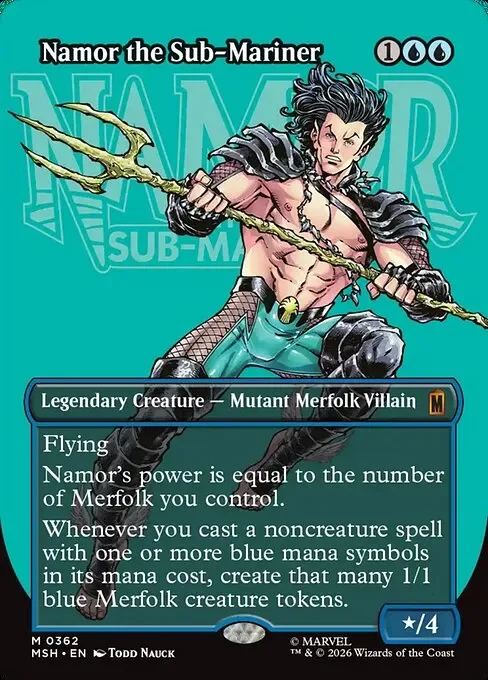
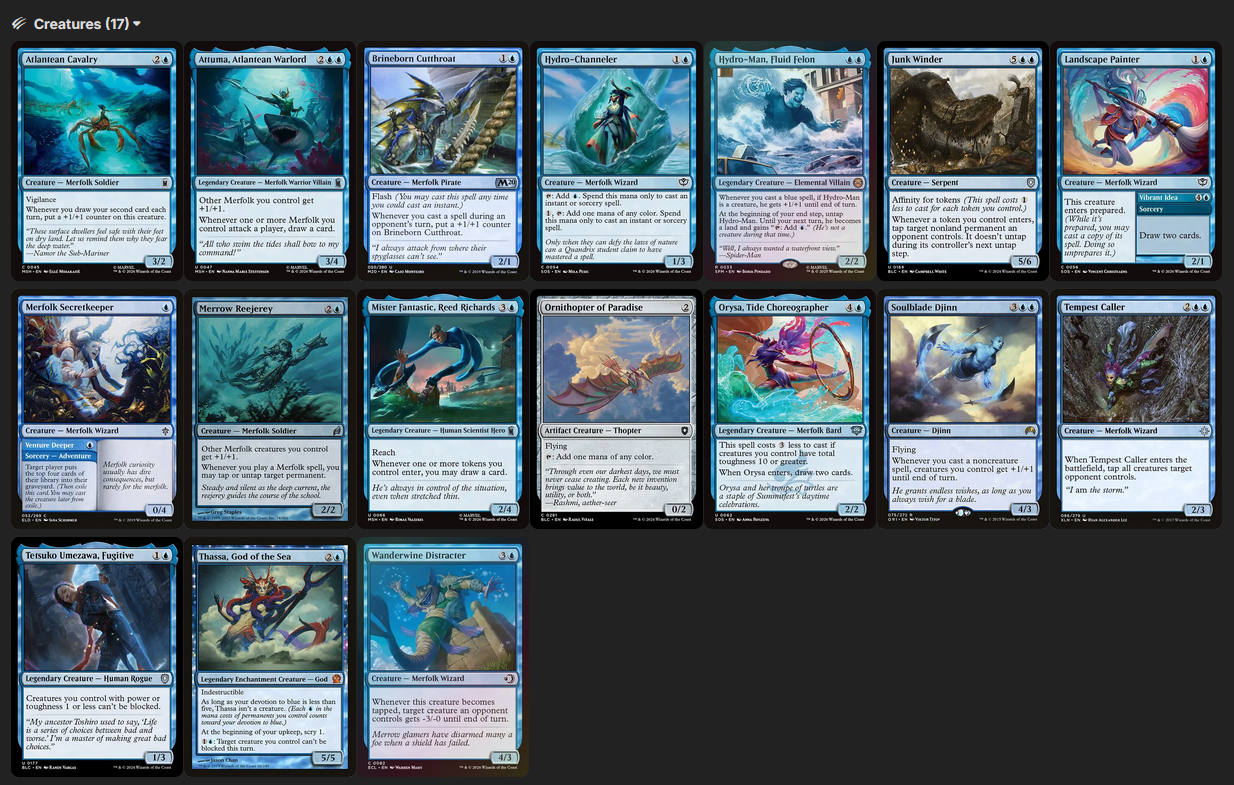
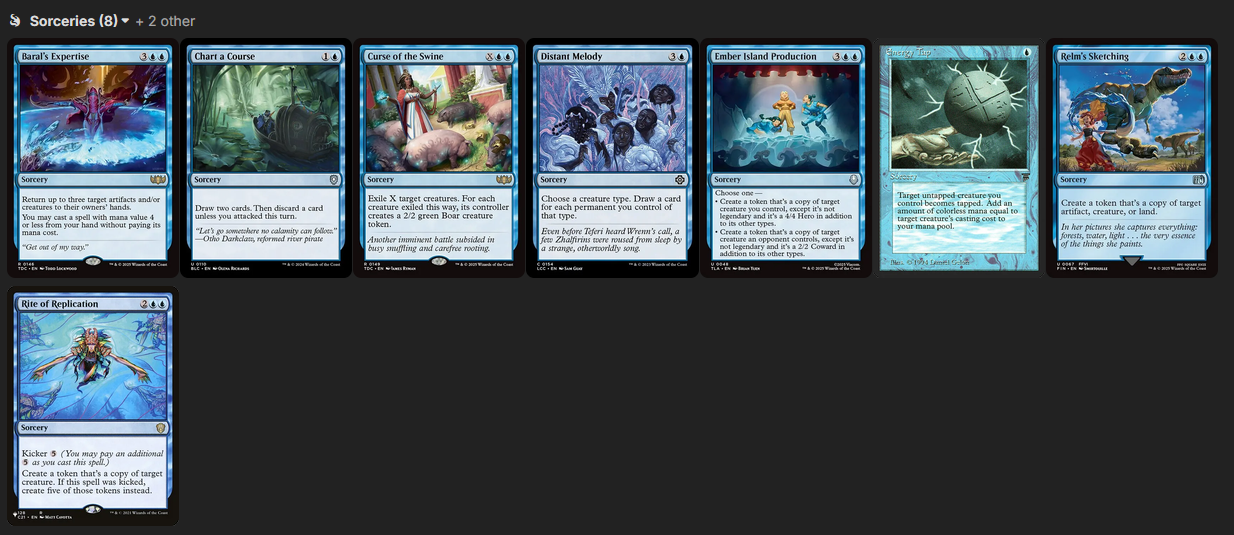
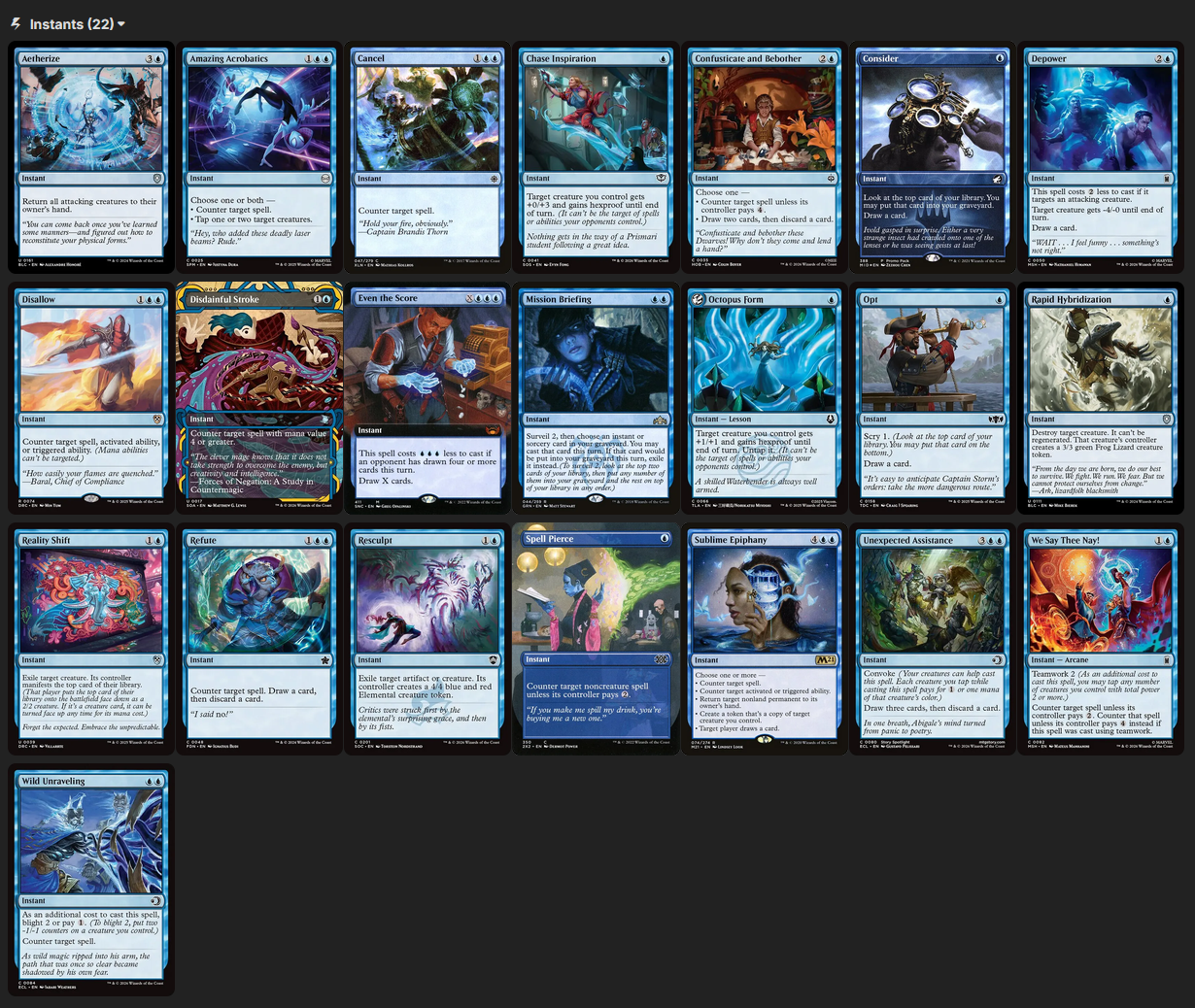
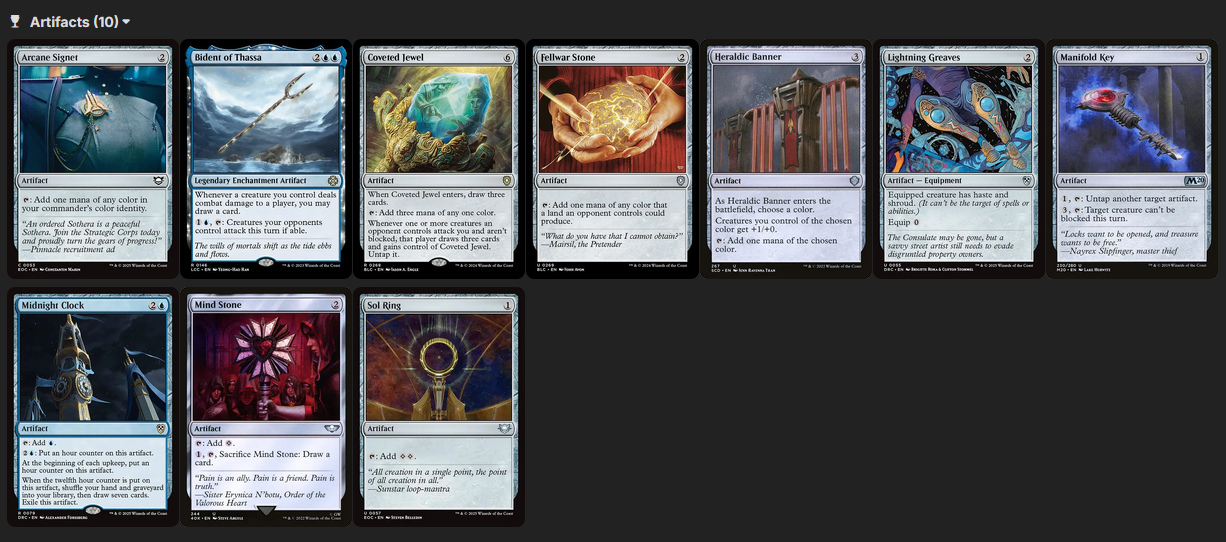
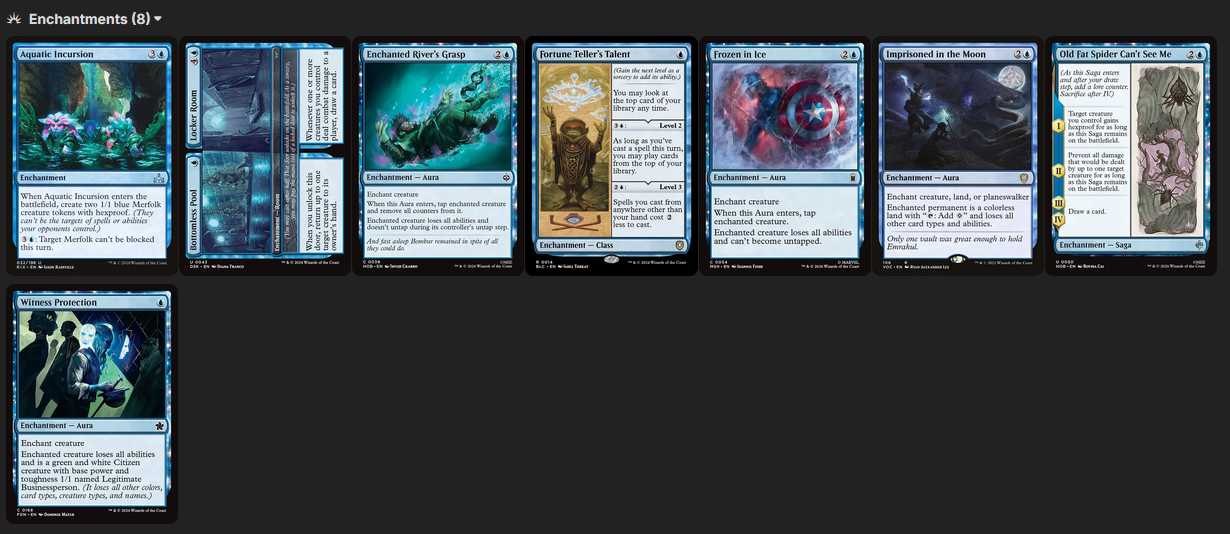
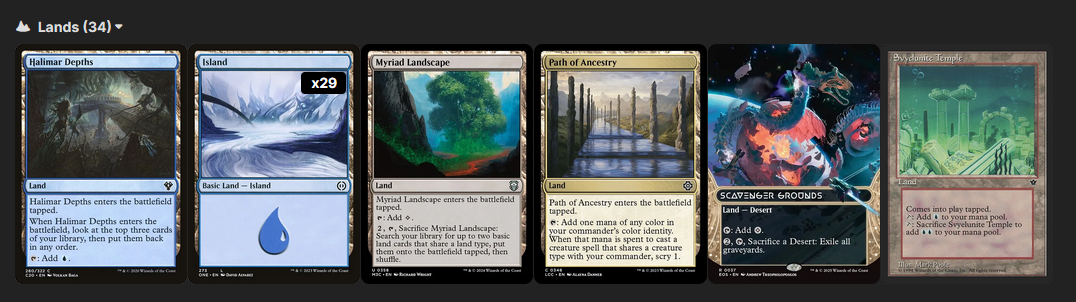
Namor the Sub-Mariner leads a mono-blue Merfolk deck that blends tribal development with a dense instant-and-sorcery control shell. Rather than choosing between committing creatures to the battlefield and holding mana for interaction, Namor converts blue noncreature spells into 1/1 Merfolk tokens while increasing his own power as the Atlantean force grows.
The result is a deliberately reactive deck that develops much of its board presence through normal spellcasting. Countermagic, removal, card selection, and tempo plays all contribute toward a widening Merfolk battlefield, allowing the deck to maintain interaction while steadily establishing a combat clock.
Deck Overview
The deck operates as a Merfolk Tokens and Spells-Control hybrid, using Namor as both its principal token engine and a scalable evasive threat. The unusually high concentration of blue noncreature spells ensures that many routine actions also produce additional creatures, making the deck less dependent on resolving traditional creature-based token generators.
Traditional Merfolk support from Merrow Reejerey, Attuma, Atlantean Warlord, Atlantean Cavalry, Orysa, Tide Choreographer, Wanderwine Distracter, and Aquatic Incursion reinforces that spell-driven core. Meanwhile, cards such as Junk Winder, Soulblade Djinn, Bident of Thassa, Distant Melody, and Mister Fantastic, Reed Richards convert the resulting token production into tempo, combat pressure, and additional cards.
Marvel and Atlantean elements remain mechanically integrated rather than functioning solely as thematic inclusions, giving the deck a recognizable Namor identity without compromising its underlying Commander structure.
Key Strategic Elements
Merfolk Generation and Tribal Scaling
Namor turns the deck's extensive noncreature package into a repeatable creature engine. Blue-heavy spells can generate multiple Merfolk from a single cast, allowing interaction and card advantage to simultaneously increase battlefield presence.
Those tokens directly increase Namor's power while providing additional value for cards such as Merrow Reejerey, Distant Melody, Bident of Thassa, Junk Winder, and Mister Fantastic, Reed Richards. Aquatic Incursion and other dedicated Merfolk cards supplement the commander's production when additional board development is required.
Card Advantage and Spell Velocity
The deck contains multiple layers of card selection and sustained draw. Opt, Consider, Chart a Course, Chase Inspiration, Distant Melody, Bident of Thassa, Even the Score, Coveted Jewel, and Midnight Clock help maintain sufficient resources for an interaction-heavy game.
Namor makes even inexpensive cantrips strategically significant. A simple card-selection spell can replace itself while adding another Merfolk, meaning the deck can continue developing without abandoning its reactive posture.
Mission Briefing adds further value by allowing important spells to be reused as the game develops.
Control and Tempo
A broad interaction suite gives the deck answers across multiple permanent and spell types. Disallow, Refute, Disdainful Stroke, Spell Pierce, Cancel, We Say Thee Nay!, and Wild Unraveling provide countermagic at different stages of the game.
Permanent-based threats can be addressed through Reality Shift, Rapid Hybridization, Resculpt, Curse of the Swine, Imprisoned in the Moon, Witness Protection, Frozen in Ice, and Depower. Aetherize and Baral's Expertise provide larger tempo swings when opponents commit heavily to the battlefield.
Because many of these answers contain blue mana symbols, Namor allows defensive play to continue advancing the deck's primary board state.
Token Utility and Combat Access
The Merfolk tokens are more than additional attackers. Junk Winder converts repeated token entry into opposing permanent suppression while benefiting from the deck's expanding creature count. Soulblade Djinn turns continued noncreature casting into temporary team-wide offensive growth.
Combat access is provided through several complementary effects. Thassa, God of the Sea can make important attackers unblockable, Tetsuko Umezawa, Fugitive gives unmodified 1/1 creatures a path through larger defenses, and Tempest Caller can remove an opponent's blockers for a decisive combat step.
Bident of Thassa then rewards successful attacks by converting creature connections into additional cards.
Closing the Game
The deck wins primarily by transforming incremental spell value into overwhelming creature density. Each new Merfolk increases Namor's power while expanding the number of bodies available for combat, card-draw triggers, and tribal effects.
Merrow Reejerey and Heraldic Banner strengthen the creature base, while Soulblade Djinn can produce substantial combat turns from a sequence of noncreature spells. Tempest Caller, Thassa, God of the Sea, and Aquatic Incursion help bypass established defenses when the deck is ready to convert its accumulated advantage into damage.
Namor himself provides a secondary pressure point. With flying and power equal to the number of Merfolk under the deck's control, a sufficiently developed battlefield can turn the commander into a significant evasive threat without requiring a separate Voltron package.
Build Philosophy
This build is structured around maximizing the functional overlap between Namor's triggered ability and a traditional mono-blue interaction package. Counterspells, removal, cantrips, card draw, and tempo effects are not separate from the deck's creature plan; they are the primary means through which that plan develops.
The supporting creature package remains focused on Merfolk, token utility, card advantage, and combat access rather than simply increasing tribal density. Flexible copying effects such as Rite of Replication, Relm's Sketching, and Ember Island Production provide additional adaptability depending on the strongest permanents available during a game.
Mana production is supported by Sol Ring, Arcane Signet, Fellwar Stone, Mind Stone, Ornithopter of Paradise, Heraldic Banner, Midnight Clock, and Coveted Jewel, while a heavily Island-based mana base keeps blue sequencing dependable. Utility lands including Halimar Depths, Path of Ancestry, Scavenger Grounds, Myriad Landscape, and Svyelunite Temple add functionality without unnecessarily complicating the deck's mono-blue requirements.
Every major package contributes toward the same central objective: cast useful blue spells, create Merfolk while doing so, preserve control of the game, and convert the resulting battlefield into sustained pressure.
Technical Details
100-card singleton Commander deck, legal for EDH
All cards in Near Mint to Lightly Played condition
Professionally sleeved and ready to play
Built for consistent performance and strategic depth
Ideal For Players Who:
Enjoy Merfolk strategies that combine tribal development with reactive blue gameplay
Prefer Commander decks where interaction and board development are integrated into the same engine
Appreciate cohesive, professionally constructed decks with strong mechanical and thematic identity
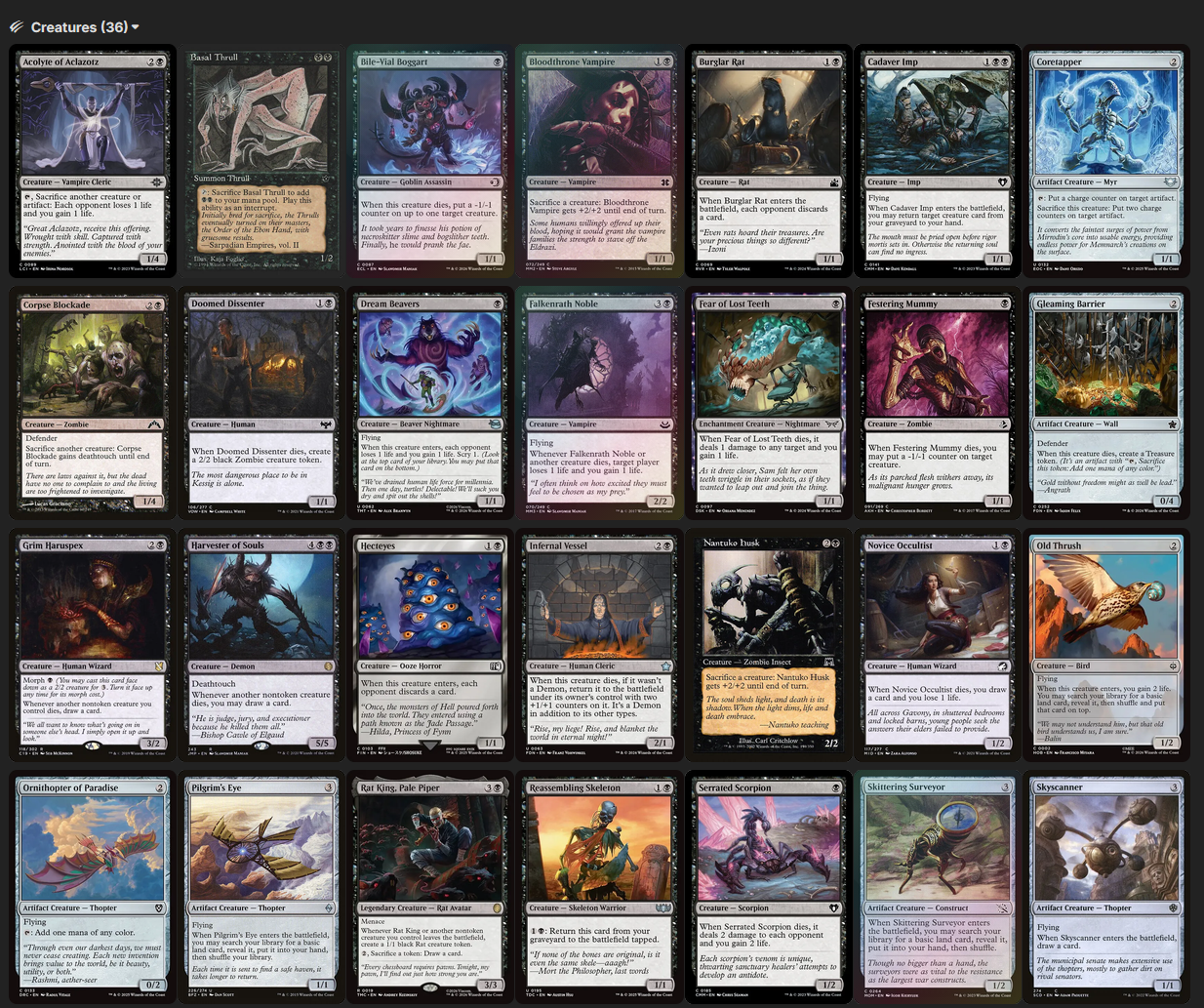
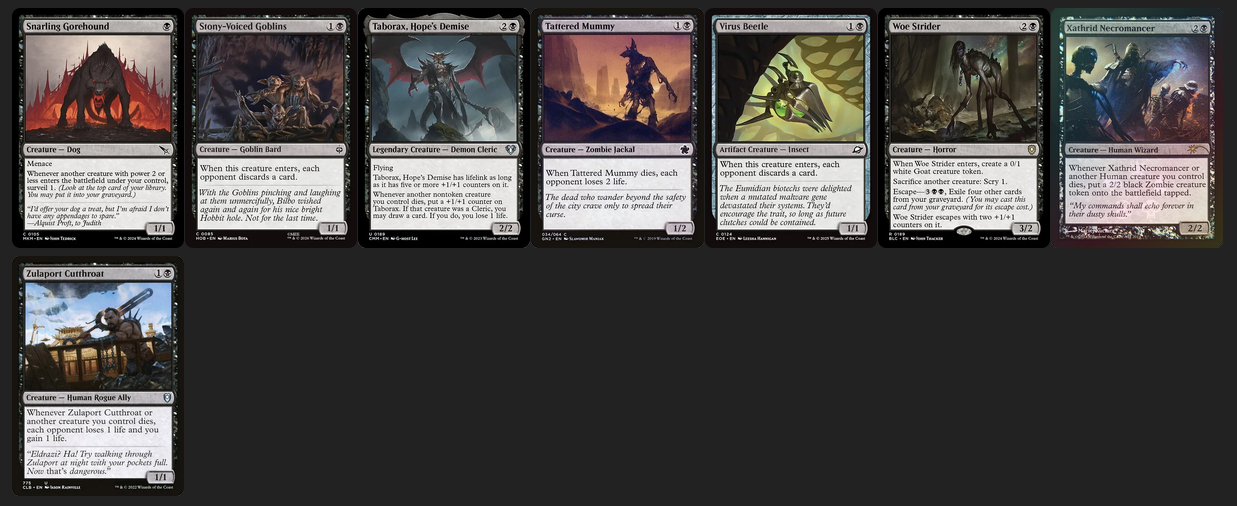
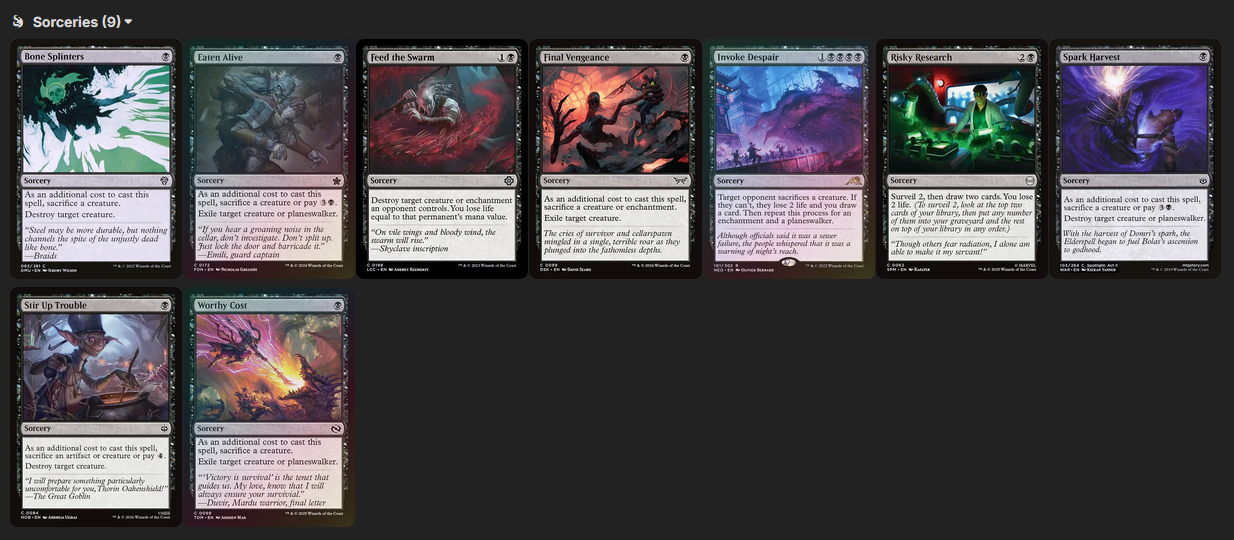
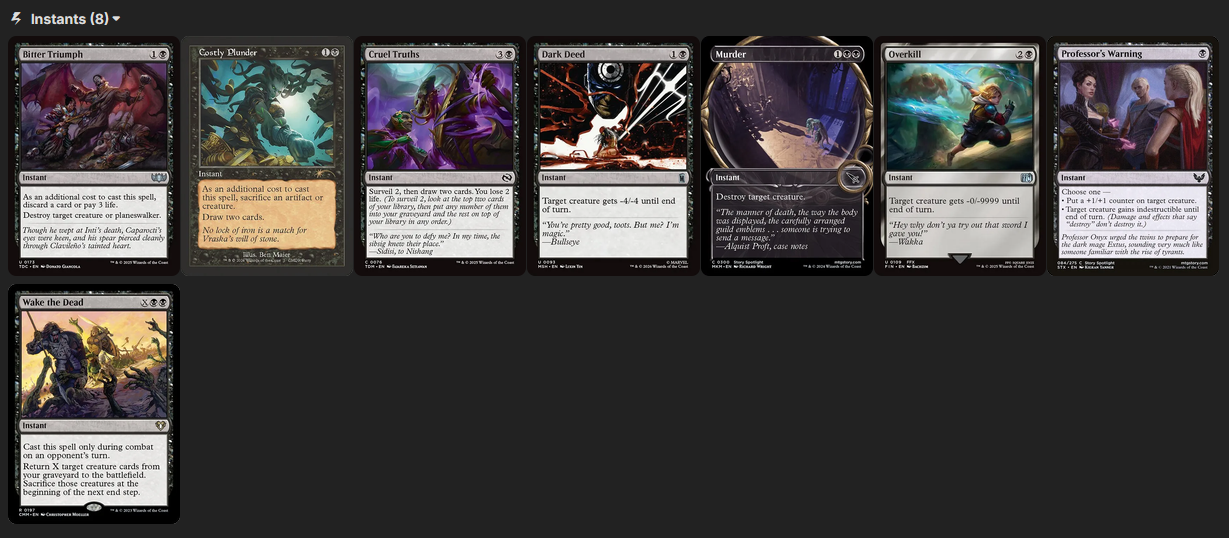
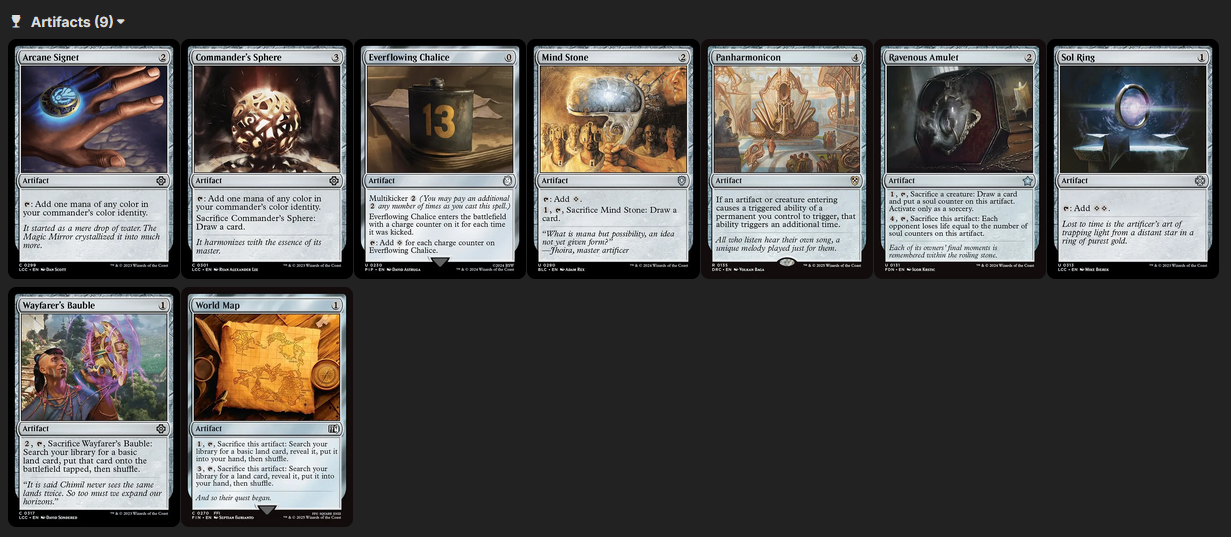
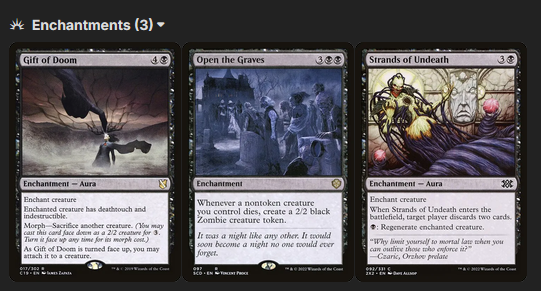
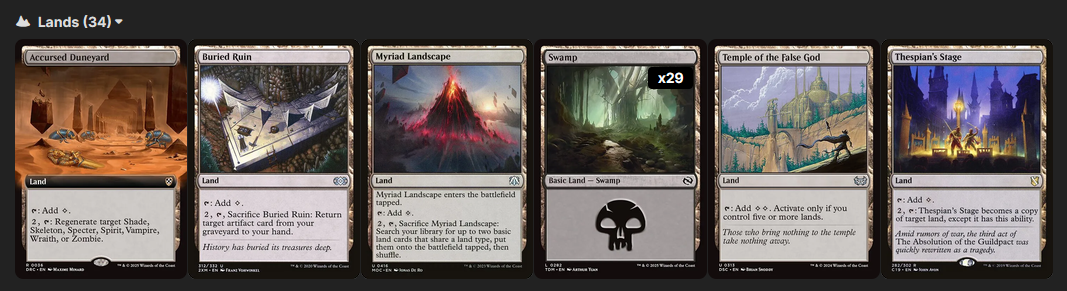
Shirei, Shizo's Caretaker leads a mono-black sacrifice and recursion deck built around repeatedly converting small creatures into cards, mana, removal, discard, and life loss. The deck is structured to exploit Shirei’s ability to return creatures with power 1 or less after they die, creating a persistent engine in which otherwise modest creatures become renewable resources.
Rather than relying on a single combo line, the deck establishes incremental advantages through sacrifice outlets, death triggers, enter-the-battlefield abilities, and recursive creatures. Its play pattern is methodical and attrition-oriented, steadily reducing opposing resources while maintaining a board that is unusually difficult to exhaust.
Deck Overview
The central engine pairs Shirei with low-power creatures whose value is realized when they enter, leave, or repeatedly move through the graveyard. Burglar Rat, Virus Beetle, Stony-Voiced Goblins, Serrated Scorpion, Festering Mummy, Tattered Mummy, Pilgrim's Eye, Skittering Surveyor, and Novice Occultist all provide effects that can become repeatable once Shirei is established.
Sacrifice outlets including Woe Strider, Nantuko Husk, Bloodthrone Vampire, Corpse Blockade, Acolyte of Aclazotz, and Basal Thrull allow these creatures to be deliberately cycled rather than waiting for opponents to remove them. Supporting pieces such as Zulaport Cutthroat, Falkenrath Noble, Grim Haruspex, Harvester of Souls, Open the Graves, and Panharmonicon ensure that each exchange contributes additional material or pressure.
Key Strategic Elements
Sacrifice and Recursion Engine
Shirei turns the deck's smallest creatures into renewable assets. Creatures such as Serrated Scorpion, Tattered Mummy, Festering Mummy, Burglar Rat, Virus Beetle, and Novice Occultist can be sacrificed for value and returned at the next end step, allowing their death or enter-the-battlefield abilities to be used repeatedly.
Reassembling Skeleton supplies an additional independent recursion engine, while Cadaver Imp, Wake the Dead, and Infernal Vessel provide further means of rebuilding or extracting value from the graveyard.
Card Advantage and Resource Conversion
The deck is designed to turn creatures into cards without sacrificing long-term board presence. Grim Haruspex and Harvester of Souls reward repeated deaths, while Costly Plunder, Risky Research, Cruel Truths, and Ravenous Amulet help convert expendable permanents into additional resources.
Because many sacrificed creatures return through Shirei, these exchanges frequently become asymmetrical: the deck receives the immediate benefit of sacrificing a creature while retaining access to that creature for another cycle.
Attrition and Opponent Disruption
Repeated discard from Burglar Rat, Virus Beetle, and Stony-Voiced Goblins pressures opposing hands and becomes increasingly difficult to recover from once Shirei begins recurring them. Festering Mummy adds repeatable creature pressure, while Zulaport Cutthroat, Serrated Scorpion, Tattered Mummy, and Falkenrath Noble translate creature deaths into direct life loss.
This creates a game plan that attacks multiple resources simultaneously rather than depending entirely on combat.
Board Control and Resilience
The removal suite includes Bitter Triumph, Feed the Swarm, Murder, Overkill, Dark Deed, Bone Splinters, Eaten Alive, Final Vengeance, Spark Harvest, and Worthy Cost, giving the deck several ways to answer creatures and other problematic permanents.
A number of these spells use sacrifice as part of their cost, which integrates removal directly into the recursion plan. Gift of Doom provides additional defensive interaction, while Shirei's recurring creatures make conventional one-for-one removal and creature combat less effective at permanently reducing the deck's resources.
Utility and Engine Support
Panharmonicon strengthens the deck's enter-the-battlefield package, increasing the value generated by creatures such as Burglar Rat, Virus Beetle, Pilgrim's Eye, and Skittering Surveyor. Open the Graves and Xathrid Necromancer provide additional bodies as creatures die, helping preserve battlefield presence through sacrifice sequences.
Mana development is supported by Sol Ring, Arcane Signet, Mind Stone, Commander's Sphere, Everflowing Chalice, Wayfarer's Bauble, Ornithopter of Paradise, Pilgrim's Eye, Skittering Surveyor, and World Map, giving the deck multiple ways to reach Shirei and continue operating after the commander enters play.
Closing the Game
The deck generally wins through accumulated attrition rather than a single large attack. Repeated sacrifice cycles with Zulaport Cutthroat, Falkenrath Noble, Serrated Scorpion, and Tattered Mummy steadily reduce opposing life totals while cards such as Burglar Rat and Virus Beetle restrict the resources available to fight back.
Over time, Shirei converts each expendable creature into another trigger, sacrifice, or card, allowing the deck to establish a resource loop that becomes progressively harder for opponents to break.
Build Philosophy
This build is centered closely on Shirei rather than functioning as a generic mono-black sacrifice deck. A substantial portion of the creature suite is deliberately kept at one power so that the commander can continually recover those creatures after they are sacrificed.
The deck balances recursive creatures, sacrifice outlets, death payoffs, removal, card advantage, and mana development so that the engine can function through several different combinations of cards. Its predominantly basic mana base supports reliable sequencing, while utility lands such as Buried Ruin, Accursed Duneyard, Myriad Landscape, and Thespian's Stage provide additional functionality without complicating the deck's mono-black structure.
Every major component contributes either to establishing the sacrifice loop, extracting additional value from it, or maintaining the battlefield long enough for Shirei's recursion engine to take control of the game.
Technical Details
100-card singleton Commander deck, legal for EDH
All cards in Near Mint to Lightly Played condition
Professionally sleeved and ready to play
Built for consistent performance and strategic depth
Ideal For Players Who:
Enjoy sacrifice and aristocrats strategies built around repeatable graveyard recursion
Prefer attrition-oriented Commander decks that generate value from incremental exchanges
Appreciate cohesive mono-black builds centered closely on their commander's unique ability
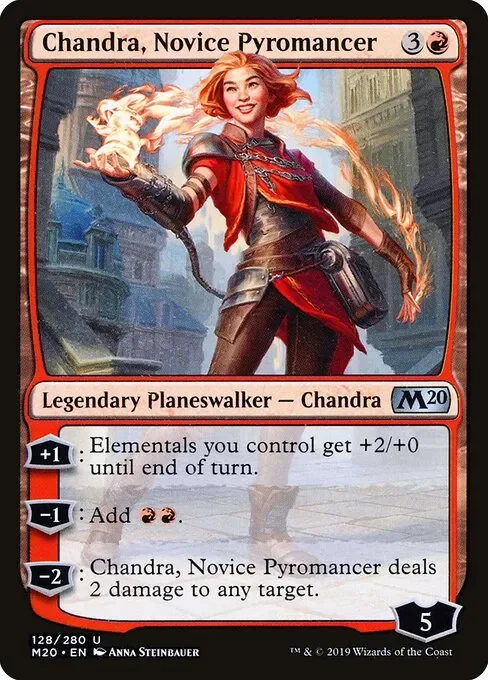
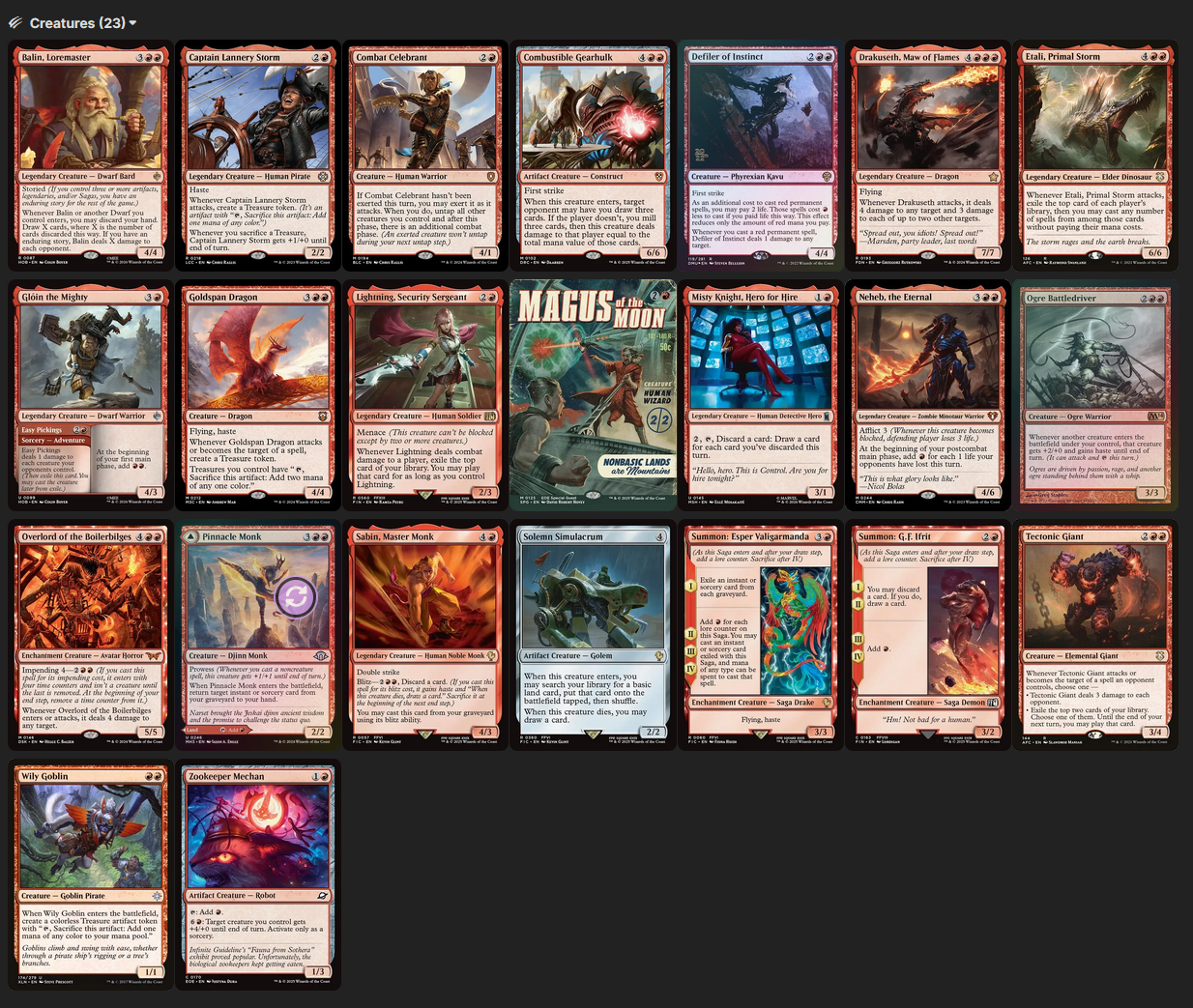
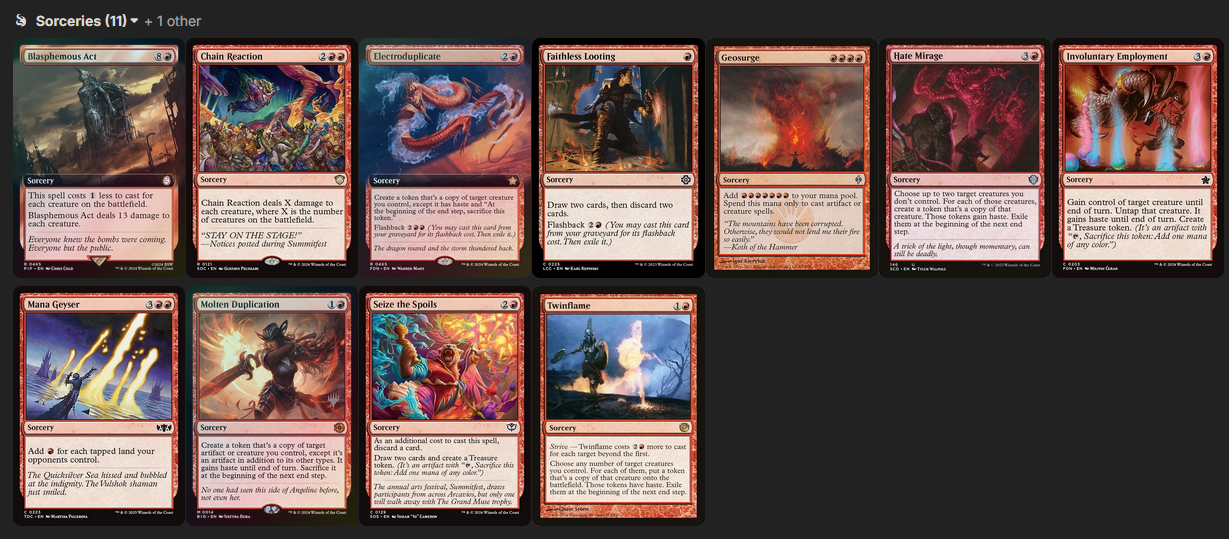
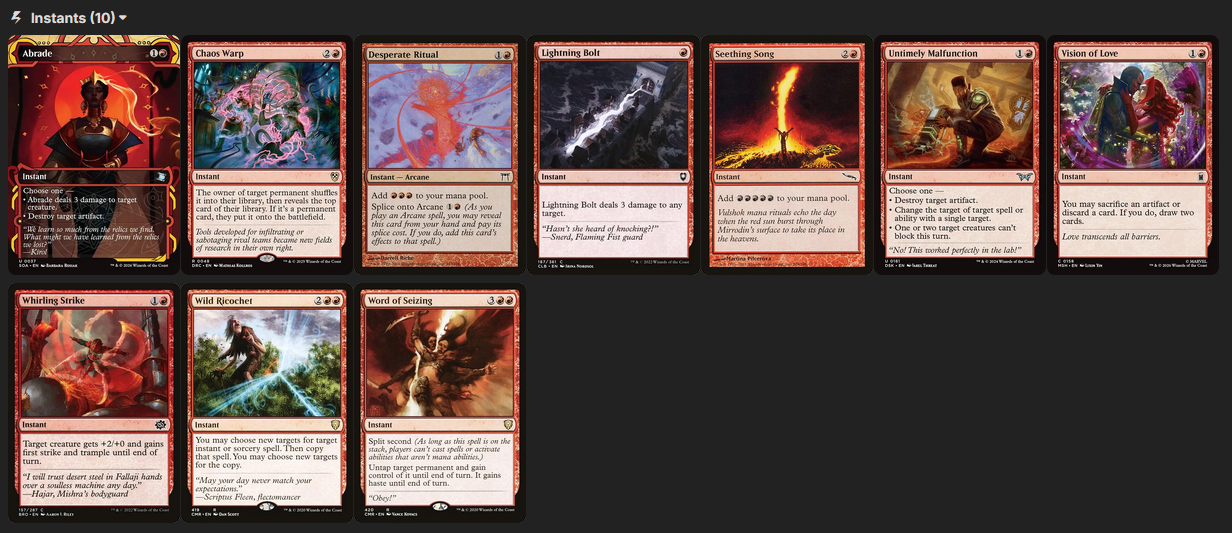
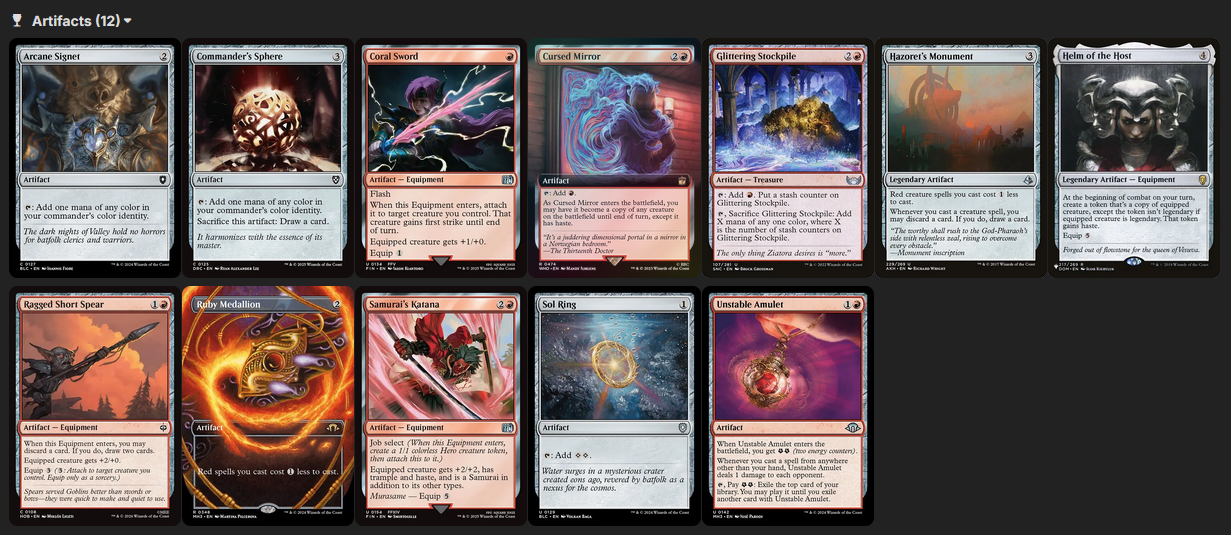
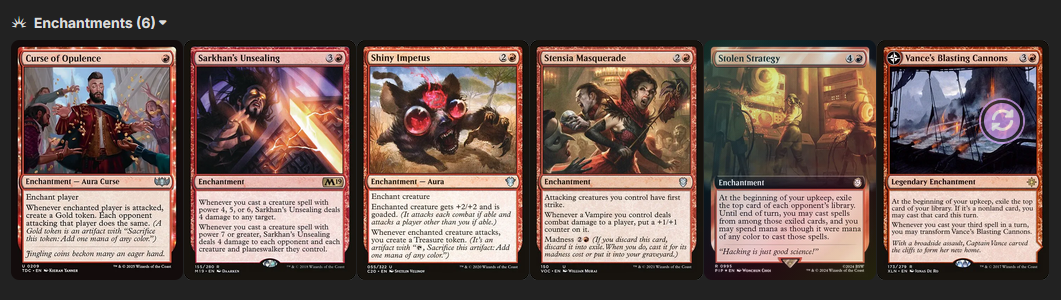
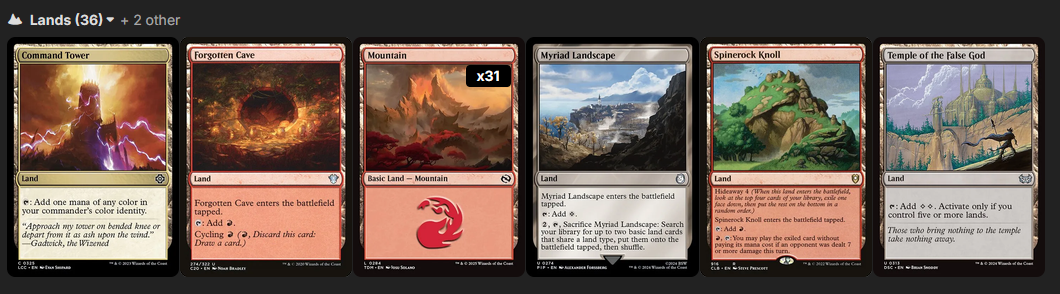
Clive, Ifrit's Dominant leads a mono-red Commander deck built around devotion, explosive mana production, and high-impact combat turns. Clive serves as both a hand-refill engine and a transforming value piece, cycling into Ifrit, Warden of Inferno for creature removal and additional mana before returning to his front face and enabling another potential reload.
The deck pairs that transformation engine with ritual effects, Treasure production, temporary copying, and a concentrated group of large red threats. Its play pattern is deliberately proactive: establish mana, maintain red permanents to improve Clive's devotion payoff, and convert sudden bursts of resources into decisive battlefield pressure.
Deck Overview
Clive's enter-the-battlefield ability rewards a board with substantial red devotion by allowing an exhausted hand to be discarded and replaced with a new set of cards. After developing the battlefield, his activated ability transforms him into Ifrit, Warden of Inferno, whose Saga progression can fight an opposing creature, generate four red mana, and eventually return Clive to the battlefield front face up.
That cycle fits naturally into a deck featuring Goldspan Dragon, Neheb, the Eternal, Defiler of Instinct, Drakuseth, Maw of Flames, and Etali, Primal Storm. These cards provide meaningful red devotion while also functioning as independent threats, giving the deck a cohesive connection between its command-zone engine and its primary win conditions.
Mana Acceleration and Devotion
The deck uses multiple layers of acceleration to move efficiently into its upper mana curve. Sol Ring, Arcane Signet, Ruby Medallion, Hazoret's Monument, and Commander's Sphere provide steady development, while Desperate Ritual, Seething Song, Geosurge, and Mana Geyser create explosive turns.
Captain Lannery Storm, Goldspan Dragon, Wily Goblin, Glittering Stockpile, and Neheb, the Eternal extend that plan through Treasure or combat-generated mana. Chandra, Novice Pyromancer provides another source of red mana while contributing a permanent to the battlefield for Clive's devotion calculation.
Copy Effects and Temporary Resources
A substantial portion of the deck is designed to extract additional value from its strongest creatures. Molten Duplication, Twinflame, Electroduplicate, Hate Mirage, and Cursed Mirror create temporary copies that can immediately contribute enter-the-battlefield triggers or combat pressure.
This is particularly effective with cards such as Combustible Gearhulk, Etali, Primal Storm, Tectonic Giant, and the deck's larger Dragons and Elementals. Helm of the Host provides a longer-term version of the same concept, allowing an established threat to generate additional material over successive combat steps.
Combat Pressure and Closing the Game
The deck is structured to turn its mana advantage into immediate pressure rather than allowing large threats to remain passive. Ogre Battledriver gives newly arriving creatures haste and additional power, while Stensia Masquerade, Whirling Strike, and equipment such as Samurai's Katana and Coral Sword improve combat performance.
Combat Celebrant introduces additional combat potential, while Drakuseth, Maw of Flames, Etali, Primal Storm, and Overlord of the Boilerbilges reward successful attack sequencing with effects that extend beyond combat damage itself. Sarkhan's Unsealing further converts the deck's larger creatures into direct interaction when they are cast.
Interaction and Battlefield Control
Mono-red interaction is distributed across efficient spot removal and scalable sweepers. Abrade, Lightning Bolt, Chaos Warp, and Untimely Malfunction provide flexible answers, while Blasphemous Act and Chain Reaction allow the deck to reset crowded battlefields.
Clive's transformed side supplies another repeatable form of creature interaction through Ifrit's first Saga chapter. Word of Seizing and Involuntary Employment temporarily appropriate opposing permanents, while Wild Ricochet can redirect and duplicate important opposing spells. Magus of the Moon adds a disruptive element against mana bases dependent on nonbasic lands.
Card Advantage and Resource Recovery
Clive is the deck's central card-selection engine, but he is supported by several independent sources of additional cards. Faithless Looting and Seize the Spoils improve hand quality early, while Stolen Strategy, Vance's Blasting Cannons, Unstable Amulet, and Tectonic Giant provide ongoing access to additional spells.
Because Clive can replace an entire hand based on devotion rather than drawing a fixed number of cards, the deck is comfortable spending resources aggressively. Rituals, temporary copies, removal, and combat pieces can be deployed rapidly before Clive converts a developed battlefield into a fresh hand.
Build Philosophy
This build treats Clive's transformation as the center of a broader mono-red resource engine rather than relying exclusively on the commander. Permanent-based devotion, ritual mana, Treasure generation, copy effects, and large combat threats all reinforce the same game plan while remaining functional independently.
The mana base and acceleration package are constructed to support a relatively substantial upper curve without sacrificing early sequencing. Each inclusion contributes either mana development, devotion, card access, interaction, or immediate battlefield pressure, producing a cohesive strategy capable of shifting between measured development and explosive multi-spell turns.
Technical Details
100-card singleton Commander deck, legal for EDH
All cards in Near Mint to Lightly Played condition
Professionally sleeved and ready to play
Built for consistent performance and strategic depth
Ideal For Players Who:
Enjoy mono-red Commander decks built around devotion, ritual mana, and large battlefield swings
Prefer commanders with transformation mechanics and a repeatable command-zone value engine
Appreciate cohesive builds combining Final Fantasy flavor with established mono-red Commander strategies
No results found
No results match your search. Try removing a few filters.